
Every year on the first Saturday of December, I get ambitious. Two years ago I strung a gorgeous cedar garland right across the entry bench — and then watched my family balance wet coats on the console, stack boots in a sad pile by the door, and lean packages against the wall like a bribe. By December 9th the entryway looked like a lost-and-found bin with a garland on it. The garland was fine. The plan wasn’t.
That’s the thing about entryways: they’re the hardest-working room in the house in December, and every other holiday guide styles them like nobody owns shoes. So this list is built the other way around. Each idea starts with what the entry has to carry — wet boots, puffy coats, deliveries, guests, a dog — and then adds the pretty on top. Most of these cost under $40; all of them will still be working on December 31st.
Table of Contents — 15 Ideas
- Map the wet zone: the first 36 inches
- The two-mat system that actually stops slush
- A boot tray with real capacity math
- Hooks with honest weight limits
- Dress the hook wall (without blocking it)
- The banister garland that won’t slide
- Light the hallway beyond the entry
- A bench that carries three jobs
- Under-bench baskets: the clutter kill zone
- The entry table formula (one spot for keys)
- A mirror does double duty in December
- One wall focal point, not five
- Lanterns beat candles in a high-traffic entry
- The package quarantine box
- Scent is the cheapest upgrade you’ll make
1. Map the wet zone: the first 36 inches
| Material | Where it survives | Verdict | Typical cost |
|---|---|---|---|
| Rubber or coir mat | 0-36 in from the door | Use it | $10-$30 |
| Metal boot tray | 0-36 in, door side | Use it | $15-$40 |
| Polypropylene basket | Wet-zone edge | Use it | $10-$25 |
| Upholstered bench | Behind the 36-in line | Keep dry only | $60-$150 |
| Paper or card decor | Far from the door | Avoid entirely | $5-$15 |
Map the wet zone: the first 36 inches
The wet zone is the patch of floor inside your door where snow, rain and road salt actually land — and in most homes it’s about 36 inches deep, or roughly one-and-a-half doormats. Everything you place inside that strip must be waterproof, washable or cheap enough to replace: coir, rubber, metal, polypropylene. Nothing upholstered, nothing paper, nothing you’d cry over.
Draw the zone before you decorate anything: open your front door fully and stand where a person lands after three steps inside. That rectangle is sacred floor. My rule after the garland-bench disaster: if an item can’t survive a puddle, it lives outside the 36-inch line, no matter how good it looks there.

2. The two-mat system that actually stops slush
| Mat layer | Size rule | Material | Typical cost |
|---|---|---|---|
| Outside scraper mat | Door width, 30-36 in | Stiff coir or rubber | $15-$40 |
| Inside absorbent mat | 24 in deep minimum | Cotton or microfiber | $15-$35 |
| Optional washable runner | Behind both mats | Low-pile, machine-washable | $20-$60 |
The two-mat system that actually stops slush
One mat is a decoration; two mats are a system. The outside mat should be a scraper — stiff coir or rubber bristles, at least as wide as the door (30–36 inches) so both feet hit it in one step. The inside mat should be absorbent — cotton or microfiber — to catch what the scraper missed. A scraper alone pushes water onto your floor; an absorber alone saturates by December 5th.
Size rule worth following: the inside mat should cover the full width of the door and run at least 24 inches deep, because people take one step, not two. And skip the “Merry Christmas” script mats for the inside layer — texture absorbs, flat printed fiber doesn’t. Seasonal message on the scraper outside, plain absorbent inside, and your floors stay clean through the whole month.

3. A boot tray with real capacity math
| Household | Boot slots needed | Tray to buy | Typical cost |
|---|---|---|---|
| 1-2 people | 3-4 pairs | One 20 x 14 in tray | $10-$20 |
| 3 people | 5 pairs | One 30 in tray | $15-$30 |
| 4 or more | 6+ pairs | Two 30 in trays | $25-$50 |
| Guests expected | Household x 1.5 | Add pebbles or wire grid | $5-$10 |
A boot tray with real capacity math
Boot trays fail in December for one reason: they’re sized for October. A standard 20-by-14-inch tray holds about two pairs of adult boots side by side — a family of three needs two trays or one 30-inch tray. Count your household, multiply by 1.5 (guests, damp backups), and buy that many boot slots. The tray belongs inside the wet zone, touching the door side, so drips never cross clean floor.
The upgrade that changes everything: a rubber boot tray with raised edges (1.25 inches minimum — 1.3 inches holds a full melt without spilling) plus a layer of river pebbles or a wire grid inside. Boots sit on the stones, meltwater drains below, and you never again lift a boot out of a puddle it created. Ten dollars of pebbles turns a sad plastic tray into something that looks intentional and works like a drain.
As an Amazon Associate, we earn from qualifying purchases.

- Two 30 × 15-inch trays, each holding 3 pairs of adult boots or 4 pairs of shoes
- 1.3-inch raised rims catch meltwater, sand and road salt before they reach the floor
- 100% recycled PP that doesn’t sag when full; 8 adhesive felt pads included to stop sliding
Price and availability shown on Amazon; listing may change.
4. Hooks with honest weight limits
| Mount type | Safe load | Holds what | Typical cost |
|---|---|---|---|
| Screw into stud | 30-50 lb per point | Wall of wet coats | $10-$30 |
| Drywall anchor | 5-20 lb | One coat per hook | $5-$12 |
| Adhesive hook | Half the printed rating | Scarves and keys only | $5-$15 |
| Rail at 16-in spacing | Both screws hit studs | 4-5 coats | $20-$40 |
Hooks with honest weight limits
December coats are heavier than they look: a wet wool coat plus scarf and bag runs 4–6 pounds, and a wall of four coats loads a single mounting point to 20+ pounds if they share hooks. That flimsy adhesive hook rated for 2 pounds is why your coat ends up on the floor by mid-December. Wall hooks screwed into studs or a mounted rail are the only things I trust for the season.
The quick audit: hang your heaviest winter coat, pull down firmly with one hand, and watch the anchor. Any flex or drywall dust means it’s decorative, not functional. Budget roughly one hook per family member plus two for guests, mounted 60–68 inches high so long coats clear the floor and the boot tray below. The shortcut to a wall that holds: a rail drilled at 16-inch hole spacing, because those holes land on standard studs and both screws bite wood instead of drywall anchors.
As an Amazon Associate, we earn from qualifying purchases.

- 16" hole-to-hole spacing lands both screws on standard wall studs — no stud-finder guesswork
- 20 mm single-piece solid wood (not particle board) with five pre-installed metal hooks
- 17.3 × 2.95 × 5.1 inches; drywall and brick/concrete anchors included, ready out of the box
Price and availability shown on Amazon; listing may change.
5. Dress the hook wall (without blocking it)
Dress the hook wall (without blocking it)
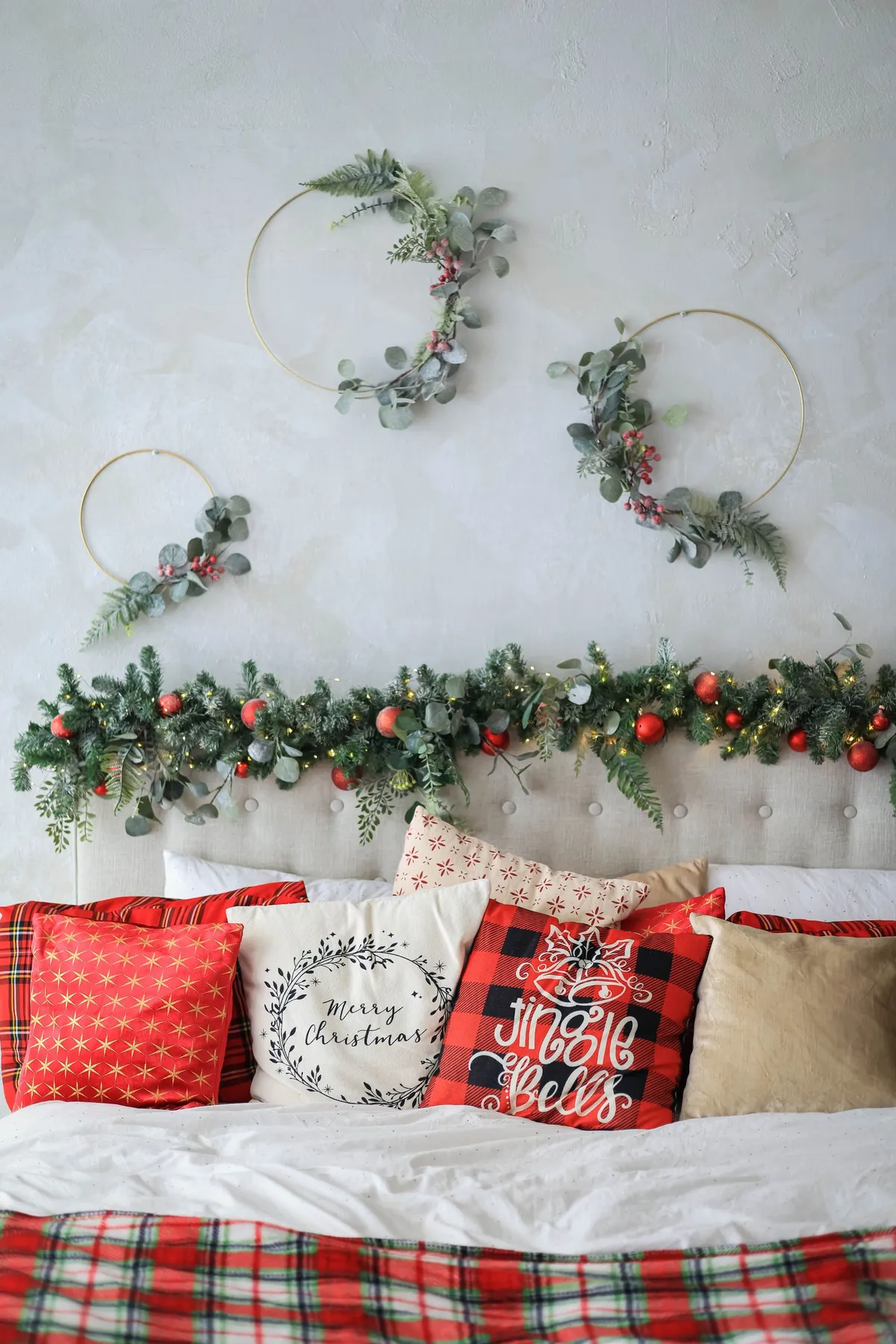
The hook wall wants to be pretty too — it’s the first wall guests see — but anything you hang there competes with coats. The compromise: style above and between hooks, never on them. A slim cedar garland running along the top of the hook rail, ornaments or dried orange slices hanging from the garland itself, and a small wreath centered above the row. All of it sits outside arm’s reach of the actual coat zone.
One warning from the trenches: garland near a hook wall catches every scarf tassel in the house. Leave 8 inches of clearance between the lowest decoration and the highest hook, and use zip ties instead of ribbon anywhere hands pass daily — ribbon looks better for exactly one week.
6. The banister garland that won’t slide
| Rail length | Garland needed | Attachment points | Typical cost |
|---|---|---|---|
| 6 ft rail | 9-12 ft garland | Zip ties every 18-24 in | $15-$35 |
| 10 ft rail | 15-18 ft garland | 6-8 ties or wire loops | $25-$60 |
| Lighted version | 1 battery strand per 12 ft | Tucked in the outer face | $8-$20 per strand |
The banister garland that won’t slide
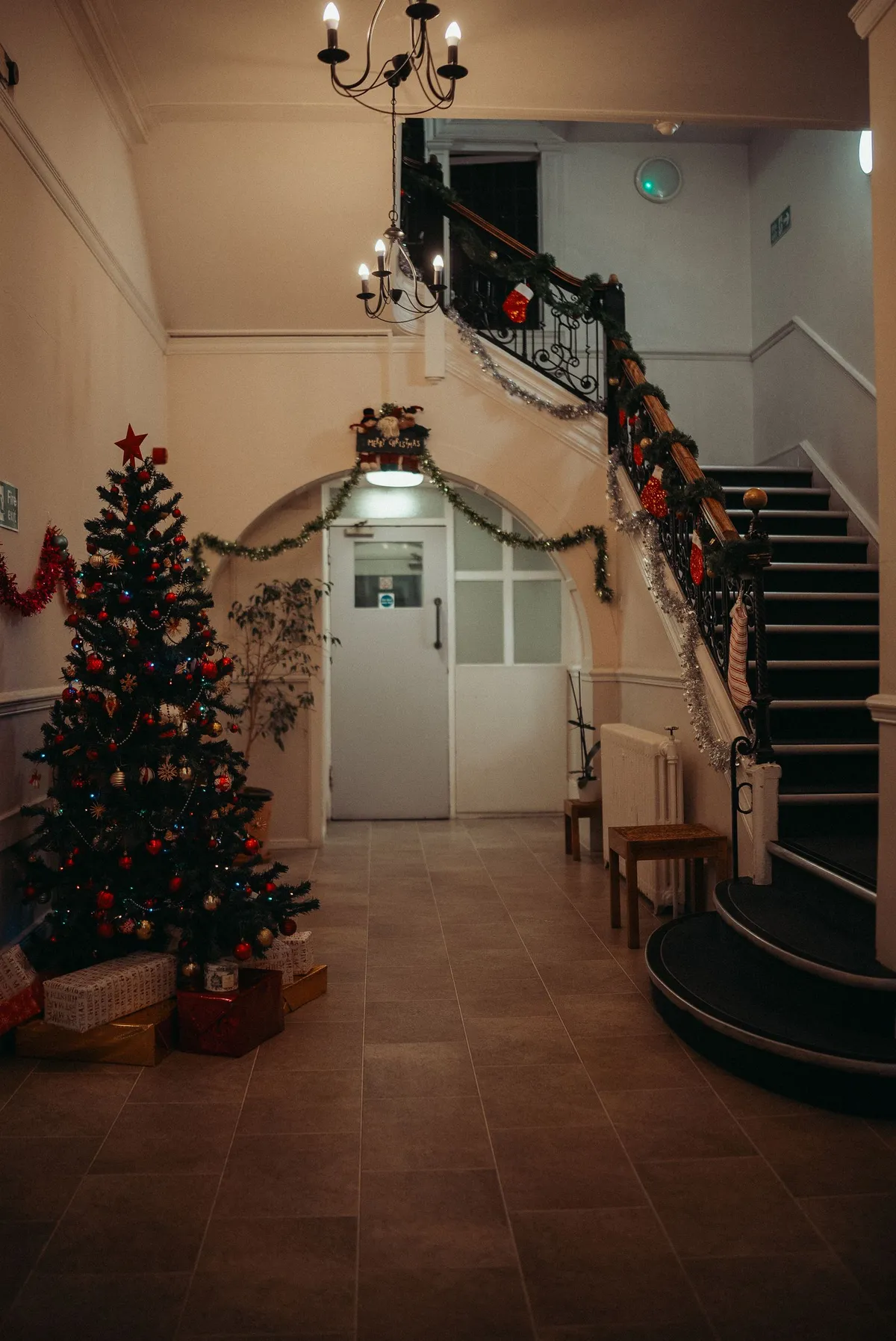
A garland wrapped around a banister looks perfect for one photograph, then slides down the rail like a deflating balloon every time someone grabs it — which, on a staircase, is constantly. The fix is attachment points, not wrapping: zip ties or green floral wire every 18–24 inches, cinched tight and fluffed over. The rail stays grippable, the garland stays put, and nobody grabs wet greenery instead of the handrail (which is a real fall risk with grandparents visiting).
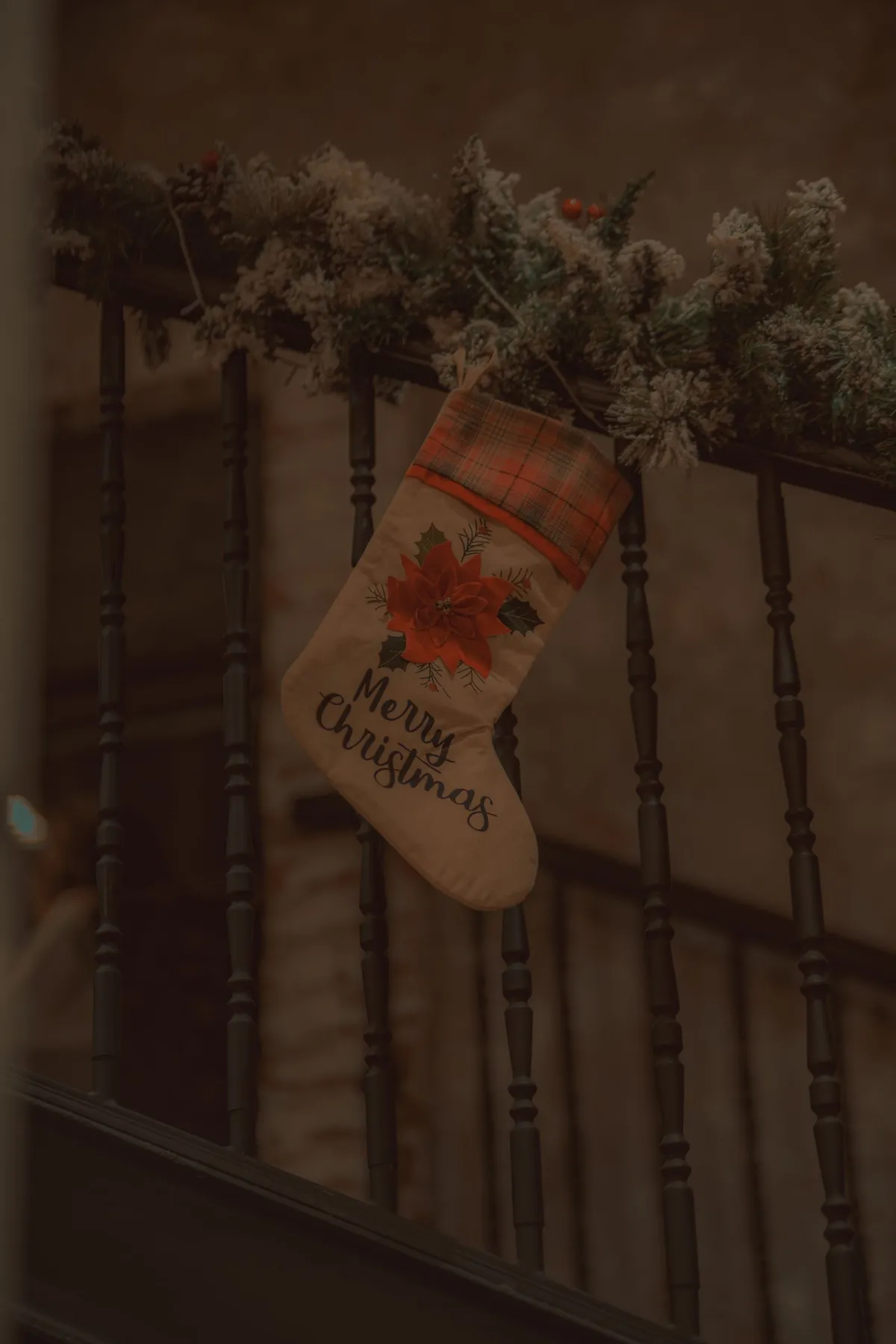
For the December-traffic version, hang the garland on the outside face of the rail — the side away from hands — and tuck a strand of battery timer lights into it. If your banister hosts a stocking or two, the hardware rules from our no-fireplace stocking guide apply here too: a stocked banister carries real weight, so anchor into the wood, not the spindles.
7. Light the hallway beyond the entry
| Light option | Key spec | Placement | Typical cost |
|---|---|---|---|
| Plug-in sconce | 2700K warm white | Beside the door | $20-$50 |
| Tabletop lamp | Back third of console | Entry table | $25-$60 |
| Baseboard string lights | 1 strand per 10 ft | Hallway floor line | $10-$25 |
| Timer plug | 4:30 p.m. to midnight | Controls the chain | $10-$20 |
Light the hallway beyond the entry
The entry in December works evening shifts — school concerts, parties, last-minute shopping runs — and it’s dark by 4:45. The single most functional decoration you can add is light that greets you before your hand finds the switch: a plug-in sconce, a tabletop lamp on the console, or string lights along the hallway baseboards on a timer. Warm white (2700K), always — cool white reads parking garage.
The hotel trick worth stealing: light the middle of the hallway, not just the entry. A single tree or lit garland halfway down the corridor pulls guests in and makes a 20-foot hallway feel furnished instead of dark and endless. One timer for the whole chain — on at 4:30 p.m., off at midnight — and the entry works itself all season.
8. A bench that carries three jobs
| Bench width | Seats | Seat height | Typical cost |
|---|---|---|---|
| 36 in | 1 adult | 17-19 in | $60-$150 |
| 48 in | 2 adults | 17-19 in | $90-$220 |
| 60 in | 3 guests at 20 in each | 17-19 in | $120-$300 |
| Two stools instead | 2, tuck under console | 17-18 in | $40-$100 |
A bench that carries three jobs
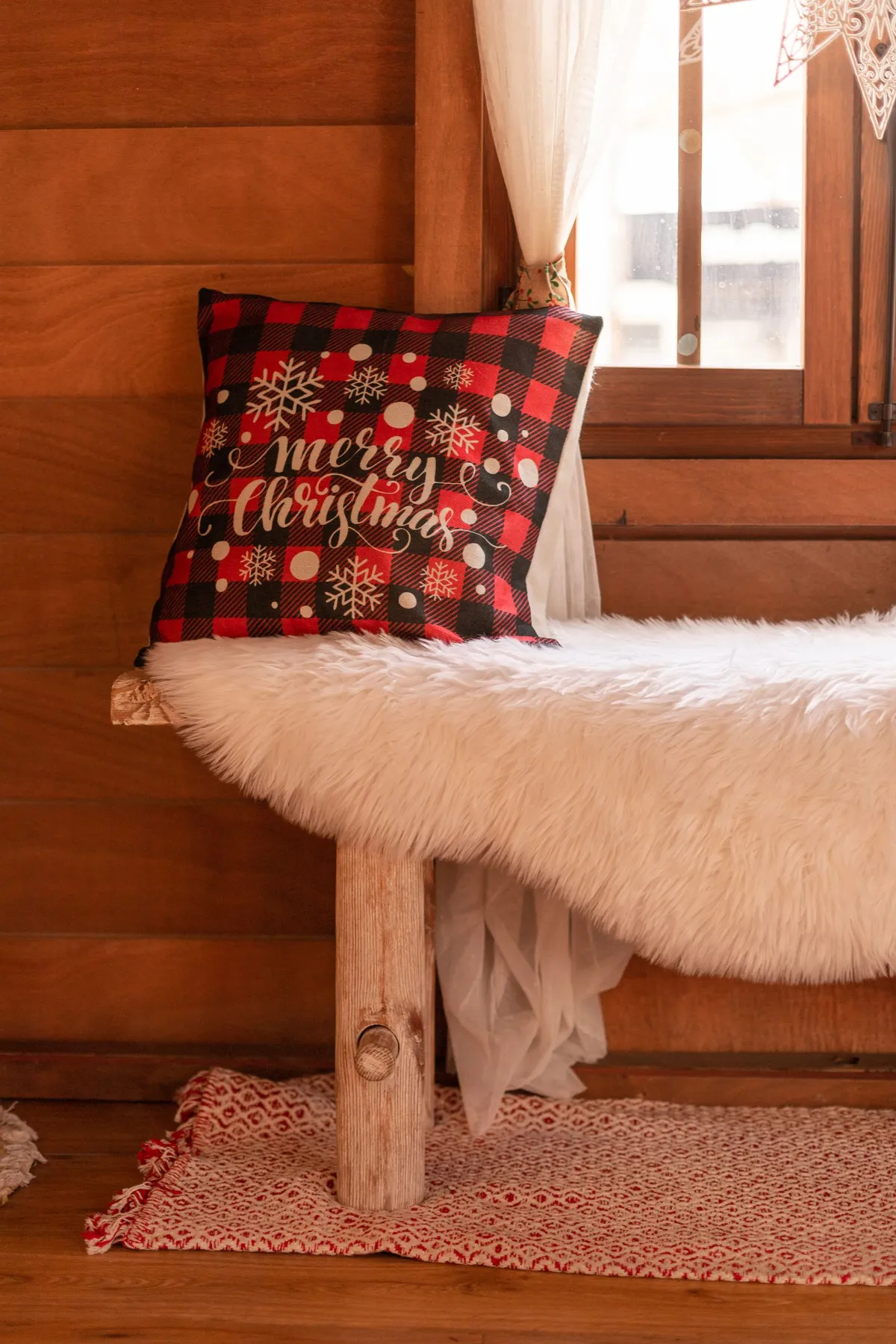
In December the entry bench is a shoe bench, a bag-drop surface and a photo moment all at once, so give it a structure that handles all three: a seat 17–19 inches high (standard shoe-changing height), a surface that wipes clean, and a spot for the decor to live without blocking the seat. Put the Christmas on the back edge — a folded throw, a small pillow, a mini tree at one end — and keep the front two-thirds bare for actual butts and backpacks.
Sizing reality check: a 36-inch bench seats one adult comfortably or two teenagers briefly; guests in a stream need 20 inches each. If your entry can’t fit that, skip the bench entirely and use a pair of stools that tuck under the console — same function, half the footprint, zero sacrificed walkway.

9. Under-bench baskets: the clutter kill zone
Under-bench baskets: the clutter kill zone
Every entry generates the same four piles in December: gloves, mail, returns, and things-that-need-to-leave-the-house. Winning entryways don’t prevent the piles — they pre-assign them. Slide two or three low baskets under the bench and label the jobs: one for hats and gloves, one for outgoing (returns, library books, the gift that needs wrapping), one for “lives here now.” When everything has a bucket, December clutter becomes a sorting problem instead of a shame spiral.
Two rules keep the system alive past December 15th: baskets must be open-top (lids become permission slips for overflow), and nothing lives on top of the bench except what’s in use today. The baskets are also your fastest reset when guests text “outside” — five minutes, everything swept in, entry presentable.
10. The entry table formula (one spot for keys)
| Height band | Placement | Examples | Typical cost |
|---|---|---|---|
| Over 12 in tall | Back, against the wall | Lamp, mini tree, candlesticks | $25-$70 |
| 6-12 in | One side only | Branch vase, garland runner | $10-$30 |
| Under 6 in | Front third | Framed card, nutcracker | $5-$20 |
| Hand-sized spot | Front edge, always clear | Keys, mail, delivery scanner | $0-$15 tray |
The entry table formula
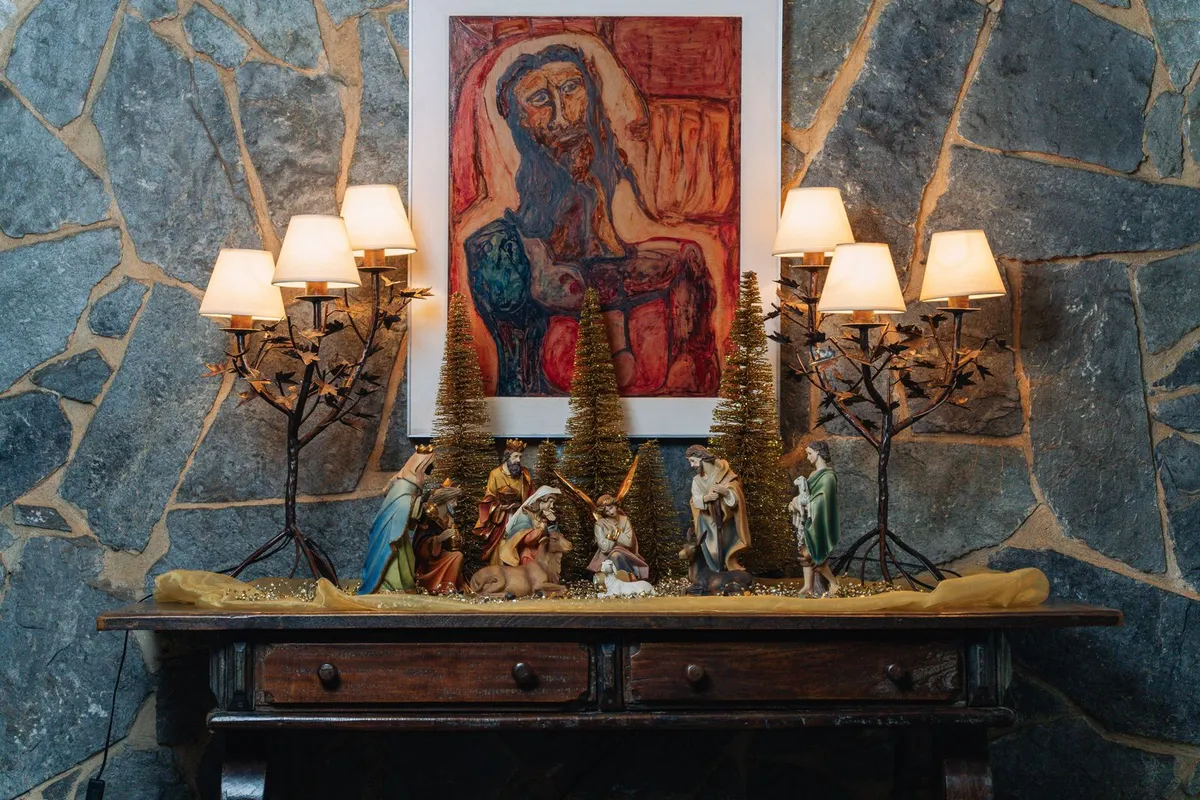
The console or entry table needs a formula, not a mood board: something tall at the back (lamp, mini tree, candlesticks), something green on one side (branch vase, small garland runner), something personal on the other (a framed card, a nutcracker, the ornament the kids made), and — non-negotiable — one clear spot the size of your hand for keys, mail and the delivery scanner. Style the back third, keep the front edge working.
The measuring trick that keeps it from turning into clutter: anything taller than 12 inches goes against the wall side, anything under 6 inches can sit forward, and the middle band stays empty. If a decoration ever has to be moved to put down a coffee cup, the table has stopped working — and in December, that coffee cup is usually someone’s third attempt at hot cocoa before the school play.
11. A mirror does double duty in December
A mirror does double duty in December
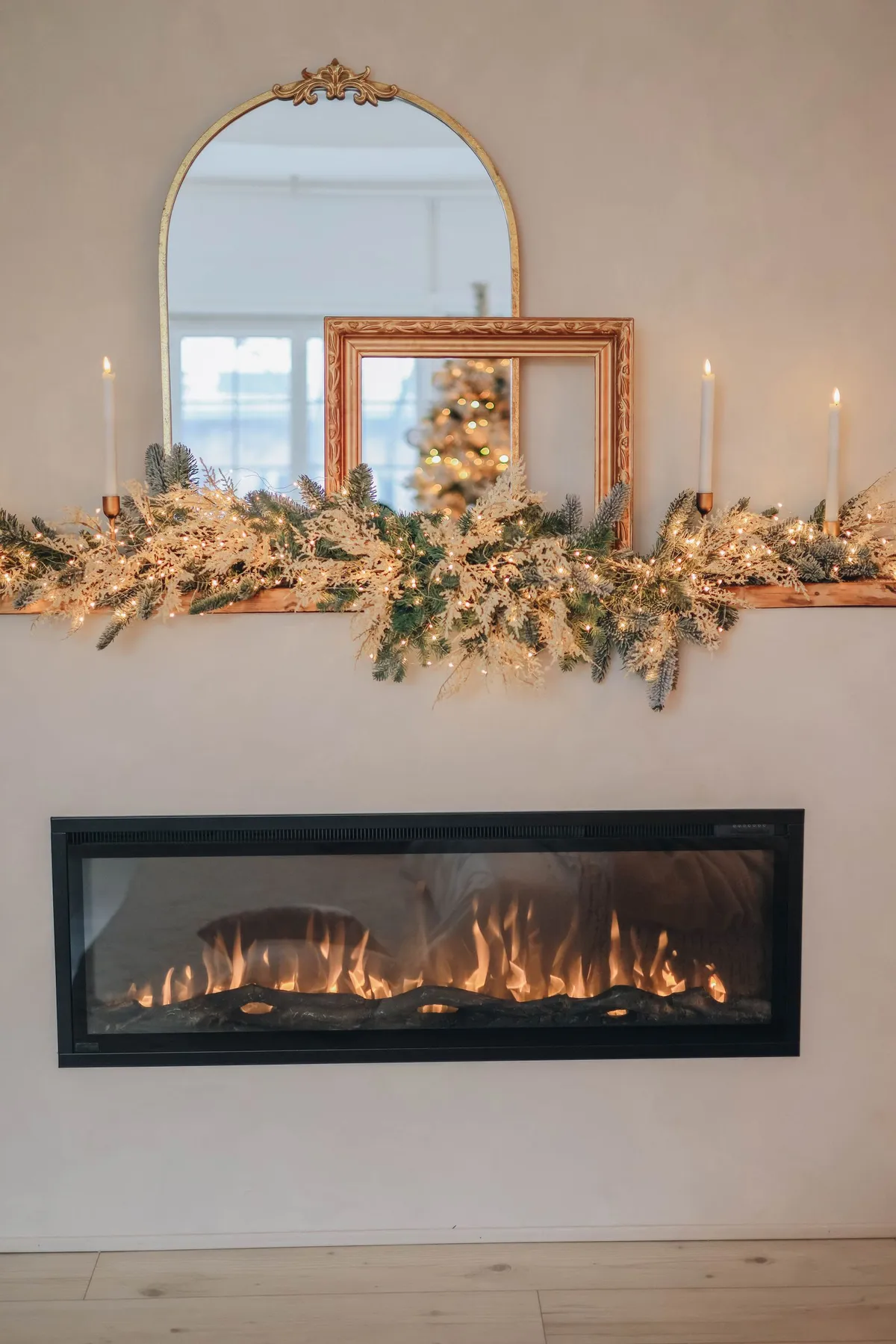
An entry mirror is a December multiplier: it bounces whatever light you add — lamp, lantern, string lights — and doubles the glow of a dark hallway for free. Style it with a simple swag (a short garland piece draped over the top corner) or a bow, and keep the glass itself mostly clear, because the other job of a December mirror is the pre-door check: coat, scarf, and whether the sweater has survived three parties.
If you have no mirror, the wall above the console is still the best focal spot in the room — a wreath hung at eye height (about 57 inches to center) reads as intentional from both the door and the street. Just remember the hardware lesson from our no-fireplace stocking guide: a heavy mirror or wreath wants a real anchor, not a hope and a hook.
12. One wall focal point, not five
| Entry width | Wreath or focal size | Best single move | Typical cost |
|---|---|---|---|
| Under 3 ft | 18-24 in wreath | One oversized wreath | $25-$60 |
| About 4 ft | 24-30 in | Wreath or lit paper star | $30-$70 |
| 5 ft or wider | 30 in and up | Wall of hanging ornaments | $40-$90 |
One wall focal point, not five
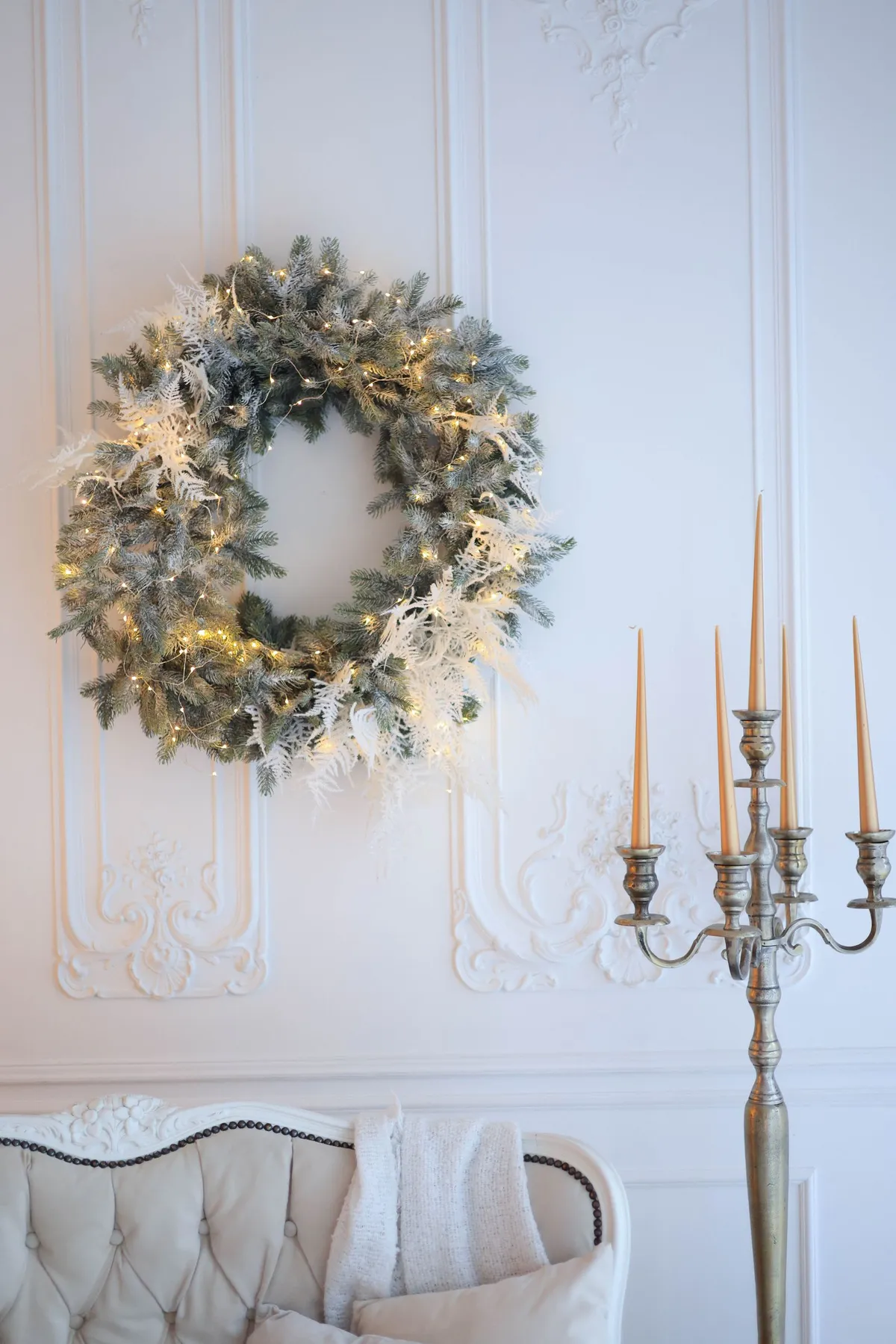
Small entries drown fast in December, and the failure mode is always the same: wreath on the door, garland on the hooks, village on the table, stockings on the wall, lights everywhere — five focal points shouting at once. Pick one wall, give it the big move (an oversized wreath, a wall of hanging ornaments, a lit paper star), and let every other surface stay quiet. In a 4-foot-wide entry, one strong piece reads designed; five read like a gift shop.
The scale trick for tiny foyers: go bigger and fewer, not smaller and more. A 24-inch wreath on a small wall looks intentional where a 12-inch wreath looks apologetic. If you’re decorating a rental and can’t drill, the damage-free hardware from our no-fireplace stocking guide — rated hooks, tension systems, weighted ledges — covers almost every wall scenario.
13. Lanterns beat candles in a high-traffic entry
| Lantern | Size | Placement | Typical cost |
|---|---|---|---|
| Console lantern | 10-12 in tall | Back third of the table | $20-$45 |
| Floor lantern | 18-24 in tall | Beside the door, off walkway | $35-$80 |
| Bench-end lantern | 8-10 in tall | Back edge of bench | $15-$35 |
| LED pillar, timer | 6 on / 18 off cycle | Inside any lantern | $10-$25 for 3 |
Lanterns beat candles in a high-traffic entry
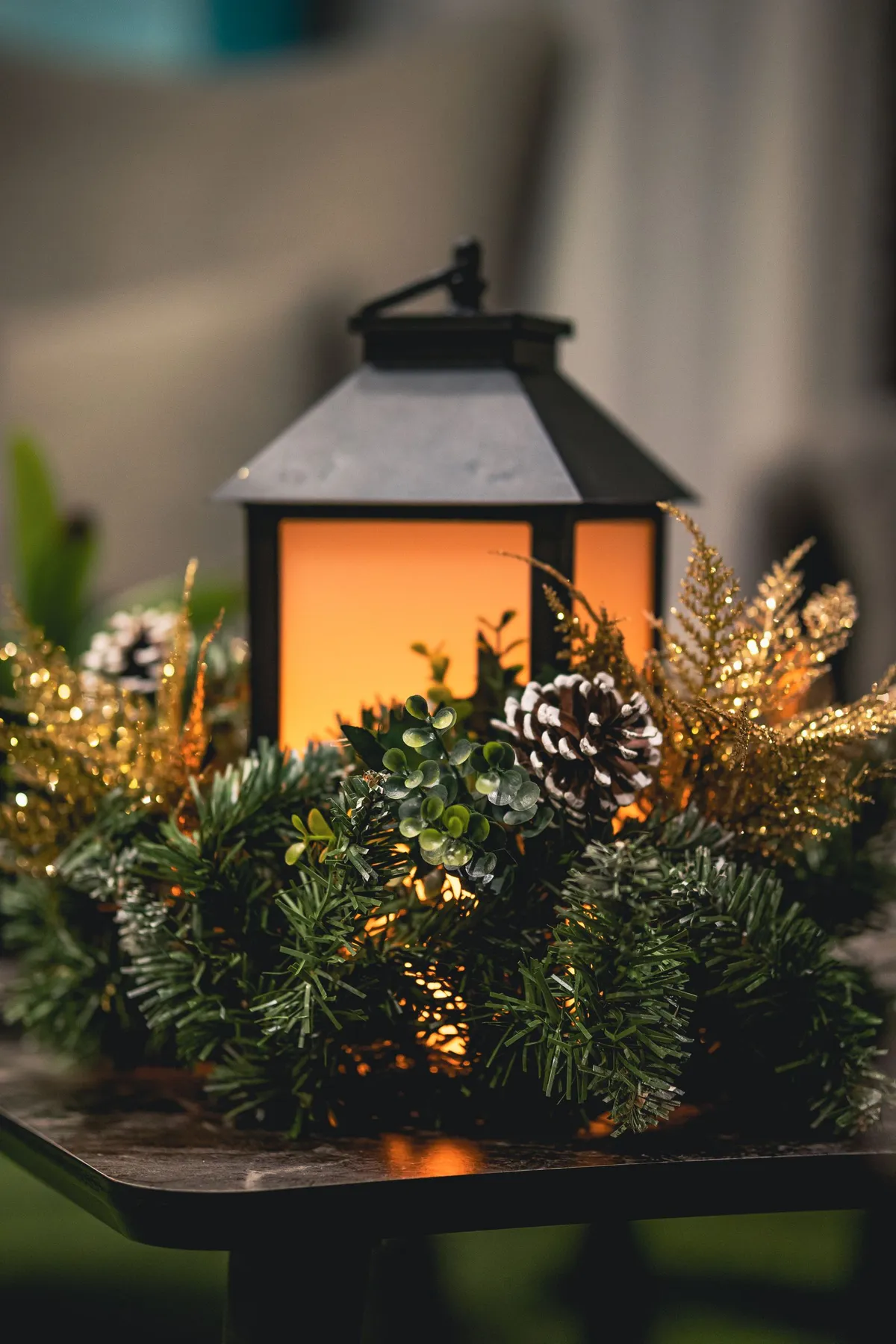
An open taper candle in a room where scarves swing and packages get dropped is a small fire drill waiting for a date. Lanterns solve it: glass panels block the breeze from the door (a real problem — entry candles gutter all evening), contain the flame away from coat sleeves, and look deliberate grouped in twos or threes with different heights. One on the console, one on the floor by the door, one on the bench end, and the entry glows from three levels.
Even better for the wet zone: LED pillar candles inside the lanterns. Nobody can tell from the doorway — the glass diffuses the tell — and the ones with timers run the same 6-hours-on schedule as the tree lights, so the whole entry clicks on at dusk and you never think about it again. The zero-effort version of this: a battery-and-USB snow globe lantern with a built-in 6-on/18-off timer — warm LED, swirling glitter, a carol if you want one, and no wick to remember.
As an Amazon Associate, we earn from qualifying purchases.

- Warm LED under swirling glitter and three red cardinals — glow with no flame near swinging scarves
- Built-in 6 hours on / 18 hours off timer, three modes: light + music, light only, off
- USB cable included or 3 AAA batteries (not included); plays eight carols including Silent Night
Price and availability shown on Amazon; listing may change.
14. The package quarantine box
The package quarantine box
December deliveries arrive at three per day in a busy household, and every one of them lands exactly in your entry walkway. The fix costs nothing: a lidded basket or bin, roughly laundry-basket size (60–80 liters), placed beside the console with one job — everything unopened lives there, not on the floor. Lid on means the entry still looks styled even when the box is full; you open, sort and recycle on your schedule, not the courier’s.
Pair it with a wrapping-forward rule: anything that still needs to be wrapped gets a second, smaller bin (the “outgoing” basket from the bench). Packages in, gifts out, and the entry becomes a one-stop logistics desk instead of a cardboard obstacle course. Your future self on December 23rd will call this the best idea on the list.
15. Scent is the cheapest upgrade you’ll make
Scent is the cheapest upgrade you’ll make
Guests smell your entry before they see it, and December scent costs almost nothing: a simmer pot of orange peels, cinnamon sticks and cloves running on the stove, a pine candle on the console, or dried orange slices tucked into whatever greenery you already have. One scent is a house; five competing plug-ins are a candle shop. Pick pine or spice, not both, and put it at nose height — a shelf or the top of the console — not the floor.
And the last habit that holds the whole list together: the two-minute sweep. Salt, needles and grit pile up inside the wet zone faster than any other room in the house; a quick broom pass every evening keeps the mats working and the entry looking like the photos instead of the lost-and-found. The prettiest December entryway is just a clean one with a garland on top.

December Entryway Load Chart
Every “keep it functional” tip from every guide, condensed into the numbers that actually matter:
| Zone / Item | The number | What it means in practice |
|---|---|---|
| Wet zone depth | 36 inches | Waterproof and washable only inside this strip |
| Scraper mat width | Door width (30–36") | Both feet hit it in one step, or it doesn’t work |
| Absorbent mat depth | 24 inches minimum | People take one step, not two |
| Boot tray capacity | Household × 1.5 pairs | Family of three needs ~30" tray or two trays |
| Wet December coat | 4–6 lb each | Four coats = 20+ lb on the hook rail |
| Hook height | 60–68 inches | Long coats clear the floor and boot tray |
| Bench seat height | 17–19 inches | Shoe-changing height; 20" width per guest |
| Wreath center height | ~57 inches | Eye level from the door and the mirror |
Budget: three ways to spend it
| Tier | What you buy | What you get |
|---|---|---|
| Under $40 — the skeleton | Scraper mat + absorbent mat, one boot tray with pebbles, four wall hooks | The entry survives December traffic even before decorating |
| Under $100 — the system | Everything above, plus a hook rail, two storage baskets, a package bin and one lantern | Clutter has assigned homes; the entry glows at dusk on a timer |
| Under $200 — the styled version | Everything above, plus garland for the rail, a mirror swag, two more lanterns and a bench throw | Fully decorated and fully functional — no moving decor to put down a cup |
The December Entry Checklist — Save All 15
- ☐ Wet zone mapped: 36" from the door, waterproof items only
- ☐ Two mats: scraper outside (door width), absorbent inside (24"+ deep)
- ☐ Boot tray sized to household × 1.5, pebbles or grid inside
- ☐ Hooks load-tested with the heaviest wet coat (4–6 lb each)
- ☐ One hook per person + two guests, mounted 60–68" high
- ☐ Garland styled 8" above the hook row, zip-tied not ribboned
- ☐ Banister garland anchored every 18–24" with the rail still grippable
- ☐ Hallway light on a timer: 4:30 p.m. to midnight, warm white
- ☐ Bench: decor on the back third, seat and walkway clear
- ☐ Three baskets under the bench: gloves / outgoing / lives-here
- ☐ Console formula: tall at back, green on one side, hand-sized key spot clear
- ☐ One wall focal point only; package quarantine box beside the console
FAQ: Christmas Entryway Edition
How do you decorate a small entryway for Christmas?
Work in this order: first the working skeleton (mats, boot tray, hooks, one clear key spot), then one focal point on a single wall — a 24-inch wreath or a lit paper star reads intentional where five small items read cluttered. Style vertical surfaces and the back third of the console; keep the first 36 inches of floor waterproof and clear. Light matters more than ornament count in a small space: one warm lamp or lantern set doubles the festive feel.
What kind of rug or mat is best for a winter entryway?
Use two. Outside: a stiff coir or rubber scraper mat as wide as the door so both feet land on it in one step. Inside: an absorbent cotton or microfiber mat at least 24 inches deep. Skip printed script mats for the inside layer — flat printed fiber barely absorbs. A low-pile washable runner behind the mats is fine if it’s machine-washable, because salt and slush will find it.
How much weight can entryway wall hooks hold?
Screws into studs: 30–50 pounds per hook point, more than enough for a wall of wet coats. Anchors into drywall: 5–20 pounds depending on the anchor type — enough for one coat, not four sharing. Adhesive hooks: trust the printed number only on smooth sealed surfaces, and halve it for painted drywall. A wet December coat with scarf and bag weighs 4–6 pounds, so plan capacity per coat, not per hook.
How do I keep my entryway clean with snow and salt?
Three layers: a scraper mat outside, an absorbent mat inside, and a boot tray with raised edges (add river pebbles or a wire grid so boots drip below, not into). Sweep the wet zone every evening — salt and needles accumulate daily in December. For hard floors, a spray of water and a microfiber mop beats salt-stain removers; for carpet, blot slush with a towel before it dries into a salt line.
Where should the Christmas tree go if the entry is the only good spot?
Only if the tape-out test passes: the footprint can’t block the door’s swing arc or leave less than 30 inches of walkway, and it needs 3 feet of clearance from any heat source. In most homes the entry is the worst room for a tree because of the traffic — a slim pencil tree in the hallway beyond the entry, or a tabletop tree on the console, gives you the glow without the obstacle. Our small-apartment tree guide has the full fit math.
How do you organize shoes and packages in a December entryway?
Pre-assign the piles. A boot tray sized to household × 1.5 pairs takes the shoes; a lidded 60–80 liter basket beside the console takes every unopened package (the lid keeps the entry styled even when it’s full); two open baskets under the bench split gloves from outgoing items. Ten minutes of setup on December 1st saves the daily floor-clearing ritual for the rest of the month.
Last updated: November 13, 2026. We only recommend hardware and decor we’d hang our own coats on.
Related Reading
- 15 Christmas Stocking Ideas When You Don’t Have a Fireplace
- 15 Small Christmas Tree Ideas for Tiny Apartments
- 15 Christmas Porch Decorating Ideas That Survive Rain
- 15 Christmas Morning Brunch Table Ideas You Set Up the Night Before
- Christmas Table Setting Ideas That Look Expensive
- Thanksgiving Table Setting for a Small Dining Room
[…] 15 Christmas Entryway Ideas That Survive December Traffic […]
[…] what decide whether the placement works. This is the same discipline as the wet-zone math in our Christmas entryway guide: December traffic is the real stress test, not the photo on setup […]