
The year I bought a seven-foot tree for a 400-square-foot studio, I measured nothing and trusted vibes. The tree looked glorious for the ninety minutes it took to discover that the balcony door now stopped at half swing, that the walkway to the kitchen had become a fir-based agility course, and that my cat considered the whole thing a personal climbing gym delivered directly to her living room. We ate dinner with a branch hovering over the fondue for a month, and the tree went back in its box with more needles on my floor than on its branches.
This is the guide I wish someone had handed me before that purchase: fifteen ways to get a real Christmas into a small apartment, each with the numbers that decide whether it actually fits. Because “small tree ideas” content everywhere skips the only part that matters — the fit math. Ceiling height, footprint diameter, door swings, the 3-foot heat clearance, and where the tree lives from January to November. Get those right and even a 4-foot tree reads festive; skip them and any tree reads as an obstacle.
Table of Contents
- Start with the height formula, not the tree
- Tape out the footprint before you buy
- Give it the corner, not the middle of the wall
- Respect the 3-foot heat rule
- Pencil trees: full height, quarter of the footprint
- Half trees and wall-mounted trees
- Ladder-shelf and bookcase trees
- Tabletop trees at eye level
- Windowsill forests
- Bottle-brush clusters
- A tree you keep: rosemary and potted minis
- Tree collar instead of tree skirt
- Light math for small trees
- The window tree
- Cat defense and the January exit plan
Every idea below sorts into three buckets: full-height slim (the tree shrinks sideways, not up), zero-floor (tabletop, windowsill, wall — the floor stays yours), and living or alternative (things that read as a tree and don’t store like one). Each one carries its own numbers, so you can match it to the measurements you’re about to take.
1. Start with the height formula, not the tree
The formula that prevents every too-big-tree disaster: tree height equals ceiling height minus 6 to 12 inches for the topper, minus another 3 to 6 inches if the stand raises the trunk. An 8-foot ceiling tops out at a 6.5-foot tree; a 7.5-foot ceiling at a 5.5- to 6-foot tree. Measure once with a tape and write it in your phone — tree listings always state height, and “it’ll probably fit” is how fondue incidents happen.
| Ceiling height | Max tree height | Why |
|---|---|---|
| 7.5 ft ceiling | 5.5–6 ft tree | 6–12 in saved for the topper |
| 8 ft ceiling | 6–6.5 ft tree | Subtract the stand if it raises the trunk |
| 9 ft ceiling | 7.5–8 ft tree | Still tape out the base diameter |
| Slanted or low ceiling | Drop 6 in more | Topper sits in air, not drywall |
For slanted or low ceilings, drop another 6 inches and lean toward designs with a tapered top, where the topper sits in air rather than pressing against drywall. And measure the width of the spot too: the two numbers together — height and the footprint in the next idea — are the entire qualification test. A tree that passes both is one you’ll never think about again; a tree that fails one is a December-long negotiation with your own furniture.
Tape out the footprint before you buy
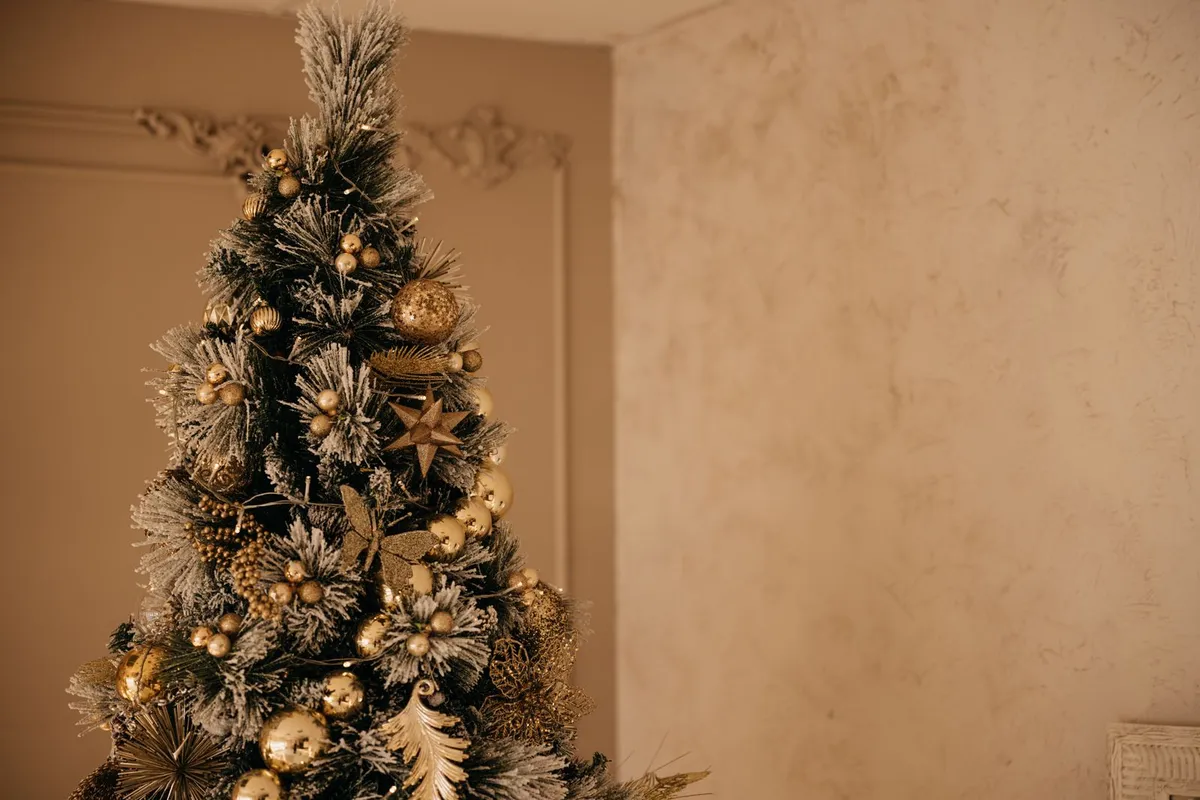
Tree listings state the base diameter — and that number is the one to test on your floor before ordering. Masking-tape an outline of the base, then live with it for a day: walk the room, open every door that swings nearby, and check that the main walking path keeps at least 30 inches of clear width. A tape outline costs nothing and exposes problems that a product photo never will.
| Fit rule | The number | Why |
|---|---|---|
| Tree height | Ceiling − 6–12 in (− stand if raised) | Topper clearance |
| Door swing | Tree outside the full 30–36 in arc | Doors lose to trees every time |
| Walking path | Keep 30–36 in clear beside the tree | Standard walkway width |
| Heat source | 3 ft clearance, all sides | NFPA fire-safety guidance |
| Pencil tree base | 18–24 in diameter | Quarter of a full tree’s reach |
| Full 6-ft tree base | 45–55 in diameter | What the small room actually loses |
| Outlet reach | Within 6 ft, or battery lights | No cords across walkways |
The last row matters more in apartments than anywhere else: an outlet behind the couch is fine until the extension cord crosses the one walkway you have. If the good corner is 10 feet from power, battery lights with a timer (idea 13) solve it for about $15.

Give it the corner, not the middle of the wall
A corner is the small room’s gift to the tree: two walls act as a backstop, the tree borrows depth it doesn’t pay for, and the walking path stays exactly where it was. Slide the base 3–4 inches off each wall so branches don’t scuff paint, angle the fullest side into the room, and the tree reads as an anchor point rather than an obstacle parked against something.
Corners next to the sofa are the classic choice for a reason — the tree sits at the end of the sightline, the seat stays usable, and presents tuck into the dead zone behind the arm. Avoid corners that gate a hallway or face the TV straight-on; the tree should end a sightline, not block one. And if the corner is dark by afternoon, that’s what idea 13’s timer lights are for.
Respect the 3-foot heat rule
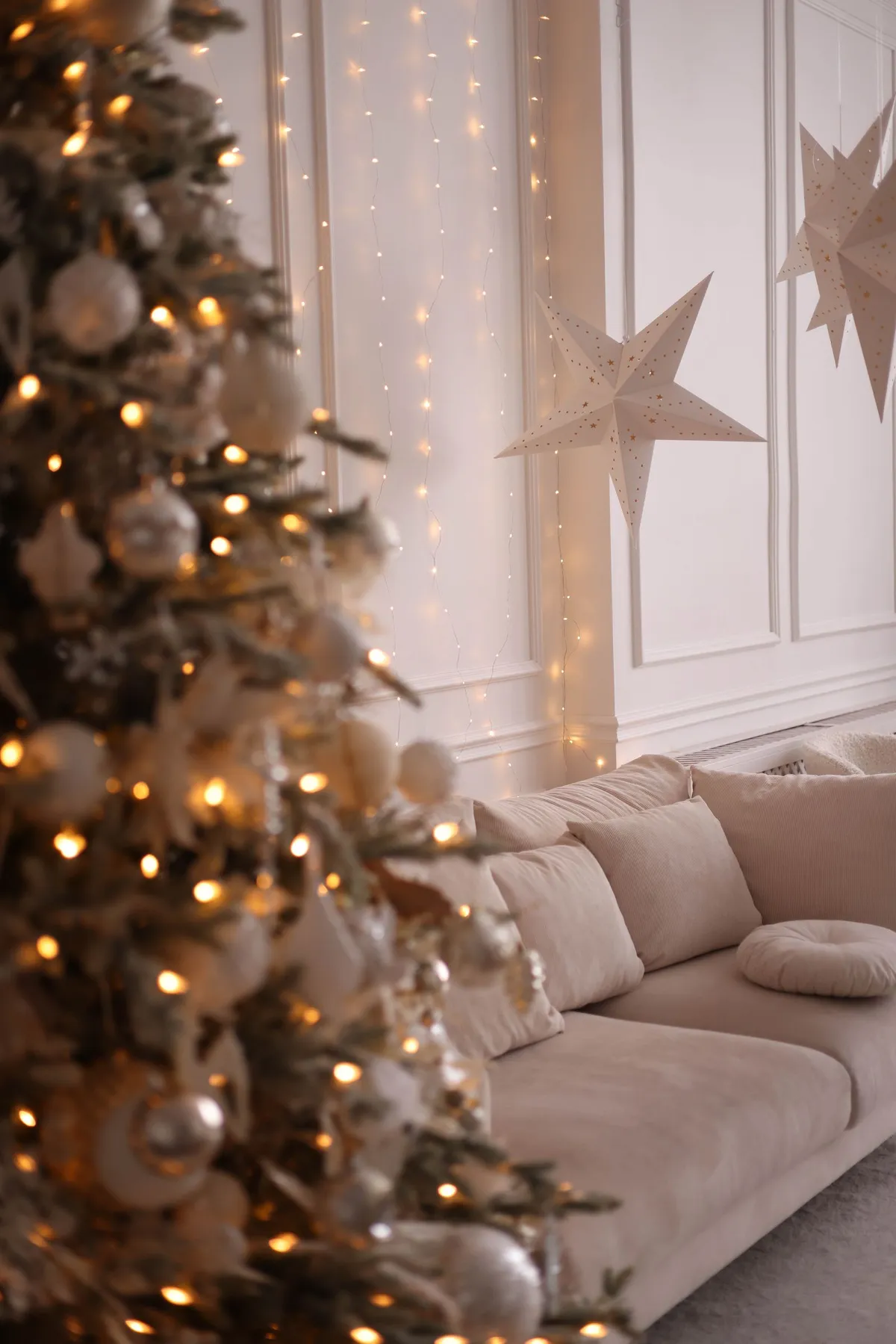
The National Fire Protection Association’s guidance is unglamorous and absolute: keep the tree at least 3 feet from any heat source — radiators, space heaters, fireplaces, heating vents — and keep real trees watered if you go that route. In small apartments the radiator is often exactly where the empty corner is, which disqualifies the best-looking spot on the floor plan before aesthetics get a vote.
| Heat source | Minimum clearance | Quick check |
|---|---|---|
| Radiator | 3 ft, all sides | Hand warm in 3 s = spot fails |
| Space heater | 3 ft, all sides | Move the tree, not the heater |
| Fireplace | 3 ft, all sides | Real trees must stay watered |
| Heating vent | 3 ft, all sides | Baseboard walls push tree to window |
Measure the heat radius the honest way: hold your hand where the tree’s branches would reach and count the seconds. Warm in three seconds means the spot fails. Apartments with baseboard heating along every wall usually push the tree to the window wall between units — which conveniently sets up the window tree in idea 14. It’s also worth noting that a smaller tree makes this rule dramatically easier to satisfy, because a tabletop tree’s 3-foot circle fits on furniture rather than floor.
Pencil trees: full height, quarter of the footprint
A pencil tree keeps the ceiling-grazing height and cuts the base to an 18–24 inch diameter — roughly a quarter of what a full 6-foot tree demands. In a narrow living room, that’s the difference between a tree and a wall: the pencil profile slots beside a bookcase, between the sofa and the TV console, or in that one awkward 2-foot gap every apartment has and nothing else uses.
| Spec | 6 ft pencil tree | 6 ft full tree |
|---|---|---|
| Base diameter | 18–24 in | 45–55 in |
| Footprint | About 2–3 sq ft | About 12–15 sq ft |
| Ornament size | 1.5–2 in baubles | 2.5–3 in baubles |
| Fits through 30 in door | Yes, boxed | Often not, boxed |
| Typical price | $40–$90 | $60–$150 |
The trade is branch depth: fewer, shorter branches mean fewer ornament slots and less room for chunky keepsakes. Decorate accordingly — smaller ornaments, more of them, wired ribbon vertical instead of draped — and the silhouette stays clean. Pre-lit pencil trees save the fiddliest ten minutes of setup, and 6-foot models routinely fit through apartment doorways still in their boxes, which the 7.5-foot full tree never does.
As an Amazon Associate, Herpickery earns from qualifying purchases.

- Just 21.75" in diameter — clears the tape-out footprint and a 30" door swing with room to spare
- Unlit on purpose: wrap your own timer light string exactly where the room needs glow
- 390 flame-retardant branch tips and a foldable metal base that flat-packs in January
Half trees and wall-mounted trees
A half tree is flat on the back — it sits flush against the wall and cuts its floor reach roughly in half while looking complete from the front. Wall-mounted trees go further and take the floor out entirely: a flat-frame tree, a garland tree outline, or ornaments hung from a mounted rail, all of it living above the skirting board where the vacuum and the dog share territory.
| Option | Floor reach | Mounting | Weight |
|---|---|---|---|
| Flat-frame half tree | About half of a full tree | Two studs | 15–30 lb |
| Garland outline | Zero | Command clips | Ounces |
| Ornament rail | Zero | Mounted rail | Light |
The hardware math is the same as our stocking guide: whatever you mount carries into studs or masonry anchors, and everything else is adhesive territory. A flat-frame half tree runs 15–30 lb, so two studs carry it; garland outlines weigh ounces and take Command clips. The honest trade is trimming joy — you can’t wrap lights around a flat tree the same way — but the payoff is a full-height tree in a room where the floor budget is zero.
Ladder-shelf and bookcase trees
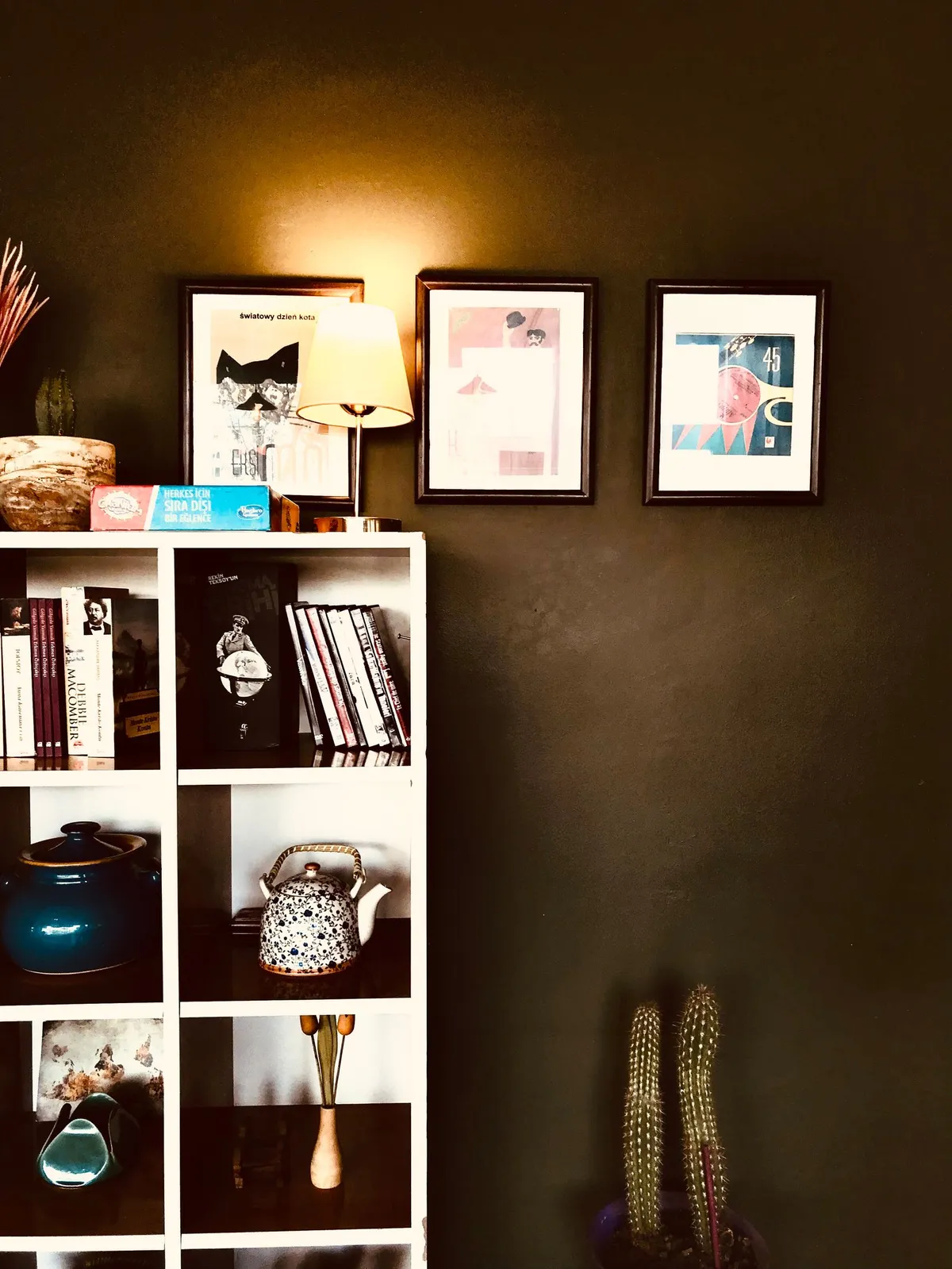
The furniture you already own is a tree frame in disguise. A ladder shelf styled with greenery, micro lights, and a small ornament per level reads as a tree from across the room — and it stores books the other eleven months. Bookcases work the same way: one shelf holds the star, one a cluster of ornaments, one a tiny tree, and the vertical string of lights does the Christmas-lifting.
The rules that keep it looking styled instead of cluttered: one decorative layer per shelf, a two-color palette, and lights on a timer so the display runs itself. This is also the cheapest idea on the page — most people are within $15 of finished using only what they own plus one light strand. The photo shows the version to copy: shelf, small tree, framed art, done.
Tabletop trees at eye level
A 2-foot tree on a console, dresser, or side table sits at eye level, which gives it the visual authority of a much taller floor tree — eye-level things always win the room. The formula: clear the surface entirely except for the tree and one or two props, so the tree reads as a styled moment rather than clutter that grew a light strand.
| Tree height | Best surface | Ornament size | Lights |
|---|---|---|---|
| 1.5 ft tree | Desk or shelf | 1–1.5 in | 100–150 micro LEDs |
| 2 ft tree | Console or dresser | 1.5 in | 150–200 micro LEDs |
| 3 ft tree | Side table or bench | 1.5–2 in | 250–300 micro LEDs |
Scale the ornaments down (1.5-inch baubles, not 3-inch), wrap micro lights deep into the branches, and put the tree where its reflection works: opposite a window or a mirror doubles its presence for free. Tabletop trees are also the renter’s best friend — no floor, no anchors, no moving-day legacy — and they move from console to dinner table centerpiece to bedroom dresser across the season without a second thought.

Windowsill forests
A trio of mini trees at three heights on a windowsill makes a small forest that glows from the street and costs less than one decent ornament. Three sizes look intentional; one looks lost. Add a bowl of oranges or a string of dried slices between them and the whole vignette smells the way it looks.
| Sill depth | What it holds | Tree size |
|---|---|---|
| Under 4 in | Flat bottle-brush trees only | 4–8 in tall |
| 4 in or more | A 10 in pot, safely | 8–12 in tall |
| 6 in or more | Trio of pots at 3 heights | 8–14 in tall |
The sill check takes thirty seconds: measure the window’s opening height (sash windows need clearance to open) and the sill depth — anything past 4 inches deep holds a 10-inch pot safely. Bottle-brush versions (next idea) weigh nothing and store flat, so the sill can host the forest from December 1st without any commitment anxiety. At night, this is the one display that does its best work for the neighbors.

Bottle-brush clusters
Bottle-brush trees are the storage champion of the entire list: sisal cones on wire bases that nest into a shoebox and come back every year without complaint. Clustered on a shelf, a mantel-less ledge, or the coffee table with a few bottle-brush “big siblings” mixed in, they build a forest that photographs far above its price point — most sets run $10–20 for half a dozen.
| Cluster | Typical price | Height tip | Storage |
|---|---|---|---|
| 3 trees | $5–$10 | Tallest 2x shortest | Nests in a shoebox |
| 5 trees | $8–$15 | Mix big siblings in | One shoebox |
| 6-tree set | $10–$20 | Odd numbers look best | Stores flat, sisal cones |
Two styling notes from mistakes made: keep them in odd numbers (3 or 5), and vary the heights by at least double between the tallest and shortest so the group has a skyline. Dust them before storing, not after — sisal holds a season of dust like a magnet, and January-you will not thank December-you for skipping it. This is also the display that survives the cat, at least until the cat develops shelf-climbing opinions.

A tree you keep: rosemary and potted minis
The living versions solve storage by refusing to be storage problems: a rosemary cone trimmed as a mini tree lives on the kitchen counter, smells like the season, and becomes an herb plant again in January. Norfolk Island pines and small spruce pots do the same on a brighter shelf — decorated with a single strand of micro lights and the lightest ornaments only, because real branches carry less than they look like they should.
| Plant | Light needs | Water rule | After January |
|---|---|---|---|
| Rosemary cone | Sunny window | Water when top inch dries | Becomes an herb again |
| Norfolk Island pine | Bright indirect | No drafts, even moisture | Houseplant year-round |
| Small spruce pot | Brighter shelf | Keep soil from drying out | Plant outside or repot |
The care math is real, so know it going in: rosemary wants a sunny window and a drink when the top inch of soil dries; a Norfolk pine wants bright indirect light and hates drafts. If that sounds like a commitment rather than a hassle, this is the only tree on the list that gets better every year you own it — and the only one whose cleanup is pruning.

Tree collar instead of tree skirt
A tree skirt sprawls 18 inches past the base in every direction — in a small room that’s a rug-sized chunk of floor you’re donating to December. A tree collar (a tapered metal or woven ring around the base) claims about 2 inches. Same finished look from above, an 18-inch radius returned to the room, and presents stack against a firm edge instead of sliding off a skirt.
| Base cover | Floor claimed past base | Look | Fit note |
|---|---|---|---|
| Tree skirt | 18 in radius | Fabric sprawl | Fits any stand |
| Tree collar | About 2 in | Tapered metal ring | Bottoms run 22–30 in |
| Upside-down basket | About 2 in | Woven texture | Measure stand’s widest point |
Baskets are the softer version: a woven basket turned upside down over the stand, with the trunk through a hole cut in the base, holds the same silhouette as a collar and adds texture that suits Scandinavian and natural palettes. Whichever you pick, measure the stand’s widest point first — collars run 22–30 inches at the bottom, and a base that doesn’t fit is a return-shipping Christmas miracle.
As an Amazon Associate, Herpickery earns from qualifying purchases.

- 22.5" base diameter — the compact footprint a tree skirt would claim double
- Reinforced wire frame under fade-proof faux wicker; tool-free upside-down assembly
- Sized for 6–7.5 ft trees and pencil trees alike, with the stand fully hidden
Light math for small trees
The working number: 100 lights per foot of tree, wrapped deeper into the branches rather than skirted around the tips — depth is what makes a small tree look expensive in photos. A 4-foot tree wants 400 lights; a tabletop 2-footer glows properly with 150–200 micro LEDs. Micro LED strands are the small-tree cheat code: thin wire disappears into branches, and they run cool near curtains and walls.
| Tree height | Light count | Strand type | Timer |
|---|---|---|---|
| 2 ft tabletop | 150–200 | Micro LED on thin wire | 5 p.m. to 11 p.m. |
| 4 ft tree | About 400 | Micro LED, wrapped deep | 6 h on, 18 h off |
| 6 ft pencil | About 600 | Battery strand at base | Solves the far outlet |
Battery strands with a timer solve the two problems apartment trees always have — the far outlet and the forgetful household. Set the timer for 5 p.m. to 11 p.m. once and the tree runs the whole season without a single cord across a walkway. Keep the battery pack tucked at the base inside the collar, and check whether the strand takes standard or coin batteries before the third December run to the convenience store. Not every glow has to come from the tree either: a 12-pack of timer tea lights runs on the same 6-hours-on cycle — click them on at 5 p.m. and they sleep at 11 — pooling warm light on the windowsill and shelves the tree can’t reach.
As an Amazon Associate, Herpickery earns from qualifying purchases.

- 6 hours on, 18 hours off — click on at 5 p.m., they sleep at 11, repeat daily
- Warm-white flicker pools light on windowsills and shelves the tree can't reach
- Twelve flames, zero cords, zero outlet hunting, nothing across a walkway
The window tree
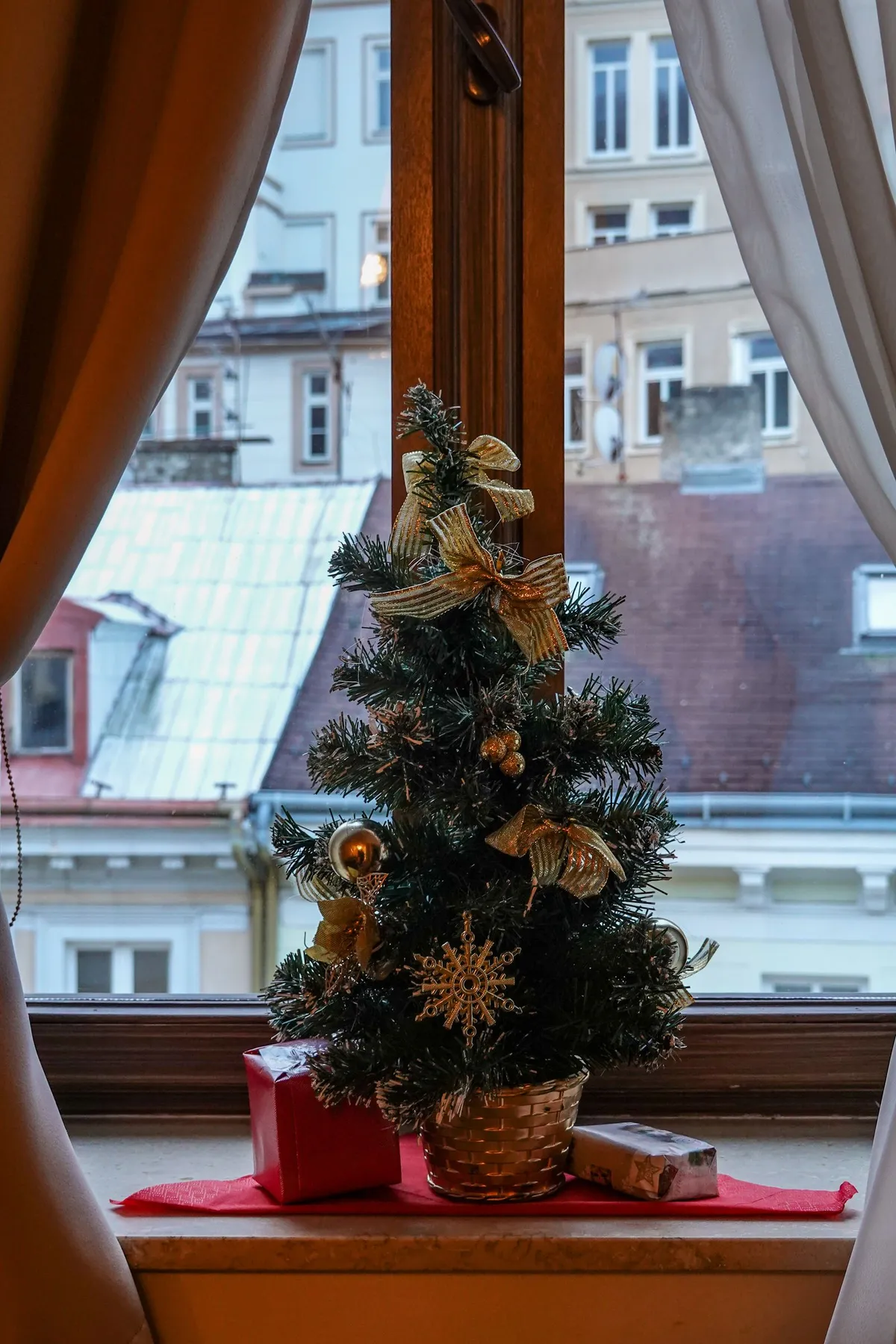
A tree placed against the window works two audiences at once: the room gets the silhouette, and the street gets the glow — which in an apartment means your tree decorates the block whether the neighbors know it or not. Keep the tree below the window’s opening height if the sash needs to open, and let the glass do the amplifying: every light doubles in the reflection for free.
This is the spot that makes a 4-foot tree punch above its class, because silhouettes read bigger than objects. Pair it with the timer lights from idea 13 and the display runs itself at dusk every evening. Two practical notes: rotate the tree a quarter turn every week or two for even light exposure if it’s real, and keep presents out of direct window sightlines — blinds people and curtains people both have stories.

Cat defense and the January exit plan
Cats treat small trees as furniture that fought back. The defense is layers: anchor the tree to the wall (a picture hook and fishing line to the top third works), skip tinsel and thin angel hair entirely — they’re the dangerous ingestibles — hang unbreakable ornaments on the lower two-thirds, and reserve the good glass for the top third or a shelf display the cat can’t reclimb. A citrus spritz on the lower branches buys you the first week while the cat negotiates.
Then the exit plan, because January is where small-space trees are won: the bottle-brush forest stores in a shoebox, the pencil tree goes back in its original vertical box behind the sofa or on top of the wardrobe, and ornaments live in one labeled bin per color. Take three photos of the finished display before dismantling — next December’s setup takes twenty minutes instead of an archaeological afternoon, and you’ll actually remember which corner it stood in.

What this actually costs
| Budget | What it buys | What you get |
|---|---|---|
| Under $30 — the edit | Bottle-brush set, one micro-light strand, a bowl of oranges | A shelf forest that stores in a shoebox |
| Under $75 — the tree | A 4–5 ft pre-lit tree or pencil tree, collar, timer lights | Full-tree ritual in a quarter of the footprint |
| Under $150 — the system | A 6 ft pencil tree, wall-mount kit for a garland tree, plus the shelf forest | Three displays, one bin of storage, zero floor sacrificed |
Before you buy: the setup checklist
The 12-point small-tree fit check
- ☐ Ceiling measured and the height formula applied (ceiling − 6–12 in)
- ☐ Base diameter taped out on the floor and lived with for a day
- ☐ Every door’s swing arc checked against the tape outline
- ☐ Walking path keeps 30–36 inches clear beside the tree
- ☐ 3-foot heat radius verified with the hand test
- ☐ Nearest outlet located; battery timer lights chosen if it’s beyond 6 feet
- ☐ Ornaments scaled down (1.5-inch class for tabletop and pencil trees)
- ☐ Collar or basket measured against the stand’s widest point
- ☐ Light count planned at 100 per foot of tree
- ☐ Anchor and fishing line staged if a cat lives here
- ☐ Tinsel and angel hair declared off-limits for good
- ☐ Three photos of last year’s display saved for the twenty-minute re-hang
Related reading
For the rest of the small-space December: our stocking ideas when you don’t have a fireplace (the hardware table pairs with the wall tree), the porch that survives rain, and the Christmas table that looks expensive. Morning after: the brunch table you set up the night before, and the New Year’s Eve table that survives until midnight. More in Cozy Home.
Last updated: November 13, 2026
[…] the station’s edge or a small lit tree nearby (we keep one going all December — see our small Christmas tree ideas for tiny apartments). Wrapping thirty gifts is a ten-hour seasonal job, and ten hours feel entirely different with the […]
[…] Tabletop trees run their own math: 2–3 feet of height at balanced density means 30–45 mini-skewed ornaments, with minis promoted from gap-filler to main event (a 3-inch ball on a 2-foot tree is a statement piece). For the full small-space playbook — where the tree goes when there’s no floor, how to fake height with a wall of lights — see our small Christmas tree ideas for tiny apartments. […]
[…] When the tape oval proves the room loses, the swaps are worth pricing honestly. A 4-foot tree instead of a 6 drops the footprint from about 12.5 to 6.3 square feet — half the floor for two-thirds of the height. A windowsill tree claims zero floor. A wall-mounted branch tree claims none, and a tabletop tree on a sideboard claims roughly 4 square feet of surface you weren’t using anyway. The full lineup with heights and placements is in our small Christmas tree ideas for tiny apartments. […]