
The year I bought my first “real” tree, I measured the corner, nodded at the number on the box, and carried in a 6-footer that turned my studio into a maze. The box said 6 feet. The box did not say 4 feet across. I spent that December walking sideways past my own Christmas tree, and the tree spent it dropping needles onto every jacket that brushed by — which was all of them, because nothing brushed by freely.
Tree footprint is arithmetic, not luck: a spread circle you can tape out in five minutes, a skirt diameter with a formula, a gift ring with a capacity, and three clearance rules (sofa, dining chair, radiator) that decide whether the tree lives in the room or fights it. This page runs all four numbers, then ends with the staging plan for the space underneath — because the footprint you claim in December should work as hard as the tree on top of it.
Table of Contents — 12 Ideas
- The real footprint: spread, not the box number
- Walkway clearance: the 36-inch rule
- Tree skirt size: the diameter formula
- Tree collars and baskets: the fit math
- The gifts ring: how many boxes actually fit
- Corner or wall: the placement multipliers
- Sofa and TV sightlines
- Dining nook trees: the chair-pullout tax
- The heat clearance: 3 feet of dry air
- Small-space swaps: the footprint you save
- Skirt, collar, or basket: which base to buy
- The gift staging plan
1. The real footprint: spread, not the box number
What footprint does a Christmas tree actually need?
My first apartment tree taught me this the hard way: the box said “6 ft slim,” I measured a 3-foot gap between the bookshelf and the sofa, and the tree still didn’t fit — because the box measures height, and the tree lives in every direction at once. The working formula: a full-profile tree’s branch spread is roughly 40–45% of its height, and its footprint is a circle of that diameter. A 6-foot tree that spreads 48 inches claims about 12.5 square feet of floor — closer to 16 once you account for the gifts ring around it.
| Tree height | Typical spread | Floor circle | Footprint area |
|---|---|---|---|
| 4 ft | 30–36″ | ~34″ | 6.3 sq ft |
| 5 ft | 38–44″ | ~42″ | 9.6 sq ft |
| 6 ft | 44–52″ | ~48″ | 12.5 sq ft |
| 7 ft | 52–60″ | ~56″ | 17.1 sq ft |
| 7.5 ft | 56–64″ | ~60″ | 19.6 sq ft |
The cheap insurance policy is a roll of masking tape. Before the tree comes indoors, stick a tape oval on the floor at the diameter from the table above, put the tree stand in the middle of it, and walk the room. A tape oval costs nothing to move; a tree with a full water stand weighs 60-plus pounds and does not. The five minutes of taping is the difference between “the tree fits” and “the tree fits and you can still open the balcony door.”

2. Walkway clearance: the 36-inch rule
How much space do you need between a tree and a walkway?
A tree that grazes the walking line sheds needles onto every pair of December socks and collects tinsel like a static brush. The rule: keep 36 inches of clear walkway between the tree’s widest branches and any route people actually take — the kitchen run, the hallway, the path to the shoes. Thirty inches is the survive-on threshold for a narrow apartment, but at 30 inches a puffer jacket brushes the branches every single morning, and by December 10th the tree looks chewed.
| Clearance zone | Minimum distance | Why it matters |
|---|---|---|
| Main walkway | 36″ | Keeps needles and tinsel off every coat that passes |
| Tight apartment walkway | 30″ | Survive-on threshold; puffer jackets brush the branches daily |
| Sofa front face | 36″ | Room to pass behind the sofa with a mug in hand |
| Dining chair pullout | 30″ | Chairs claim 30″ behind the table edge when someone sits |
| Heat source (radiator, vent) | 36″ | Heat doubles water needs and triples needle drop |
| Window glass | 6″ | Prevents condensation on panes and crushed outer tips |
Measure the walkway at its narrowest point — usually where the coffee table juts or the radiator bulges — and subtract, don’t average. The tree’s spread circle is round, but your room’s pinch points are what decide whether the placement works. This is the same discipline as the wet-zone math in our Christmas entryway guide: December traffic is the real stress test, not the photo on setup day.
3. Tree skirt size: the diameter formula
What size tree skirt for a 6-foot tree?
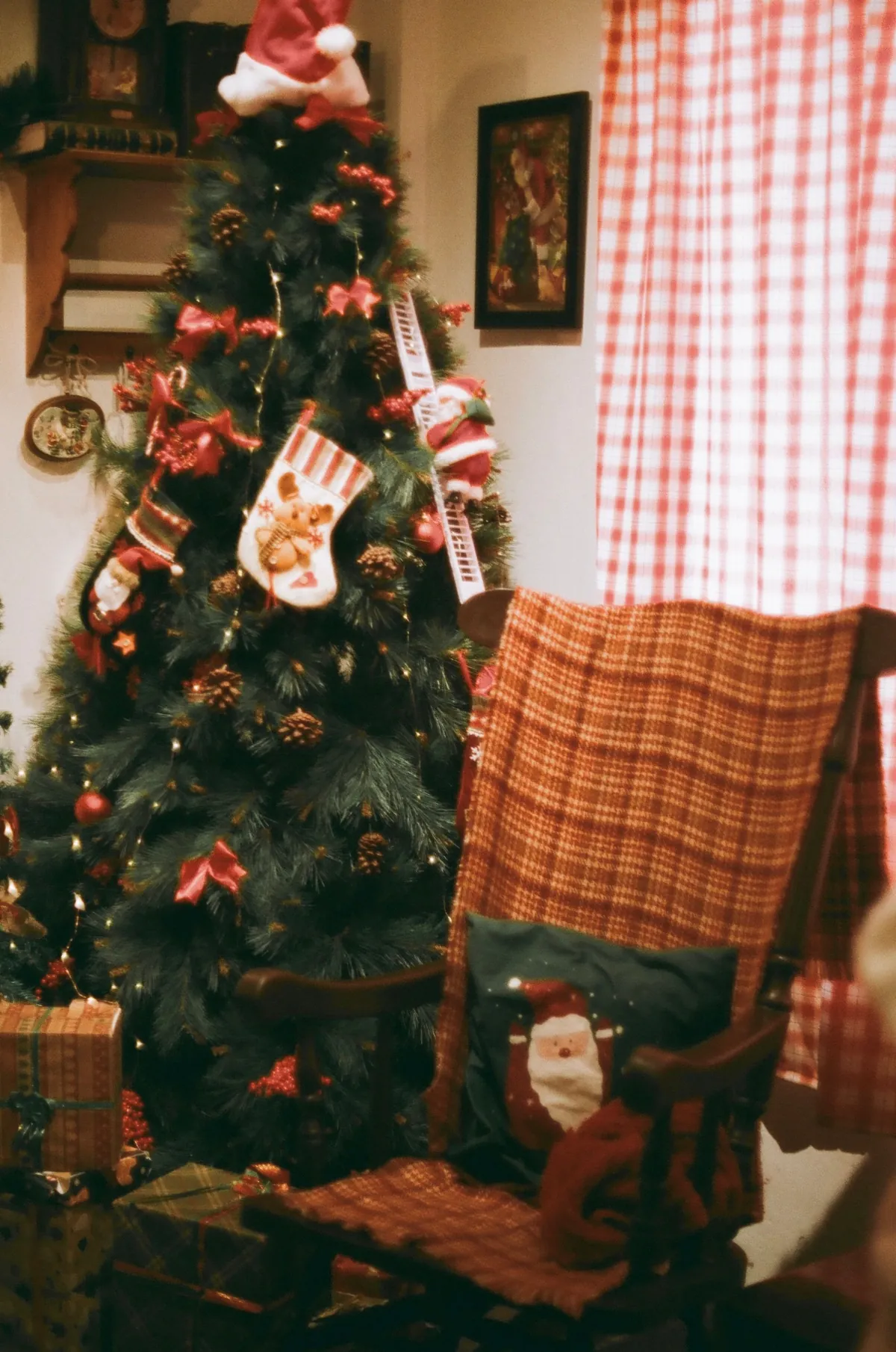
A skirt that’s too small is the most common tree-base mistake, and it’s visible in every photo: branches splayed over a sad little circle of fabric. The formula: skirt diameter = branch spread + 8 to 12 inches. The skirt’s job is to catch needles and cover the stand, so it must extend past where the lowest branches actually hang — at full droop, on day 25, with the ornaments’ weight on them. For that 6-foot tree with a 48-inch spread, the right skirt is 56 to 60 inches, not the 48-inch one the box suggests.
| Tree spread | Minimum skirt | Comfortable skirt | Notes |
|---|---|---|---|
| 34″ (4 ft tree) | 42″ | 48″ | Most “48-inch” skirts suit 4–5 ft trees |
| 42″ (5 ft tree) | 50″ | 56″ | Check your tree’s real spread, not its height |
| 48″ (6 ft tree) | 56″ | 60″ | The classic “60-inch skirt” lives here |
| 56″ (7 ft tree) | 64″ | 72″ | Under 64″ and the stand shows at the back |
One honesty note the skirt listings won’t tell you: a skirt’s stated diameter is measured flat, but a real tree lifts the fabric at the outer edge — branches push it into a shallow cone. Buy the comfortable size, not the minimum, or the gap between skirt edge and branch tips widens every week as the branches settle.
As an Amazon Associate, we earn from qualifying purchases.

- 60″ diameter — the classic full-size skirt for 6-foot trees in our table above
- Double-layer snow-white plush with a hook-and-loop slit closure
- Thick 2″ pile hides the stand and reads bright against dark floors
Price and availability shown on Amazon; listing may change.
4. Tree collars and baskets: the fit math
What size tree collar or basket fits a 6-foot tree?
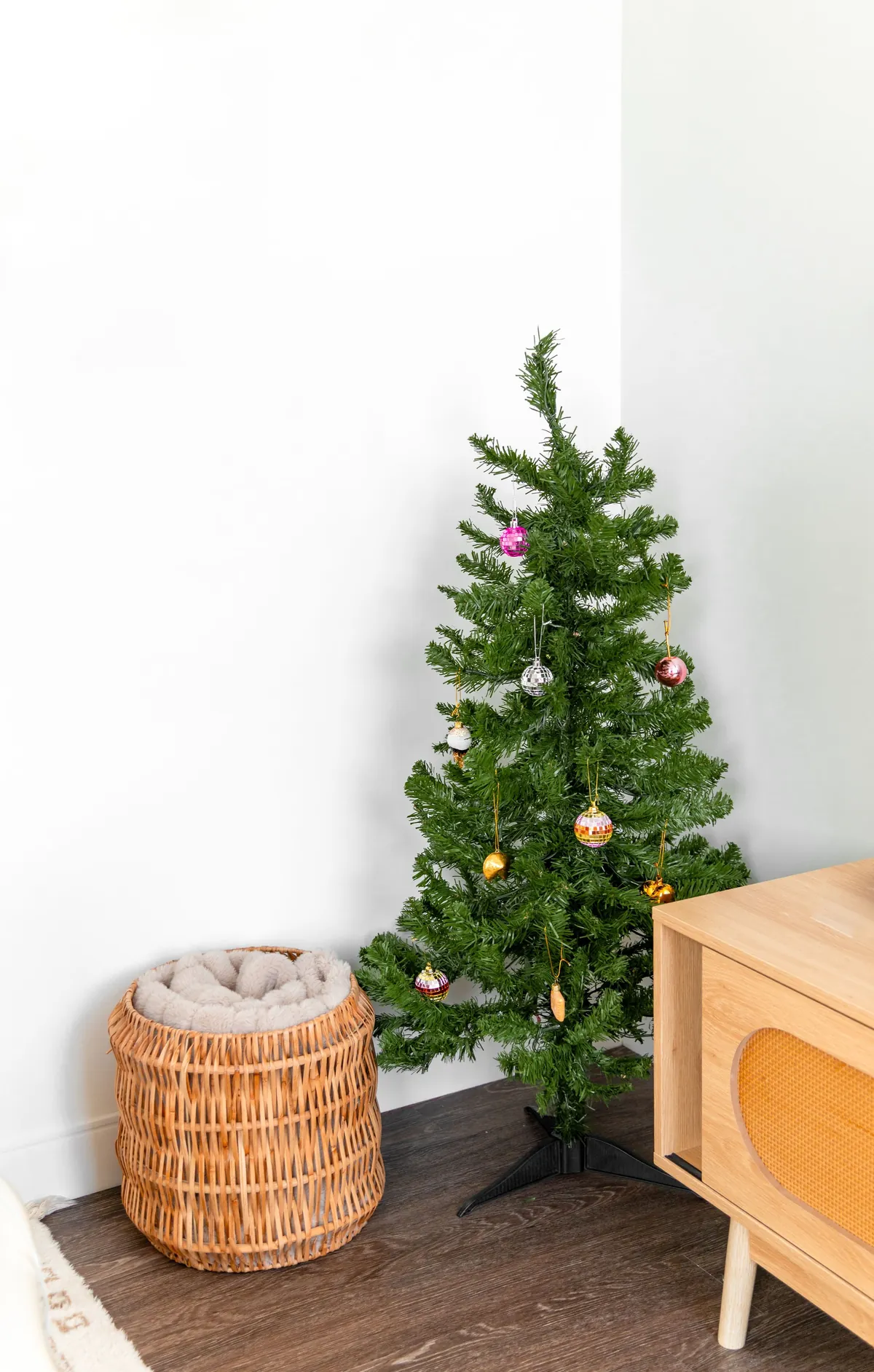
Collars and baskets replace the skirt’s fabric circle with a structured ring, and their fit rule is different: the opening at the collar’s top rim must clear the tree’s lowest branch ring plus two inches — measure the branch spread at the stand, not the tree’s mid-height. A collar that fits the trunk but fights the lowest branches either gets pushed off-center or forces you to prune branches you paid for. For a 6-foot tree, that usually means a collar 26 to 30 inches across at the top and 18 to 22 inches tall. Narrow and pencil trees break the rule in your favor: their branch rings tuck tight to the trunk, so a 22-inch opening can clear them comfortably — measure the branch ring, not the tree’s label.
Basket-style collars add one more variable: the tree trunk sits inside a water stand, and the stand needs to drop into the basket before the tree goes in. Check the stand’s base diameter against the basket’s floor — a stand that overhangs the basket’s bottom by an inch tilts the whole tree a degree or two, which reads as “slightly drunk” in every photo from every angle.
As an Amazon Associate, we earn from qualifying purchases.

- 22½” base diameter × 10″ H — the slim-tree size that clears tight branch rings
- Waterproof imitation wicker over a reinforced wire frame, fade-resistant
- Suits 6–7.5 ft slim and pencil trees; keeps pets out of the stand water
Price and availability shown on Amazon; listing may change.
5. The gifts ring: how many boxes actually fit
How many gifts fit under a 6-foot tree?
The space under a tree is a ring, not a circle — the trunk and stand own the middle, and the lowest branches own the top. For the 6-foot tree with a 48-inch spread: usable floor ring ≈ 11 square feet (the 12.5-square-foot circle minus about 1.5 for the stand), and the usable height under the lowest branches is typically 12 to 18 inches. At two layers of standard shirt-boxes (12 × 8 × 4 inches), that ring holds about 24 to 32 gifts; single-layer display for a photo-clean look, call it 14 to 18.
| Tree height | Branch spread | Gifts, two layers | Gifts, single layer |
|---|---|---|---|
| 4 ft | 34″ | ~12-16 | ~7-9 |
| 5 ft | 42″ | ~18-24 | ~10-14 |
| 6 ft | 48″ | 24-32 | 14-18 |
| 7 ft | 56″ | ~32-40 | ~18-24 |
The math that matters more than capacity is the stagger: gifts look styled when heights step down from the trunk outward — the big boxes buried deep against the stand, the small ones on the outer ring where the branches lift high enough to see them. Boxes deeper than 14 inches under a 6-foot tree will fight the lowest branches, so measure your under-branch clearance before you buy big boxes to stage underneath. The wrapping itself comes from the gift wrapping station pipeline — same supplies, different final destination.

As an Amazon Associate, we earn from qualifying purchases.

- 18 lidded boxes in 4 sizes, from 17″ robe boxes to small jewelry boxes
- All styles stay 2–4″ deep — they stage cleanly under 12–18″ branch clearance
- Includes 18 gift tag stickers and 144 corner support stickies
Price and availability shown on Amazon; listing may change.
6. Corner or wall: the placement multipliers
Where should a tree go in a small room?
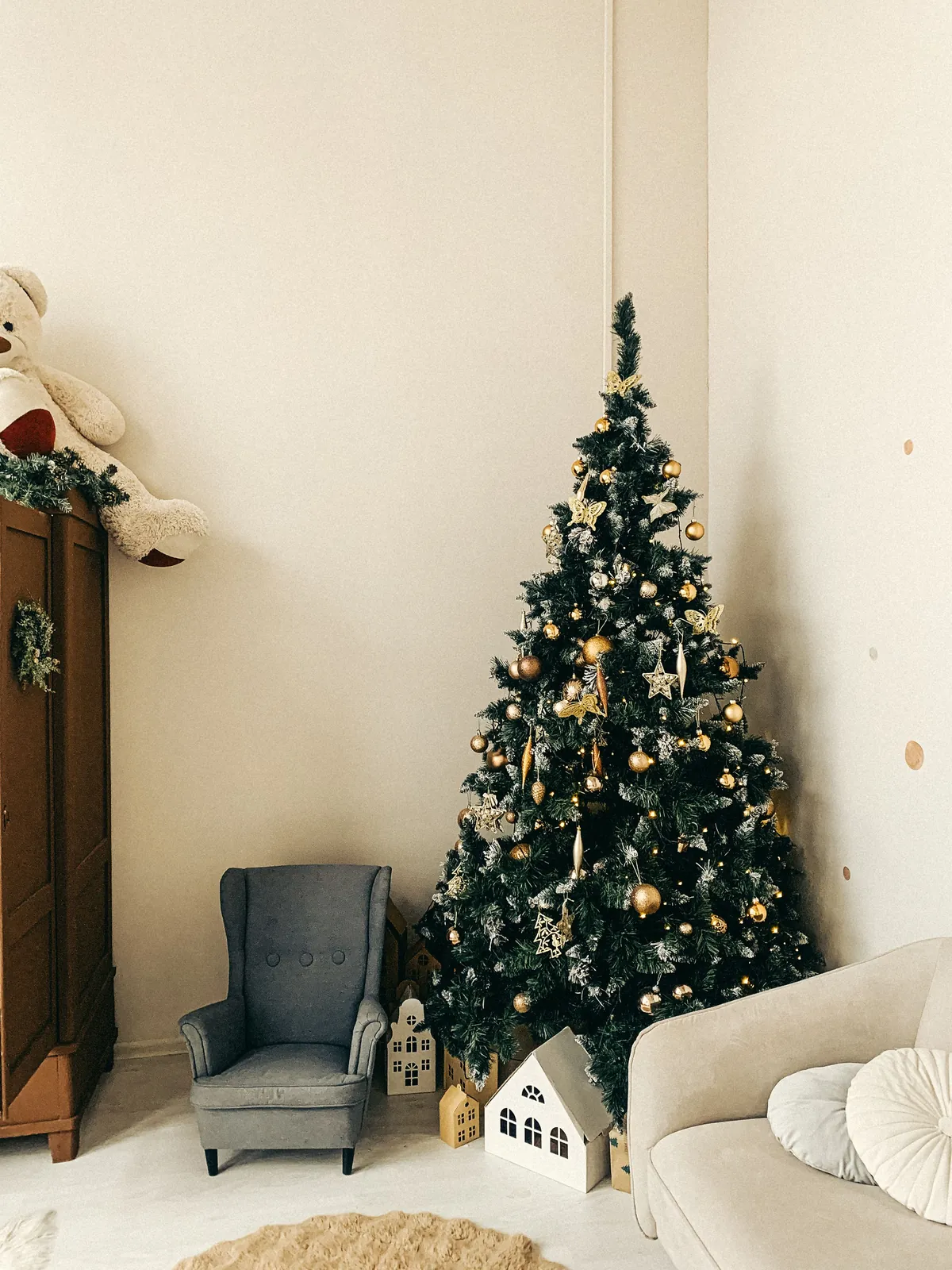
Placement is the cheapest footprint hack there is. A tree floated in the room shows all 360°; against a wall it shows about 270°; tucked in a corner, about 180° — and the corner placement effectively gives back floor on two sides, which is often where your walkways live. The same 48-inch spread circle consumes the room very differently depending on how many sides of it are furniture-facing, and the corner tree’s “hidden” back quarter is where the gift overflow goes.
| Placement | Visible arc | Floor given back | Best for |
|---|---|---|---|
| Floating in the room | 360° | None | Open floor plans, island-style layouts |
| Against a wall | 270° | One side | Narrow living rooms with one free wall |
| Tucked in a corner | 180° | Two sides | Small rooms where walkways need the space |
| Bay window | 270° | Wall space | Visibility from the street; keep 6″ off the glass |
The trade is light and presence: a corner tree is seen from fewer seats, so it earns fewer glances from the sofa. Compensate with decorating depth — the corner tree’s visible faces carry the whole show, so the two visible sides get the richer treatment while the hidden quarter holds the utility boxes.
7. Sofa and TV sightlines
How far should a tree be from the sofa?
The sofa edge is a hard boundary: branches that reach the cushion line get sat on, and needles migrate into the seams by the second week. Keep 36 inches between the tree’s spread circle and the sofa’s front face — enough for a person to pass behind it without a branch encounter, which is exactly the path everyone takes to the kitchen carrying a mug. If the room can’t give 36 inches, the tree goes where the sofa isn’t, and the sofa accepts a view of the tree’s side.
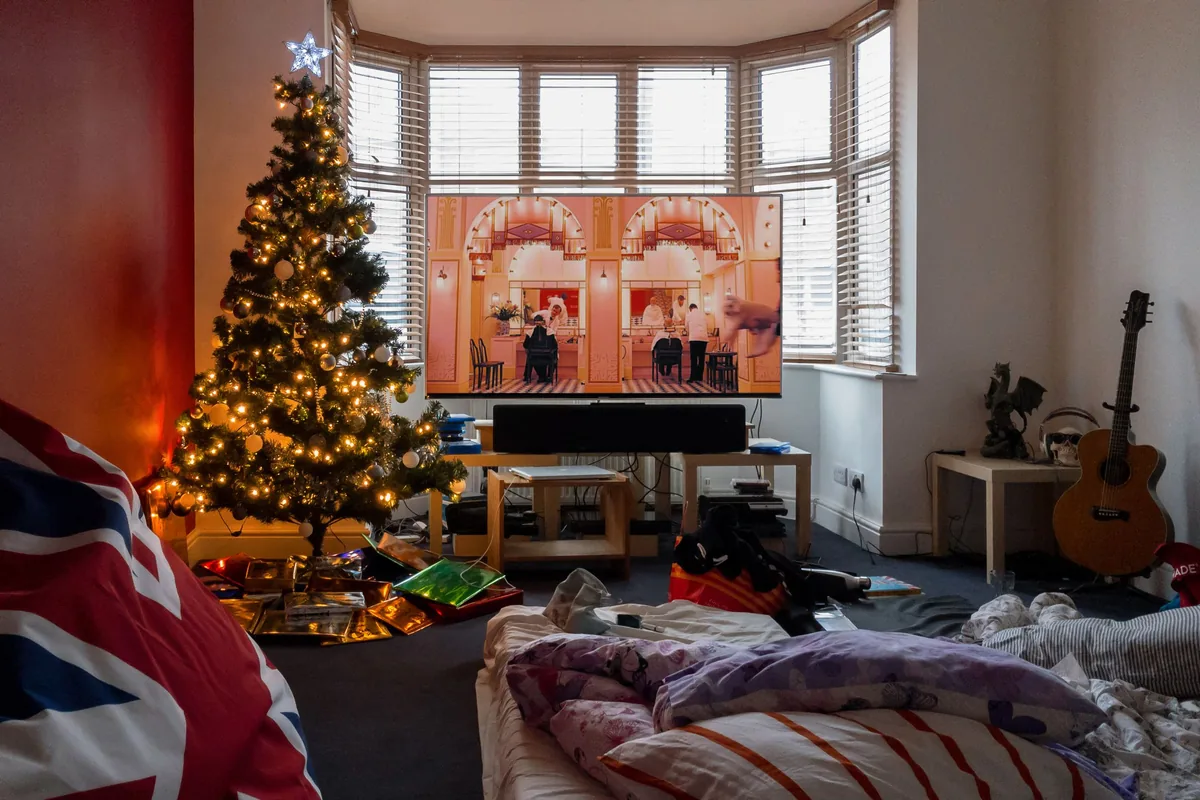
The TV is the other sightline: a lit tree between the sofa and the screen turns every evening show into a glare contest. Either place the tree outside the TV cone — offset past the screen’s edge by at least its own width — or accept that December movies happen with the tree lights winning. Families who solve this with a “tree off during movie night” rule are happier than families who pretend the glare isn’t there.
8. Dining nook trees: the chair-pullout tax
Can a Christmas tree go in a dining area?
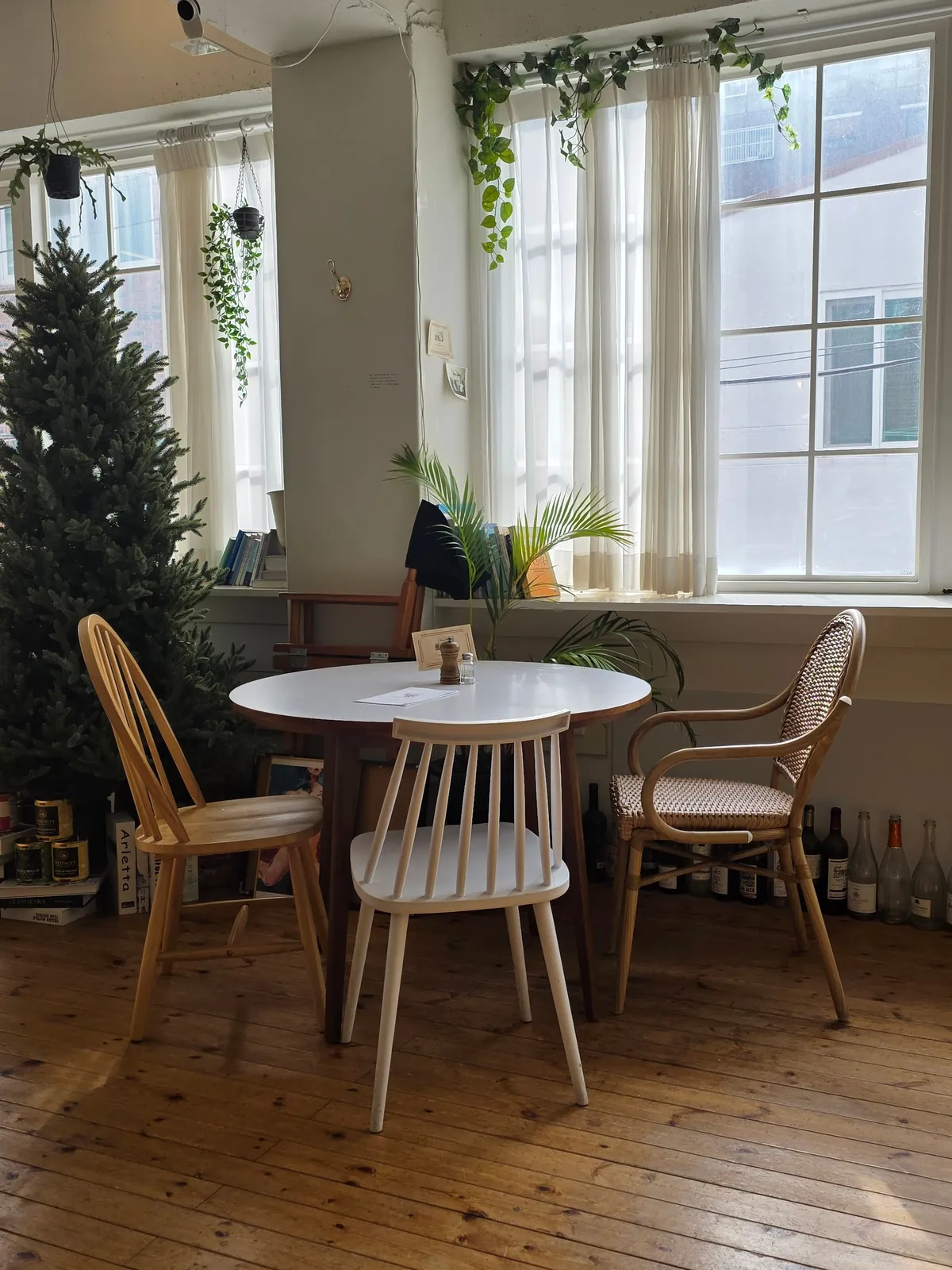
A tree in the dining zone pays a tax most people forget to calculate: every chair needs its pullout. A chair pulled back for sitting claims 30 inches behind its place at the table, and a tree that stands in the pullout zone gets bumped on the first dinner night and every one after. The rule: the tree’s spread circle ends at least 30 inches behind the table edge, or it moves to the wall opposite the chairs.
The dining nook is still one of the best tree locations in an open-plan home — it’s where eyes already go at mealtimes, and the tree shares the window light instead of competing with the TV. Just measure the chair arc on both sides of the table, not one: December guests sit in different seats than the household does, and the guest side is always the one that collides.
9. The heat clearance: 3 feet of dry air
How far should a tree be from a radiator or vent?
The footprint calculation isn’t finished until the heat sources are counted. A radiator, floor vent, or fireplace mantel dries the air in a roughly 3-foot radius, and a real tree standing in that radius drinks twice as fast and drops needles three times as fast — the tree’s water math and its placement are the same problem. Keep the spread circle 36 inches clear of any heat output, and note that “clear” means branches, not the stand: the outer tips are where needles start their exit.
Artificial trees pay a different tax in the same spot: sustained heat makes PVC branches relax and shed their shape by spring storage time. The 3-foot rule costs almost nothing in a normal room — the corner that’s 3 feet from the radiator is usually the corner that was winning anyway — but it’s the one rule worth enforcing even when the tape oval says the tree “fits” closer.

10. Small-space swaps: the footprint you save
What if the tree footprint doesn’t fit at all?
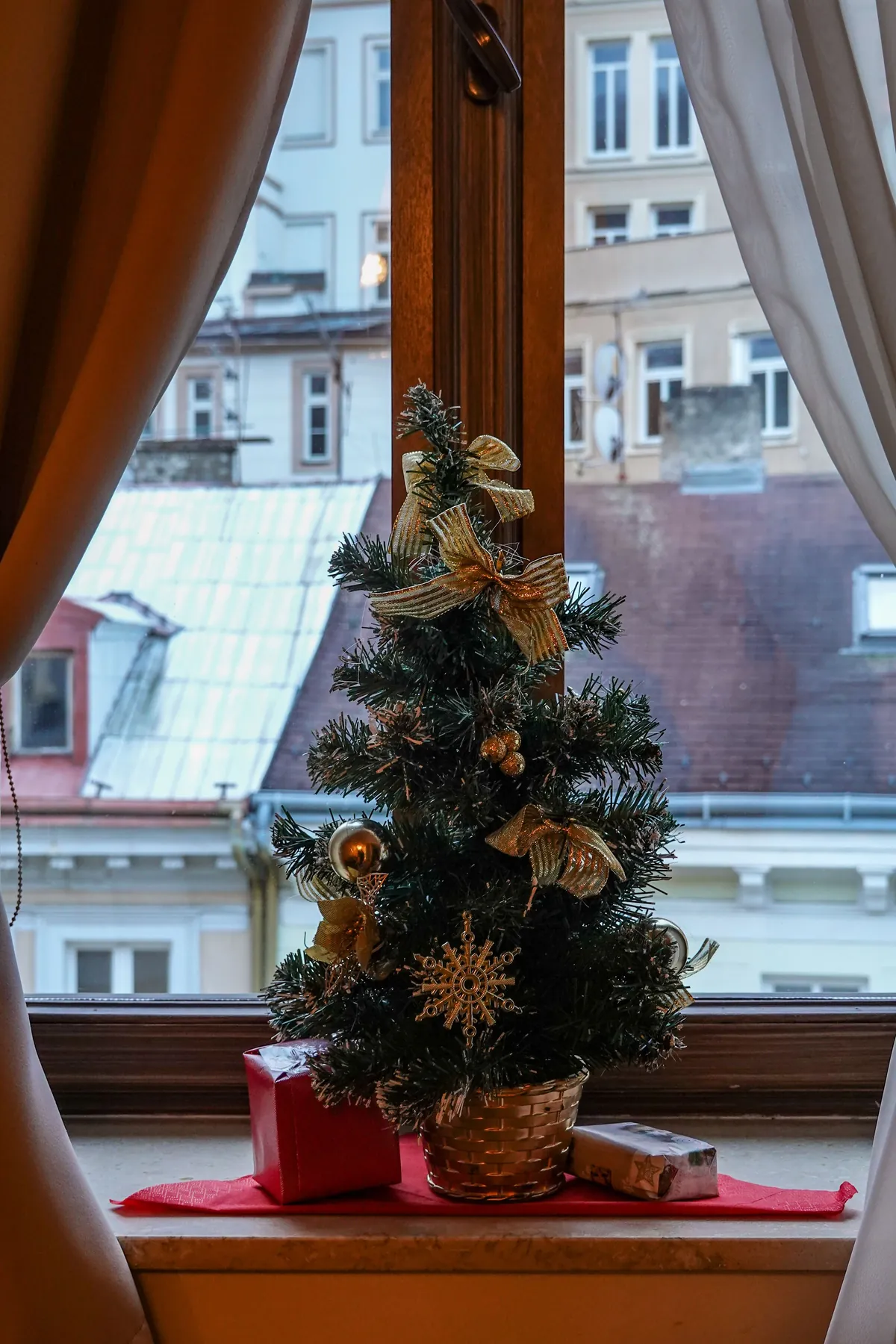
When the tape oval proves the room loses, the swaps are worth pricing honestly. A 4-foot tree instead of a 6 drops the footprint from about 12.5 to 6.3 square feet — half the floor for two-thirds of the height. A windowsill tree claims zero floor. A wall-mounted branch tree claims none, and a tabletop tree on a sideboard claims roughly 4 square feet of surface you weren’t using anyway. The full lineup with heights and placements is in our small Christmas tree ideas for tiny apartments.
| Swap | Floor claimed | Typical height | The trade |
|---|---|---|---|
| Full 6 ft tree (baseline) | 12.5 sq ft | 6 ft | Needs ~90 ornaments and 600 lights |
| Full 4 ft tree | 6.3 sq ft | 4 ft | Half the floor; ~45 ornaments and 400 lights |
| Tabletop tree on a sideboard | ~4 sq ft of surface | 2-3 ft | Uses surface you weren’t using anyway |
| Windowsill tree | Zero floor | 1-2 ft | Keeps the window view, zero footprint |
| Wall-mounted branch tree | Zero floor | Any | Pure wall decor; nothing under it but wall |
The calculation most people skip: a smaller tree decorated properly beats a big tree decorated sparsely, because ornament and light counts scale with height (10–12 ornaments and 100 lights per vertical foot at balanced density). A 4-foot tree needs about 45 ornaments and 400 lights to look finished — a kit that costs less and stores in one bin instead of three. The footprint decision and the decorating budget are the same decision.
11. Skirt, collar, or basket: which base to buy
Tree skirt vs collar vs basket
The three base options solve the same problem with different geometry, and the right answer depends on what your footprint can spare. Skirts lie flat and forgive everything; collars stand and need branch clearance; baskets stand, carry the weight, and double as a design object for the other eleven months. Here’s the honest comparison:
| Option | Best for | Footprint cost | The catch |
|---|---|---|---|
| Tree skirt | Wide-spread trees, traditional rooms | Zero (lies under the branches) | Shows every needle; needs the +8–12″ diameter |
| Tree collar | Slim and pencil trees, modern rooms | 6–10″ ring around the stand | Top rim must clear the lowest branch ring |
| Basket collar | Small trees, farmhouse and Scandi looks | 10–14″ ring, adds visual height | Stand must fit the basket floor before the tree goes in |
The needle detail decides it for most households: a skirt collects needles on its surface and shakes clean outside; a collar funnels them inside, where they wait for January. If you vacuum weekly anyway, either works; if you don’t, the collar’s built-in accumulation is the tidier lie.

12. The gift staging plan
How do you stage gifts under the tree?
If your household opens gifts on Christmas morning, the under-tree ring doubles as storage, and the staging plan is simple arithmetic: count the boxes, sort by size, and place big-to-the-trunk with a visible “front row” of three to five wrapped pieces that carry the whole look. The front row gets the good paper — that’s where eyes land — and the utility boxes behind it get the plain kraft, which is why the kraft pack from the wrapping station buys 30 feet of ribbon-feel for a fraction of the premium rolls.
The rotation trick earns its keep in households with children or early gift-buyers: wrapped gifts enter the ring in waves — a few in early December, the rest on the 23rd — and each wave goes deep-to-shallow so the newest boxes always dress the front. The tree stays photogenic all month, the pile never reads as overflow, and nothing gets kicked by a cat at 2 a.m. because the outer ring stays walkable from the tree’s own footprint outward.

The Footprint Cheat Sheet
Every number from this page, in the order you’ll need them on setup day:
- ☐ Tape the spread oval on the floor before the tree comes inside (spread ≈ 40–45% of height)
- ☐ Check 36″ walkway clearance at the room’s narrowest pinch point
- ☐ Skirt diameter = spread + 8–12″ (6 ft tree → 56–60″)
- ☐ Collar top rim clears lowest branch ring + 2″; stand fits the basket floor
- ☐ Gift ring: 24–32 boxes two-high on a 6 ft tree; big boxes deep, small ones out
- ☐ 36″ from the sofa face, 30″ behind every dining chair, 36″ from any heat source
Frequently Asked Questions
What size tree skirt do I need for a 6-foot tree?
A 6-foot tree with a typical 44–52-inch branch spread needs a skirt of 56 to 60 inches in diameter. The formula is skirt diameter = branch spread plus 8–12 inches, measured at the tree’s lowest branches — not the trunk.
How many gifts fit under a 6-foot tree?
About 24 to 32 standard shirt-boxes (12 × 8 × 4 inches) stacked two layers deep in the ring around the stand, or 14 to 18 displayed single-layer. Usable height under the lowest branches is typically 12–18 inches, so measure that before staging deep boxes.
How much floor space does a Christmas tree take?
A full-profile tree’s footprint is a circle roughly 40–45% of its height in diameter: about 12.5 square feet for a 6-foot tree, 17 for a 7-foot, and 6.3 for a 4-foot. Add 2–3 square feet for the gift ring if you stage presents underneath.
How far should a Christmas tree be from a radiator?
At least 36 inches. Heat dries the air in a roughly 3-foot radius, which doubles a real tree’s water needs and triples needle drop, and relaxes artificial PVC branches out of shape over a season.
Can I put a Christmas tree in front of a window?
Yes — bay windows are prime tree real estate because the tree is visible from outside without claiming wall space. Keep the branches off the glass by 6 inches to avoid condensation on the panes and crushed outer tips.
What size tree collar fits a 6-foot tree?
Look for a collar 26–30 inches across at the top rim and 18–22 inches tall. The top rim must clear the lowest branch ring by about 2 inches, which is why measuring the branch spread at the stand matters more than the trunk diameter.
Related Reading
Last updated: November 15, 2026. We tape the oval before the tree comes inside — every time.
[…] a standing jump into a decision. The corner placement that wins on floor-space math (see our Christmas tree footprint guide) also wins here: two walls mean only one approach vector to […]