
My parents’ porch is covered, which is exactly why I thought porch decorating was easy — until I helped a friend decorate her exposed front step in a December sleet storm and watched a paper-wrapped wreath bow dissolve in about ninety seconds. The wreath survived. The bow did not. Neither did the cardboard “JOY” letters by morning. Everything that died that weekend had one thing in common: it was made for a mantel, not a porch. Everything that lived was plastic, sealed, or wired.
That’s the whole difference between porch decorating and indoor decorating, and it’s why this list exists. These are fifteen ideas that hold up through rain, sleet, snow, and the wind that funnels straight at your front door — with the materials spelled out, because “weatherproof” on a product listing and weatherproof in a storm are two different things. If you’d rather start inside, we’ve already covered the Christmas table that looks expensive and the cozy fall living room; the porch is the layer guests see first, and it’s the cheapest one to fix.
In this guide: 15 Christmas porch ideas built for bad weather
- Buy the wreath once, in weatherproof form
- Hang everything without drilling a single hole
- Wrap the door frame in outdoor-rated garland
- Choose string lights with an IP44 rating or better
- Line the steps with lanterns on timers
- Fill two urns with greens that never drop needles
- Layer a coir doormat over a flat-weave rug
- Build a gift stack that can sit out all month
- Dress a bench or crate in one weatherproof vignette
- Light the path, not just the porch
- Wire everything down before the first storm
- Keep any fresh greenery alive with two cheap moves
- Pick a three-color palette that reads in the dark
- Give the porch ceiling one string of its own
- Do the twenty-minute version on a dark evening
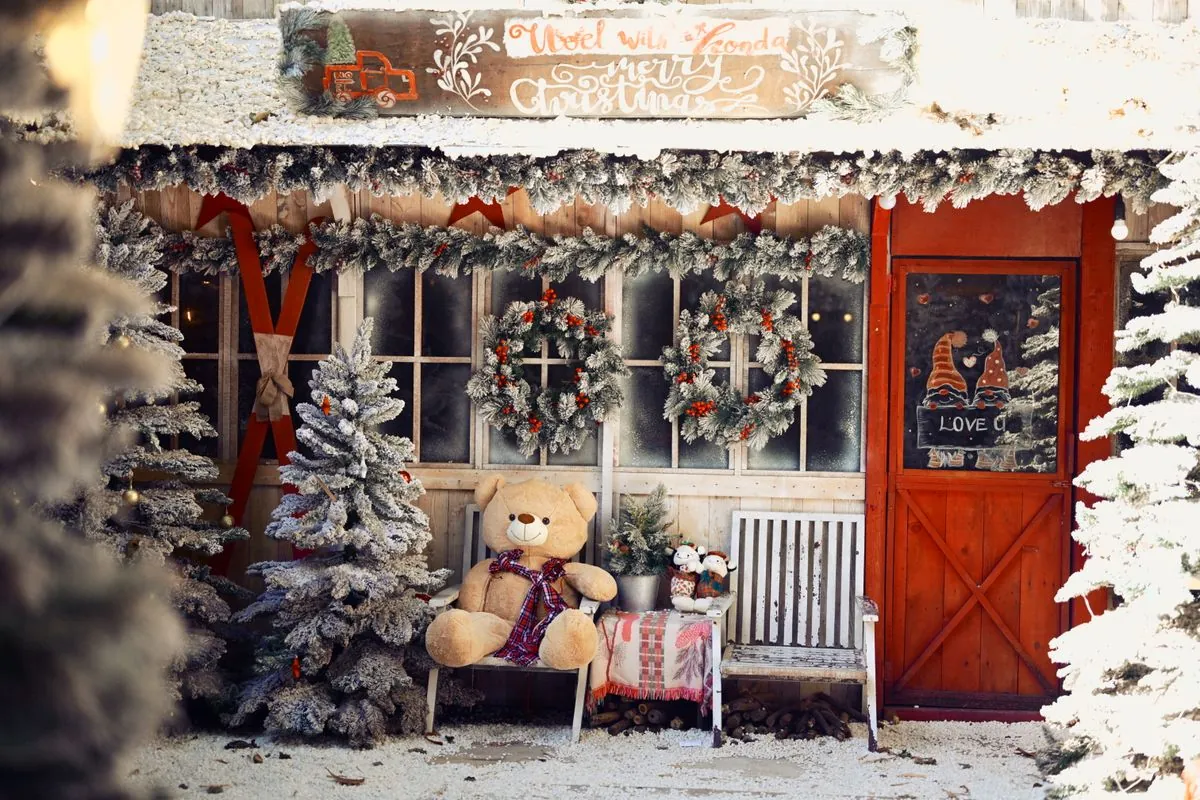
The one rule that decides what survives outside
Every porch decoration fails in one of two ways: water gets into it, or wind takes it away. So before buying anything, sort your porch into two zones. The covered zone — under a roof, awning, or deep overhang — behaves like indoors with colder air: fabric bows, fresh greenery, wooden signs, and wrapped gifts all survive there for weeks. The exposed zone — anything rain can reach, including walls above a low porch roof — only tolerates plastic, powder-coated metal, sealed stone, and outdoor-rated electronics.
Walk out during the next rain and watch where the water actually goes; wind-driven rain doesn’t respect the roofline the way you’d expect. Mark the two zones mentally, and every choice below gets easier: greenery and fabric go in the covered zone, plastic and metal go everywhere else. This one habit — buying for the zone, not the look — is what separates porches that look good on December 26 from porches that look like a yard sale.
15 Christmas porch decorating ideas that hold up in bad weather
1. Buy the wreath once, in weatherproof form
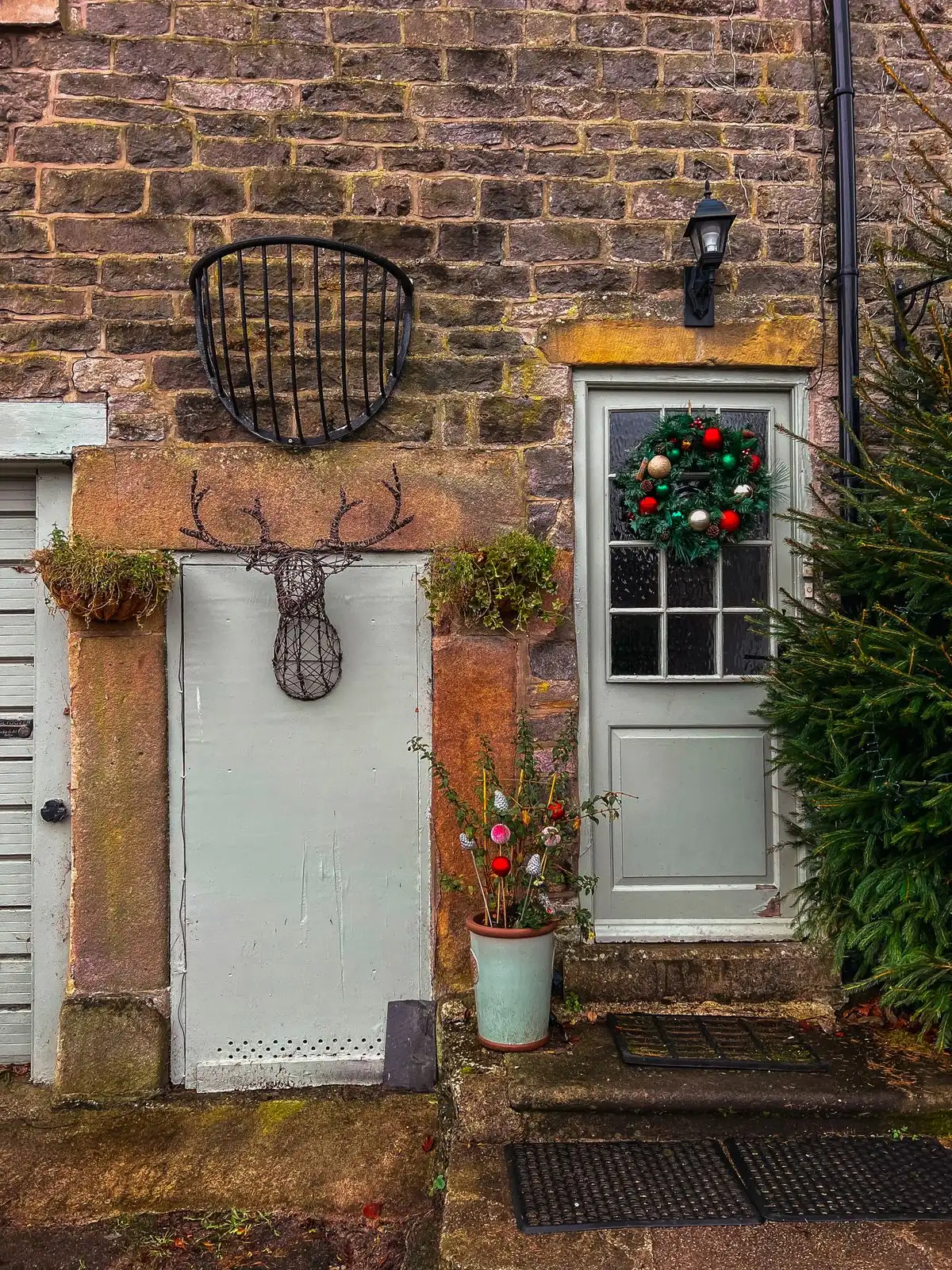
A wreath is the porch’s anchor, so it takes the worst of the weather — and that’s why the material matters more than the style here. An outdoor-rated artificial wreath (labeled UV-resistant or “for outdoor use”) looks identical to fresh for years, doesn’t shed into the doorway, and survives driving rain that would turn a fresh balsam wreath brown by New Year. Twenty-four inches is the right size for a standard door — big enough to read from the street, small enough not to block the peephole. Choose berries and pinecones attached with wire, not glue: glue lets go in freezing rain, wire doesn’t. For a covered porch, a fresh wreath is still worth it for the scent, and we’ll cover how to keep one alive in idea 12.
| Wreath size | Best door | Street view | Typical cost |
|---|---|---|---|
| 18-inch | Narrow entries, apartment doors | Subtle up close only | $15–$30 |
| 20-inch | Doors with sidelights | Clear at the walkway | $20–$40 |
| 24-inch | Standard 36-inch front door | Reads from the street | $25–$60 |
| 30-inch | Double doors, tall entries | Statement scale | $40–$80 |
As an Amazon Associate, Herpickery earns from qualifying purchases.

- Pre-lit with 50 clear LEDs on a built-in timer — hang once, it runs itself
- Pinecones and red berries wired on, not glued — glue fails in freezing rain
- 160-tip faux spruce holds color all season; no shedding into the doorway
2. Hang everything without drilling a single hole
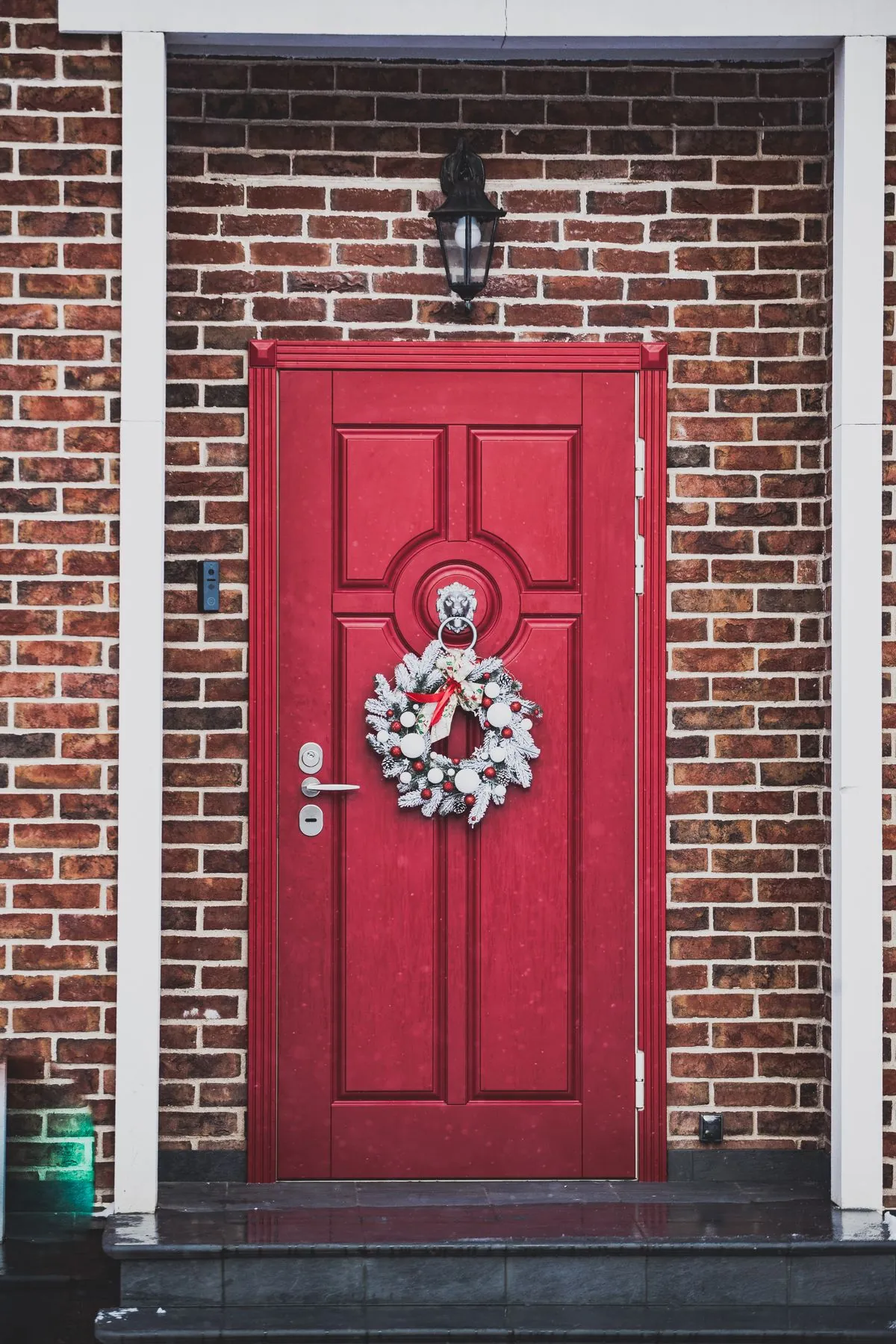
The fastest way to ruin a December porch is a drill bit in a wet doorframe — and the fastest way to lose a decoration is trusting indoor tape outside. Use three tools instead. A metal over-the-door wreath hanger carries any wreath up to about 20 pounds with zero contact adhesive. Outdoor-rated Command hooks (the water-resistant ones, usually black) hold garland ends, light strings, and small signs on siding and trim; press them on a dry, above-freezing day and they’ll survive the season. For glass doors and sidelights, heavy-duty suction hooks with a dab of petroleum jelly on the cup hold better than any adhesive in wet weather. None of these leave a mark, which matters when the doorframe is painted wood that swells in winter.
| Tool | Holds up to | Best surface | Typical cost |
|---|---|---|---|
| Over-the-door metal hanger | 20 lbs | Door top, zero adhesive | $8–$15 |
| Outdoor-rated Command hooks | About 5 lbs | Siding, painted trim | $10–$15 per pack |
| Heavy-duty suction hooks | 5–10 lbs with jelly | Glass doors, sidelights | $8–$20 |
| Florist wire and zip ties | Reinforcement layer | Any hook or railing | About $5 total |
3. Wrap the door frame in outdoor-rated garland
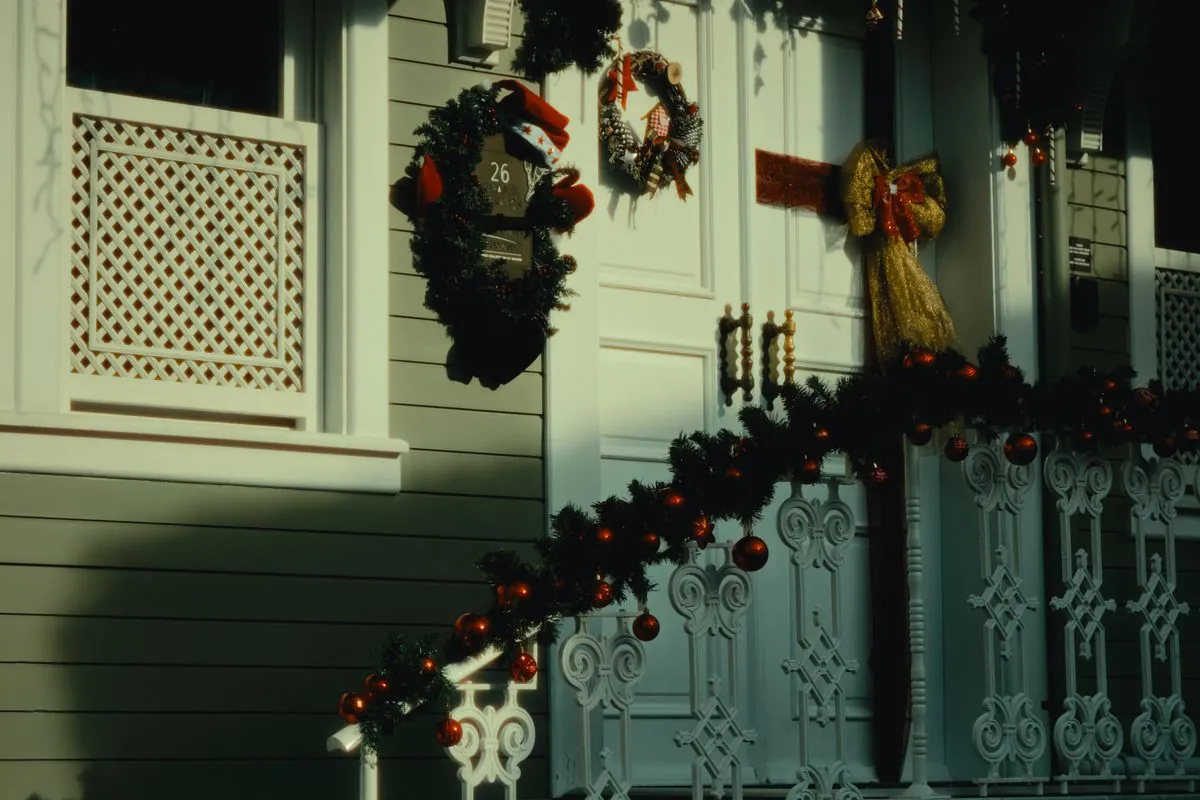
Garland around the door frame is the single highest-impact porch move after the wreath — it turns a door into an entrance. The weather decision is the same as with wreaths: PE plastic greenery (the kind with molded, not cut, needles) is the only garland that shrugs off a month of rain on an exposed frame; look for “outdoor” or “UV” on the listing, because most cheap garland is indoor-only and fades fast. Covered porches can use fresh cedar or pine, which smells incredible for two to three weeks in cold air. Whatever the material, secure it with the outdoor Command hooks from idea 2 every 18 inches or so — garland fails in wind by peeling away at the ends first, so anchor the top corners hardest.
| Spot | Garland length | Anchor spacing | Typical cost |
|---|---|---|---|
| 36-inch door frame | 18–22 ft | Every 18 in, corners tightest | $25–$60 |
| Railing, per 10 ft run | 10–12 ft | Every 18 in | $25–$55 |
| Column wrap, 8 ft | 8–9 ft | Every 18 in | $25–$50 |
| Full arch or surround | 24–30 ft | Every 18 in | $50–$120 |
4. Choose string lights with an IP44 rating or better
“Outdoor” on a light box is not a standard — IP44 is. The IP code tells you exactly what weather the string survives: IP44 means rain-safe from any direction, IP65 means hose-safe. Anything lower stays inside. The second spec to look for is a timer, which turns a nightly chore into a non-event: on at dusk, off six hours later, every day, in the rain, without you touching a wet switch. Warm white (2700K–3000K) is the correct color for a porch — the blue-white 6000K ones read as hardware store. One 33-foot string wraps most door frames, two columns, and half a railing; 100-foot runs handle porch ceilings and full elevations without joins — either way it beats buying specialty lengths for each spot.
| Spec | What it means | Where to use it |
|---|---|---|
| IP44 | Rain-safe from any direction | Exposed walls, steps, greenery |
| IP65 | Survives jets of water | Low spots where snow piles up |
| 2700K–3000K warm white | Home glow, not hardware store | All porch lighting |
| Built-in timer | On at dusk, off 6 hours later | Every string, no exceptions |
| 33 ft / 100 ft lengths | One frame / full elevation | Match run length, skip joins |
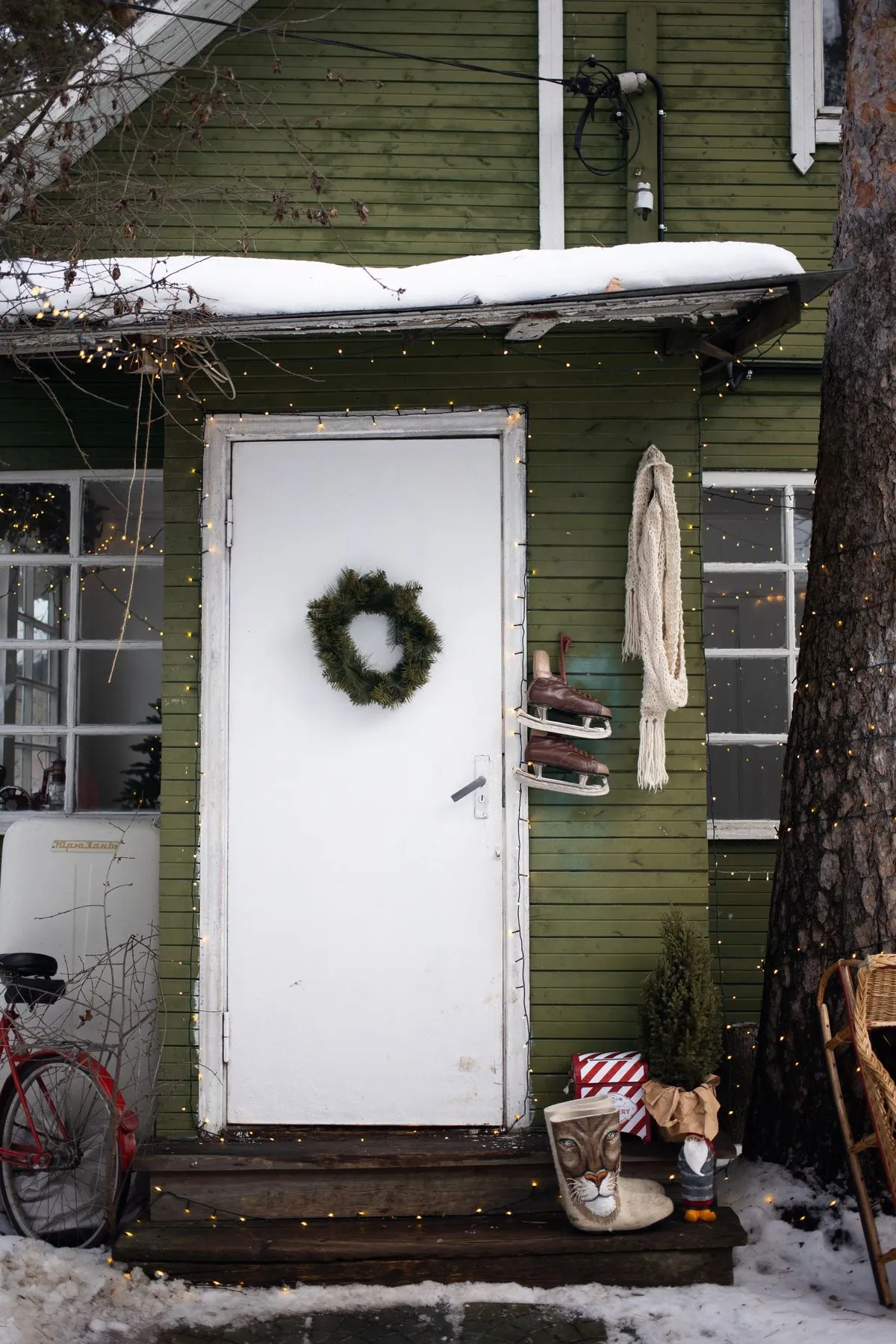
As an Amazon Associate, Herpickery earns from qualifying purchases.

- 102 feet, 30 shatterproof bulbs — columns, railing, and eaves in one run
- Solar + waterproof: no outlet hunt, no extension cords across wet steps
- Remote with dimmer, 3 modes, and timer; charges last 20+ hours
5. Line the steps with lanterns on timers
Lanterns solve three porch problems at once: they light the steps (the number-one safety upgrade), they look intentional in daylight because they’re objects, not just glow, and with flameless timer candles inside they run themselves all season. Choose metal or weather-resistant resin lanterns — glass panels are fine outdoors; it’s the frames that rust or peel that look bad by spring. Group them at two heights — one at the base of the steps, one on the landing — a matched pair on narrow steps, three if the entrance is wide, and put a 5-hour timer candle in each so the porch lights itself at the same moment every evening. A candle in each window or beside the door continues the line for pennies.
| Entrance | Lantern count | Placement | Typical cost |
|---|---|---|---|
| Narrow steps | 2, matched pair | One at base, one on landing | $30–$80 per pair |
| Wide entrance | 3, odd grouping | Two heights, staggered | $45–$120 per set |
| Windows or doorway | 1 per spot | Eye or knee level | $15–$40 each |
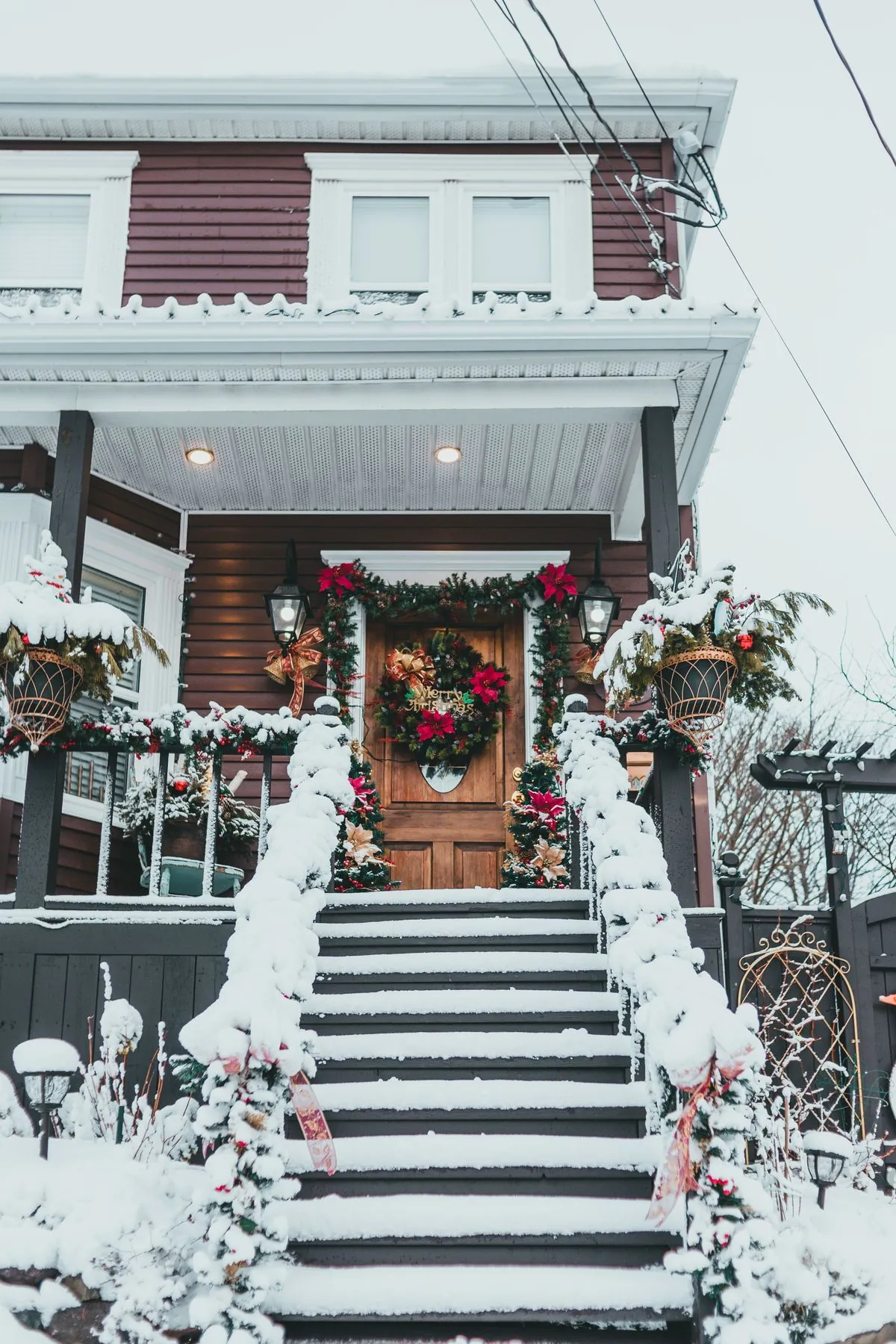
As an Amazon Associate, Herpickery earns from qualifying purchases.

- Powder-coated metal, no glass panels — nothing to crack or rust through a wet month
- Timer LED candles included: soft flicker, no open flame near guests
- Two sizes give you the height rule for free: one on the step, one on the landing
6. Fill two urns with greens that never drop needles
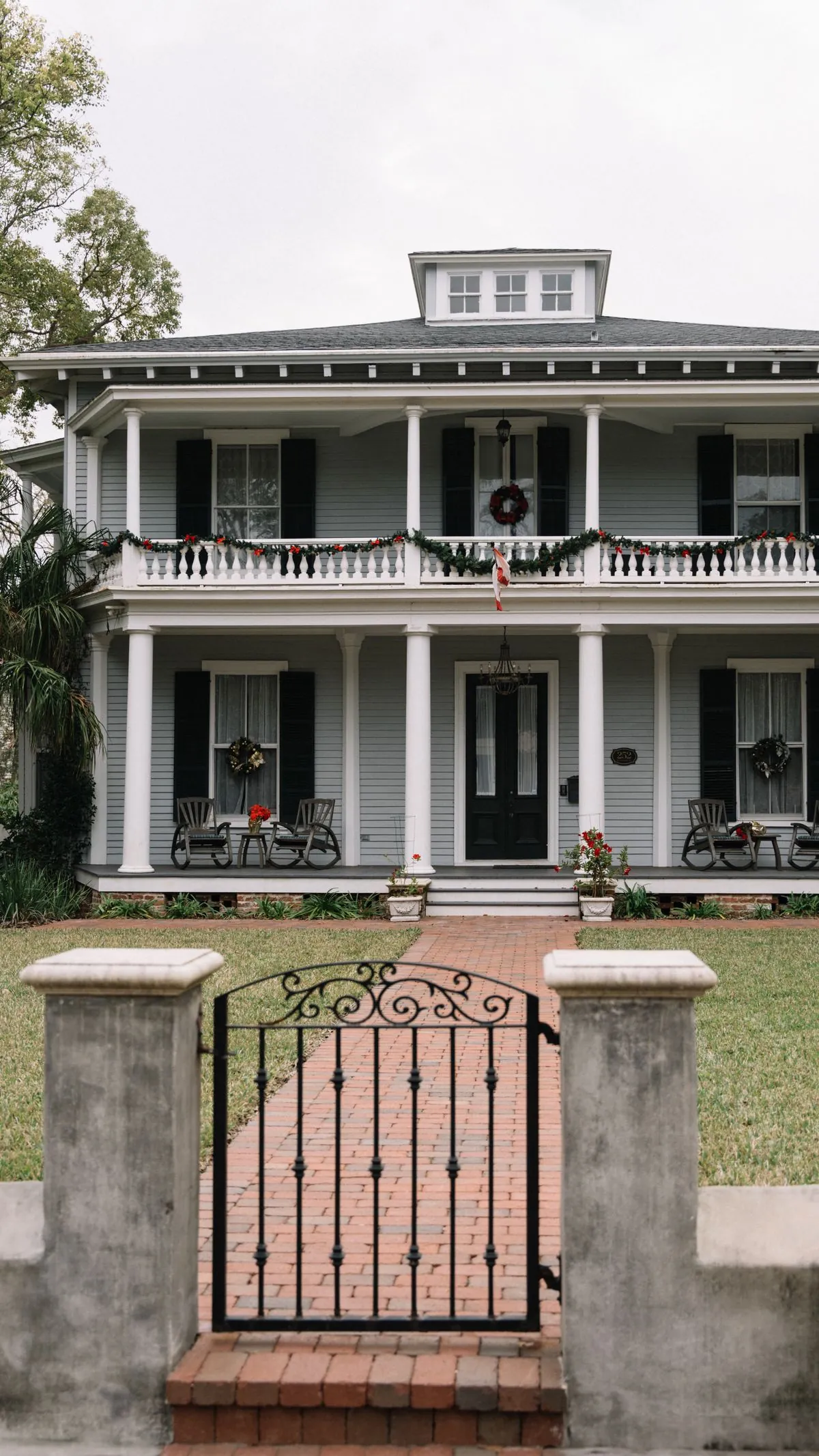
Framing the door with two matching urns or planters is the trick that makes small porches look architecturally finished — symmetry does the work, so even inexpensive pots read as design. Fill them with faux evergreen stems (the PE-plastic kind again), one bundle of red twig dogwood or magnolia branches for height, and a few outdoor ornaments pushed deep into the greenery so the wind can’t pop them out. The branches are the part everyone gets wrong: they need to be wired to the pot’s rim or stuck into floral foam soaked in water, because an unanchored bundle is a street decoration by Thursday. Two urns, one bundle each — this idea costs less than most wreaths and carries the whole entrance.
7. Layer a coir doormat over a flat-weave rug
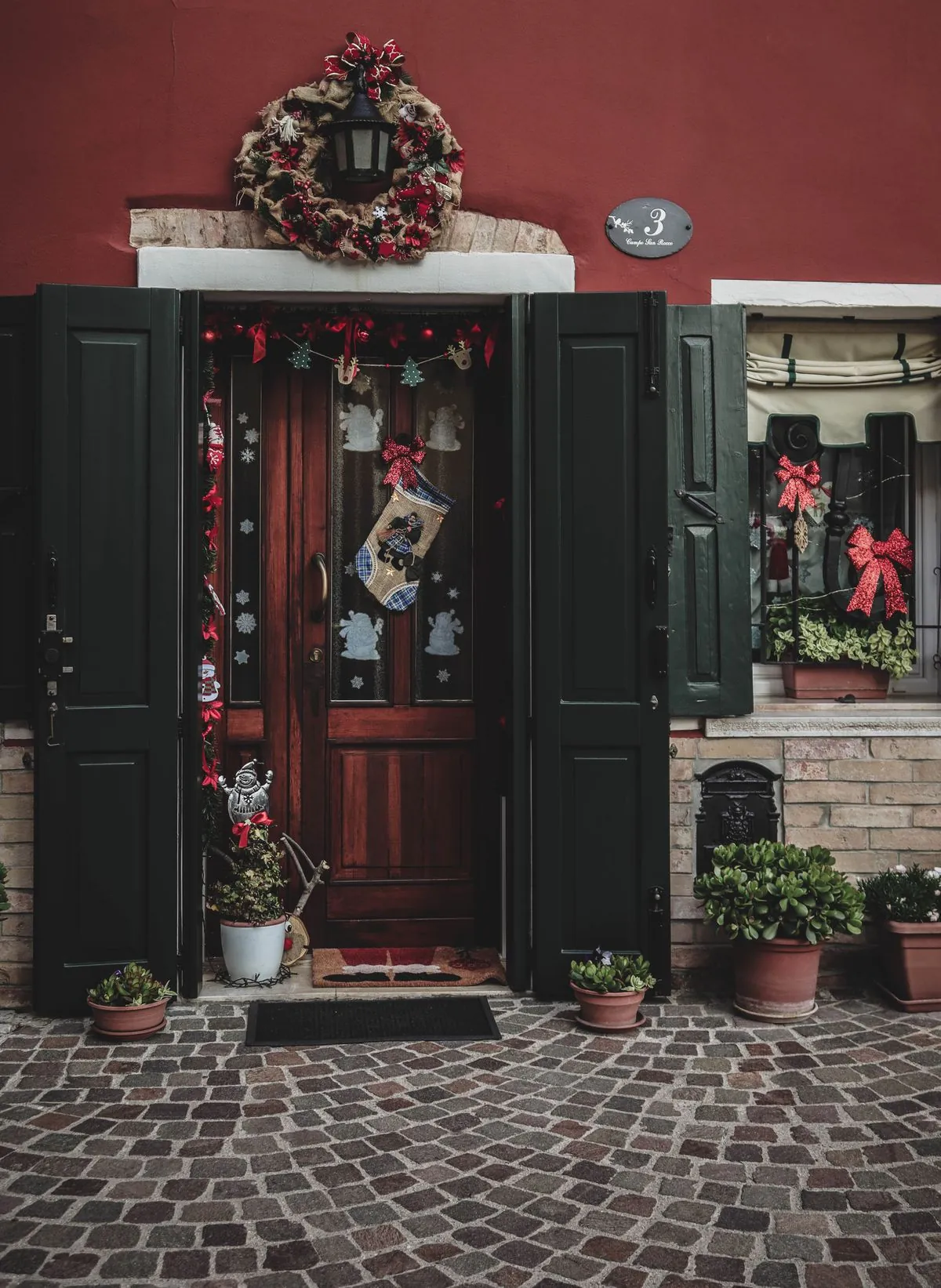
The doormat is the one porch item every single guest steps on, and it’s where weather shows first. The layered look — a flat-weave outdoor rug underneath, a coir (hairy natural fiber) mat on top — costs about the same as one decorative mat and survives rain far better, because the coir sheds water and dries fast while the rug underneath keeps mud off the actual porch floor. Pick the rug in a dark color with a simple border pattern; darker weaves hide a month of slush. Skip anything with a rubber foam backing that isn’t labeled outdoor — it traps water underneath and grows that gray mildew ring by mid-December. Add a second printed mat on top at Christmas if you like the stacked “Merry Christmas” look; coir takes the wear so the printed one stays legible.
8. Build a gift stack that can sit out all month
A stack of gift boxes beside the door is the most borrowed porch idea on Pinterest, and the version that survives rain costs nothing extra to build: wrap empty plastic storage boxes and sealed foam coolers instead of actual cardboard. Cardboard wicks water in one wet night and blooms brown stains you can’t unwind; plastic boxes wipe clean and can be rewrapped in a different paper next year. Use outdoor ribbon (polyester or velvet over poly — real velvet slumps when wet), skip paper bows entirely, and stack three boxes in two orientations with the smallest on top. If your porch is covered and dry, real kraft paper is fine and looks great — the zone rule from the top of this article decides which version you build.
| Box type | Survives rain | Bow to use | Reusable |
|---|---|---|---|
| Cardboard box | One wet night, no | None survives | No, stains set in |
| Plastic storage box | All season | Poly ribbon, no paper bows | Yes, rewrap yearly |
| Sealed foam cooler | All season | Poly ribbon | Yes |
| Kraft paper wrap | Covered porches only | Paper bows fine | Recycle after |
9. Dress a bench or crate in one weatherproof vignette
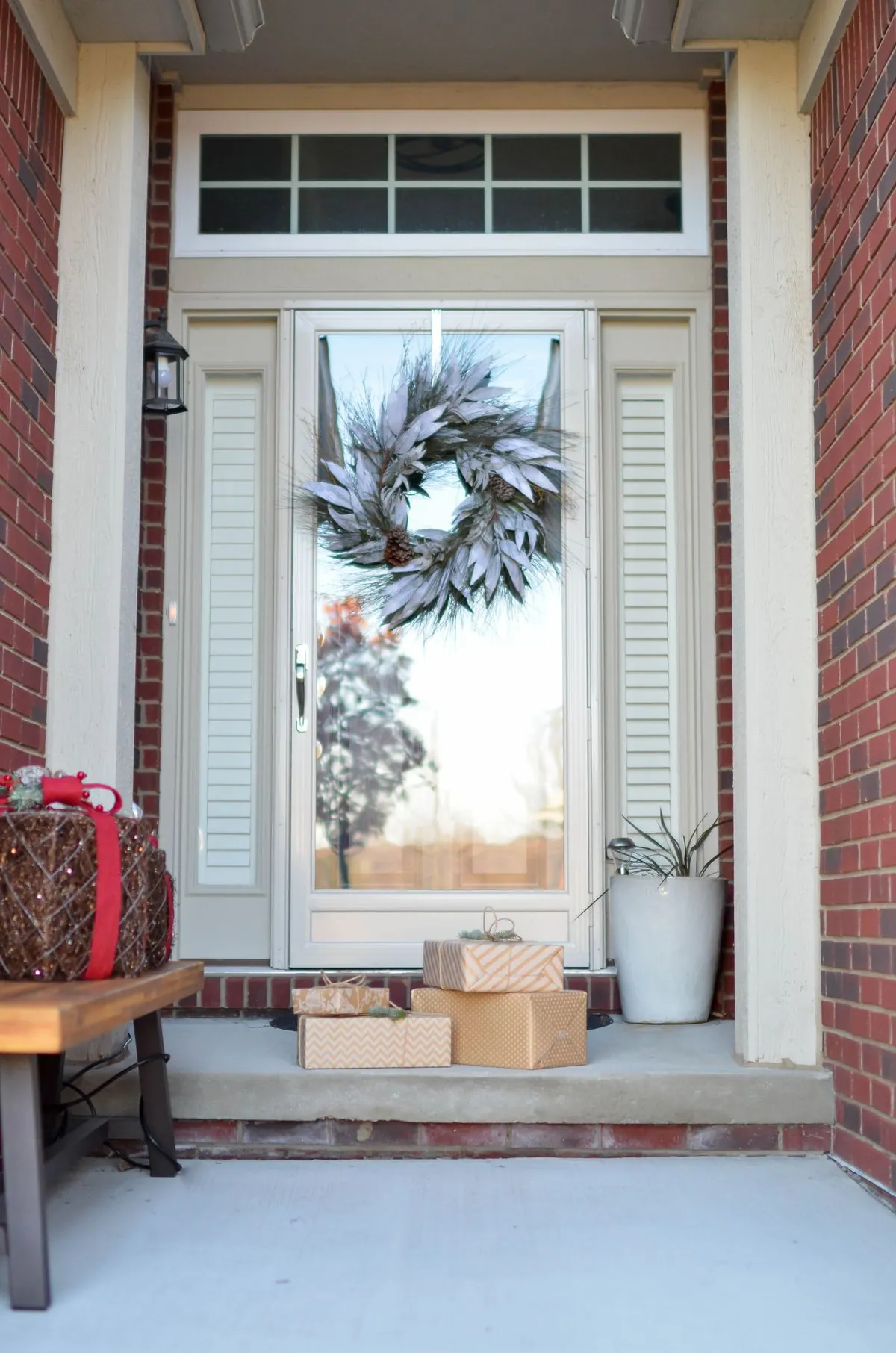
If the porch has a bench, an old chair, or room for one wooden crate, that’s your “styled moment” — and on a covered porch, one vignette carries more charm than a dozen scattered items. The formula that works from the street: something to sit on the surface (a lantern from idea 5 or a potted mini tree), something hanging off the edge (a plaid outdoor throw that you accept will get damp, or better, a weatherproof blanket you don’t mind washing), and something on the ground beneath (the gift stack or a galvanized bucket of greens). Three objects, one corner. An uncovered porch wants the plastic-and-metal version only — crate, lantern, bucket — because fabric left exposed overnight in rain is a wet rag by morning, no matter how good it looked at 5 p.m.
10. Light the path, not just the porch
The porch ends where the walkway begins, and a glowing door above a dark path looks unfinished from the street — plus icy walkways in the dark are the actual hazard of the season. Two weatherproof options, in order of effort: solar path lights (cheapest, zero wiring, weaker glow — buy 4–6 and put them every 3 feet along the walk) or plastic luminaria bags with LED tea lights (the classic paper-bag look, but in the plastic outdoor-rated version that doesn’t turn to pulp in rain). Weight the luminarias with a cup of sand and line them on dry days only. Either way, the light should reach the sidewalk: guests judge a house by how easy it is to arrive at, and a lit path doubles the impact of everything you hung on the door.
| Option | How many and where | Brightness | Typical cost |
|---|---|---|---|
| Solar path lights | 4–6 lights, every 3 ft | Weaker glow, zero wiring | $20–$40 per set |
| Plastic luminarias | Line on dry days, sand weight | Soft classic bag glow | $15–$30 per dozen |
11. Wire everything down before the first storm
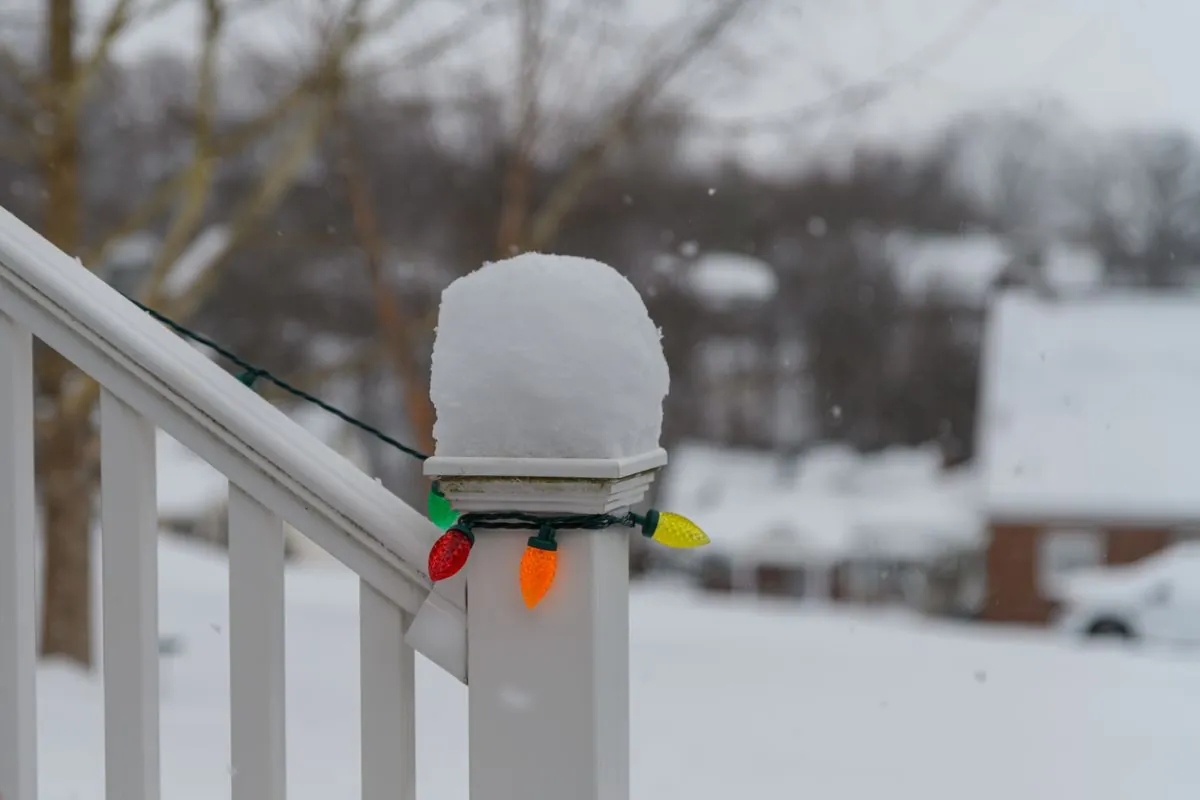
Wind, not water, is what actually destroys porch decor, and the fix costs about $5: a spool of green florist wire and a bag of zip ties. Wire wreaths to their hangers (one loop through the frame, twisted tight at the back), zip-tie garland to hooks and railings where hooks alone would let it swing, and wire ornament stems into urn greenery so they can’t vibrate loose. Check the manufacturer wind claim on anything inflatable — most consumer inflatables are fine to about 20 mph and must come down or be anchored with the included tethers and sandbags beyond that. Ten minutes with wire after hanging everything saves you from collecting your decorations off the neighbor’s lawn, which is a real December tradition in my neighborhood.
| Item | Fix | Wind limit | Cost |
|---|---|---|---|
| Wreath | One wire loop, twisted tight at back | All storms | Wire, about $5 |
| Garland ends | Zip-tie to hooks and railings | Peels at ends first | Ties, a few dollars |
| Ornament stems in urns | Wire into the greenery | Stops vibration loosening | Same wire spool |
| Inflatables | Tethers and sandbags, or take down | Most rated to 20 mph | Included in box |
12. Keep any fresh greenery alive with two cheap moves
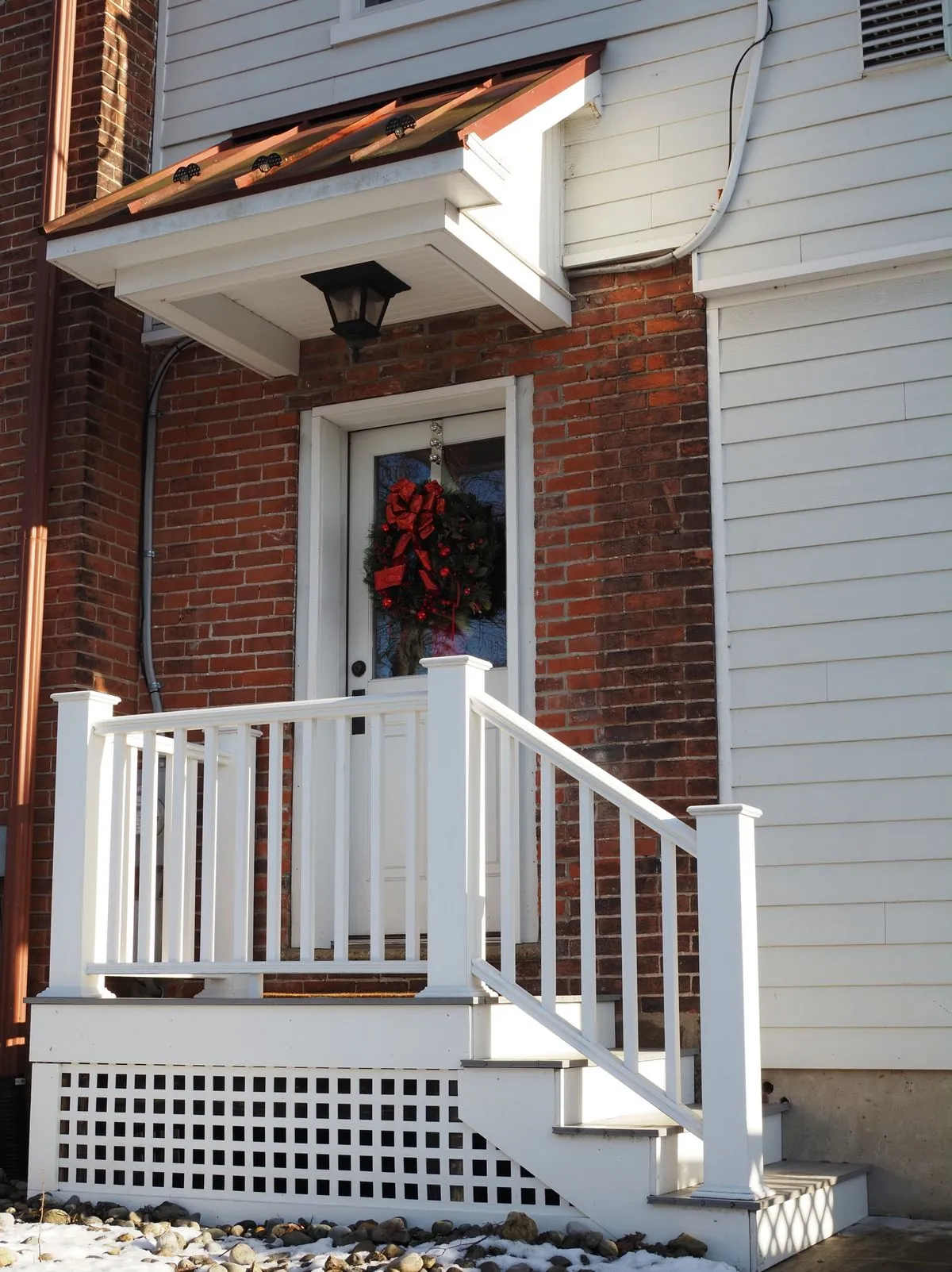
Fresh cedar, pine, and magnolia genuinely outperform faux on a covered porch — the scent alone is worth it — but they die in predictable ways, and both are preventable for under $10. Move one: anti-desiccant spray (wilt-proofing, sold at any garden center) sprayed on fresh wreaths and garland before hanging; it seals the needles and can double their good-looking life outdoors. Move two: keep cut stems in water — floral water tubes for anything in an arrangement, a soaked floral-foam brick in the urns, and for standing greenery, a bucket of water refilled weekly. In freezing climates fresh greenery outside lasts two to three weeks; mist it on days above freezing and it stretches toward four. Inside the covered zone, keep fresh away from the door’s heat blast and it rewards you every time someone walks in.
| Setup | Expected good-looking life | Fix and cost |
|---|---|---|
| Fresh, fully exposed in sleet | 1–2 weeks | Replace mid-season, $20–$40 |
| Fresh on covered porch | 2–3 weeks | Soaked foam brick, $5–$10 |
| Fresh plus anti-desiccant spray | Toward 4 weeks with misting | Spray, $8–$12 |
| PE plastic greenery | Full season, for years | One purchase, $20–$60 |
13. Pick a three-color palette that reads in the dark
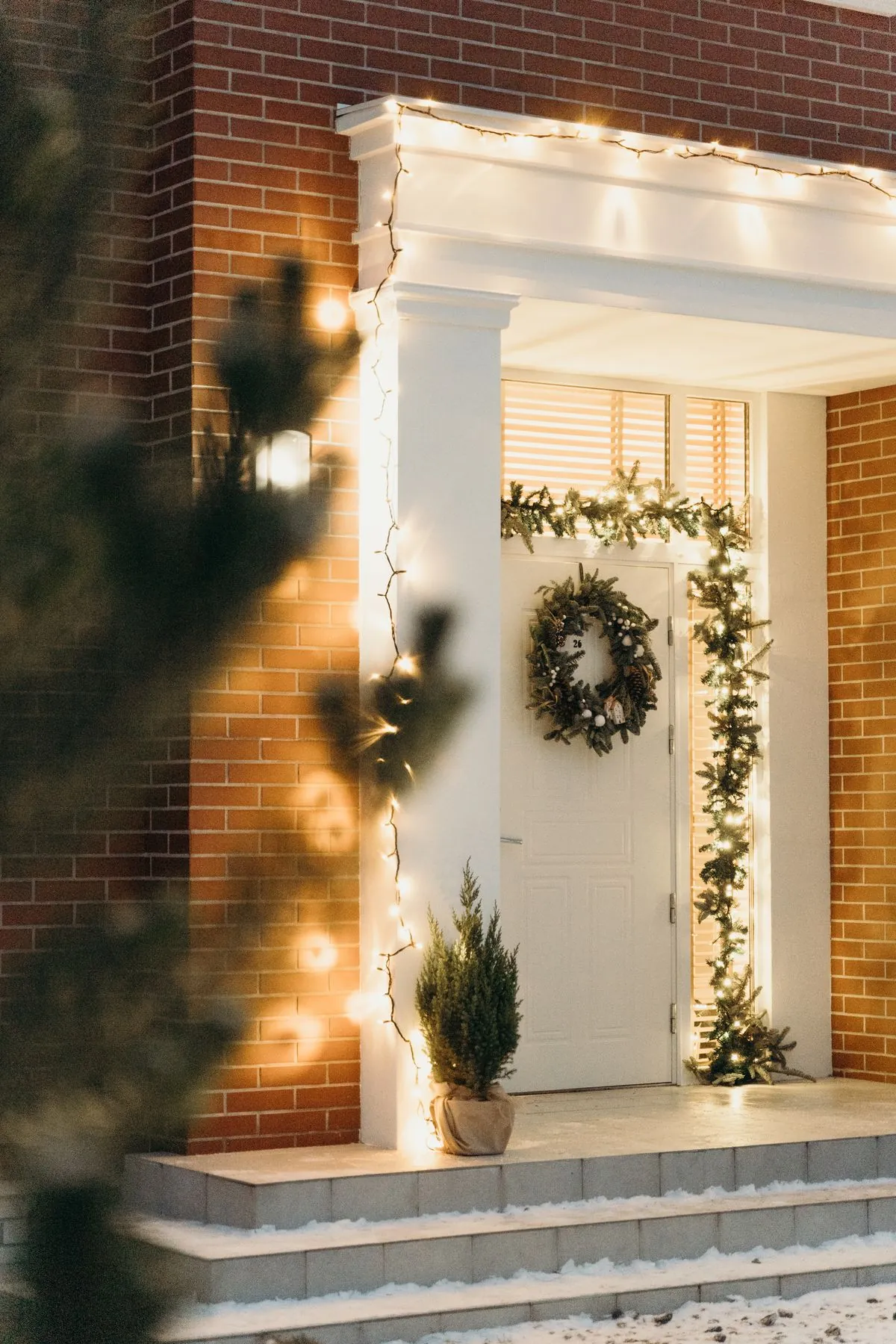
Weather darkens everything it touches, and porches are seen mostly at dusk — so palette choices that look subtle indoors disappear outside. The rule that holds up: one deep base, one metallic, one bright. Deep green and near-black bases (charcoal planters, dark doors) make the other two pop; the metallic — brass, copper, or gold — is what catches porch light and lantern glow; the bright is your accent (classic red, berry, or plaid) used in exactly two or three places, not ten. Compare that to a porch in pastels or a four-color mix: in rain and low light it turns to visual mush, which is why the neighbor’s red-bow-and-lantern porch photographs better than your twelve-color version even if yours cost twice as much. Two colors carry a small porch; three is the maximum that still reads from the street.
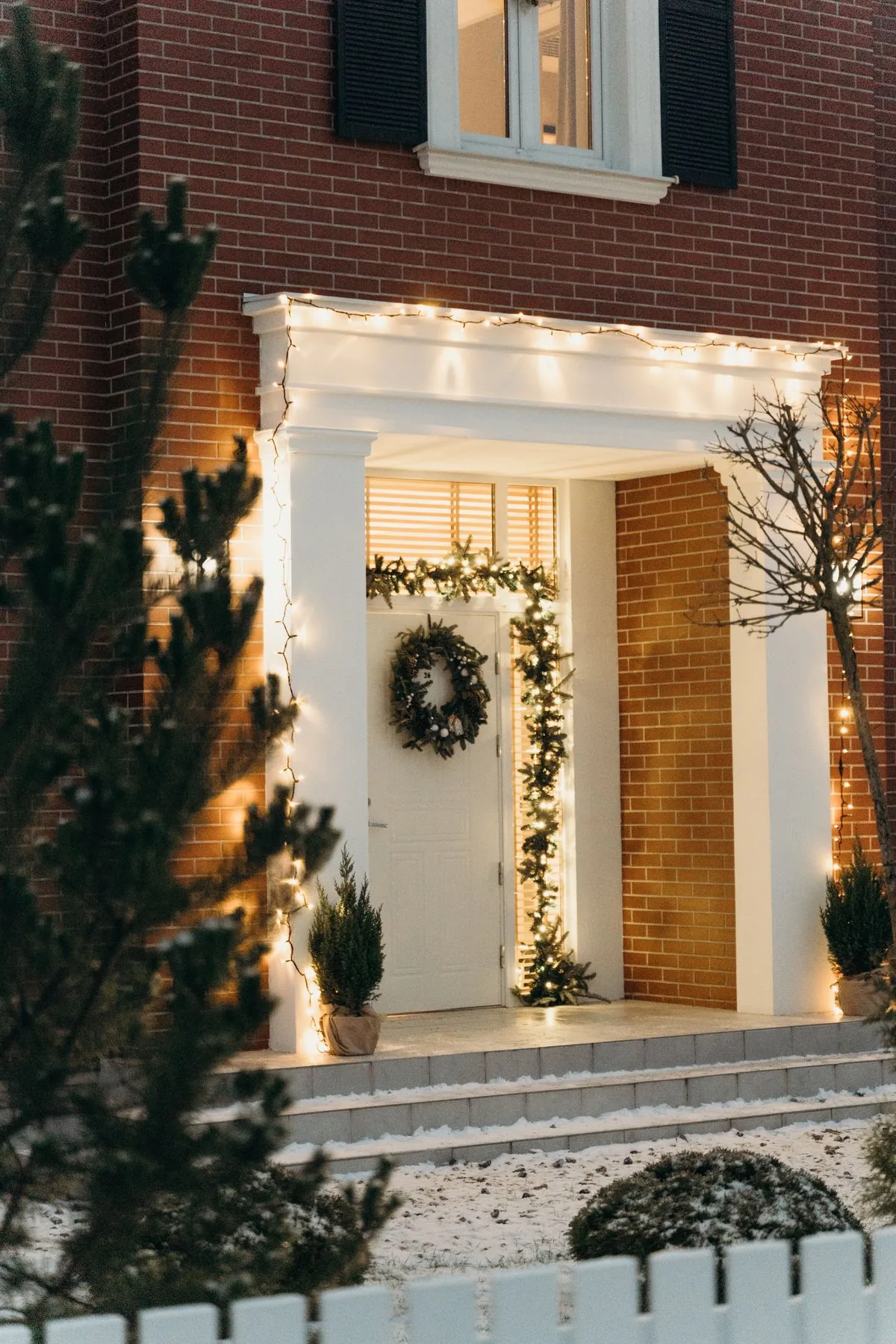
14. Give the porch ceiling one string of its own
Nobody decorates the porch ceiling, which is why it’s the cheapest way to look like you spent real money. One warm-white string (the same IP44 lights from idea 4) run in parallel lines across a covered porch ceiling — or swagged in gentle scallops from the outer beam — turns the whole porch into a room after dark, and it does it without occupying a single inch of floor the snow needs. Staple-free attachment: screw in small cup hooks every 2 feet and zip-tie the string to them, so January takedown takes five minutes and the ceiling keeps its paint. In daylight the string is nearly invisible; at night it’s the difference between a decorated door and a decorated porch, and the difference is about $15.
15. Do the twenty-minute version on a dark evening
It’s December 20-something, guests arrive tomorrow, and the porch is bare. Twenty minutes and one store run if you have a wreath: hang the wreath with an over-the-door hanger (two minutes), lay the coir mat flat and sweep it once (three minutes), push two lanterns with timer candles to either side of the door (five minutes), and wrap one string of timer lights around whatever’s nearest the door — column, railing, or the doorframe itself with outdoor hooks (ten minutes). Set the timers, turn off the porch ceiling light, and look back from the sidewalk. That’s the whole effect; the other thirteen ideas are what you add when December isn’t actively happening to you.
| Step | Time | What you need |
|---|---|---|
| Hang wreath on over-door hanger | 2 min | Metal hanger |
| Lay and sweep coir mat | 3 min | Coir mat |
| Place two timer-candle lanterns | 5 min | 2 lanterns, either side of door |
| Wrap one timer light string nearby | 10 min | IP44 string, outdoor hooks |
| Set timers, view from sidewalk | Total 20 min | One store run at most |
What survives the weather — and what doesn’t
| Material / item | Exposed porch (rain hits it) | Covered porch (under a roof) |
|---|---|---|
| PE plastic greenery (wreath, garland) | ✅ All season, UV-rated lasts years | ✅ All season |
| Fresh cedar / pine | ⚠️ 1–2 weeks, browns fast in sleet | ✅ 2–4 weeks with spray + water |
| Wrapped cardboard boxes | ❌ One wet night ruins them | ✅ Fine all season |
| Plastic boxes wrapped | ✅ All season | ✅ All season |
| Fabric bows (real velvet, satin) | ❌ Slump, stain, fade | ✅ Fine; mist-safe |
| Poly outdoor ribbon | ✅ Holds shape in rain | ✅ |
| IP44+ string lights with timer | ✅ Rain-safe all season | ✅ |
| Indoor-only string lights | ❌ Shock and failure risk — never | ⚠️ Only if truly dry |
| Wooden signs, cardboard letters | ❌ Warp and stain | ✅ The covered-zone star |
| Metal / resin lanterns + timer candles | ✅ All season | ✅ |
Three porch budgets, three outcomes
| Budget | What it buys | What the street sees |
|---|---|---|
| Under $40 — the frame | 24″ weatherproof wreath, over-door hanger, coir mat, two timer LED candles | A deliberate, finished entrance — nobody can tell what you skipped |
| Under $120 — the glow | Everything above, plus IP44 timer string lights, two metal lanterns, florist wire and outdoor hooks | The porch that’s lit before you get home, and survives every storm |
| Under $250 — the full picture | Everything above, plus two urns with greens, wrapped plastic gift stack, path lights, ceiling string | The house on the street that people slow down for |
If your porch decorating is really about the arrival of guests rather than the street view, the same weather logic applies indoors — the small-dining-room table plan handles the seating crunch, and the expensive-looking Christmas table handles the moment everyone actually sits down.
Christmas porch decorating: frequently asked questions
How do I keep Christmas porch decorations from getting ruined by rain?
Choose plastic, powder-coated metal, and sealed materials for anything rain can reach, and reserve fabric, fresh greenery, and paper for the covered zone under a roof. Everything electronic should carry an IP44 rating or higher, and everything hangable should be wired or zip-tied to its hook — wind peels decor off before water soaks it. A covered porch can be decorated almost like indoors; an exposed one is a materials test, and this whole article is the cheat sheet.
Do outdoor wreaths need to be covered?
No — an outdoor-rated artificial wreath is built to hang exposed all season; that’s what the UV-resistant labeling means. Fresh wreaths are the ones that want shelter: under a porch roof or awning they last two to four weeks, while fully exposed fresh greenery in freezing rain can brown in under two. If your only hanging spot is exposed and you want fresh, plan on replacing it mid-season or spray it with anti-desiccant first and accept the shorter clock.
What kind of string lights can stay out in the rain?
Anything rated IP44 or higher is rain-safe from any direction — that’s the number to look for on the box, not the word “outdoor.” IP65 goes further and survives jets of water, which matters only if your lights sit low where snow gets shoveled onto them. All outdoor strings should plug into a GFCI-protected outlet, and a built-in timer is the feature that actually gets used every night without fail.
How do I hang porch decorations without drilling?
Three tools cover every situation: a metal over-the-door wreath hanger for the door itself, outdoor-rated Command hooks pressed onto siding and trim on a dry day, and suction cups with a smear of petroleum jelly for glass. None of the three leaves marks, all three survive a season of rain, and all three come off in minutes in January — which is also why they’re kinder to rental porches than any screw ever will be.
How long does fresh garland last on a porch?
On a covered porch in cold weather, two to three weeks, stretching toward four with anti-desiccant spray and weekly misting on days above freezing. Fully exposed, expect a week to ten days before it starts dropping needles on the doorstep. If your garland needs to survive the whole month of December outside, that’s the case for PE plastic garland — the fresh version is a covered-porch luxury, not an exposed-porch plan.
How early is too early to decorate the porch for Christmas?
Weather-wise, early is actually safer: hang weatherproof pieces in mid-November and they only improve as the lights get more dramatic against dark evenings. The social convention most people follow in the US is after Thanksgiving; the practical convention is whenever the first hard freeze locks in, because installing outdoor hooks and wire on a warm dry day beats doing it in sleet. So: materials can go up early, and if anyone judges, they’ll be back in January asking where you store it all.
The 12-point weatherproof Christmas porch checklist
Screenshot or pin this — it’s the whole porch in one list:
- ☐ Wreath is outdoor-rated, wired berries, 24″
- ☐ Over-the-door hanger — zero holes in the door
- ☐ Garland is PE plastic if rain can reach it
- ☐ Hooks every 18″ along the garland, corners tightest
- ☐ All string lights IP44 or higher, warm white
- ☐ Every light and candle on a timer
- ☐ Lanterns in odd numbers, two heights, steps lit
- ☐ Coir mat layered over a dark flat-weave rug
- ☐ Gift stack is wrapped plastic, poly ribbon, no paper bows
- ☐ Everything wired or zip-tied before the first storm
- ☐ Three-color palette: deep base, metallic, one bright
- ☐ Path lit to the sidewalk, not just the door
Last updated on November 13, 2026. All photos via Pexels.
Related reading: the Christmas table that looks expensive, the cozy fall living room on a budget, the Thanksgiving table for small dining rooms, and our full fall decor and cozy home collections.
[…] and centerpieces that can’t wilt. It’s the same weatherproof logic we used for the porch that survives rain, applied to the table that survives the party. If you’re still finishing December, the […]
[…] just aimed at the one meal where the hosts deserve to sit down the most. After dinner, the weatherproof porch guide takes over the rest of the […]
[…] 15 Christmas Porch Decorating Ideas That Survive Rain […]
[…] 15 Christmas Porch Decorating Ideas That Survive Rain […]
[…] the rest of the December house: our porch decorating ideas that survive rain, the Christmas table that looks expensive, and the brunch table you set up the night before. After […]
[…] slices, cinnamon sticks and berries, gathered from the yard (the same trimmings trick we use in our Christmas porch decorating ideas) or from the tree lot’s discard pile. One sprig under the ribbon knot turns plain paper into […]