
Last Thanksgiving I hosted eight people in a dining room that measures roughly ten by eleven feet — the table is a 60-inch rectangle I bought secondhand in college, and there are exactly nine inches between its edge and the radiator. I spent the whole Wednesday before panicking that the room was too small to feel special, and then spent Thursday watching eight adults barely bump elbows once. The room wasn’t the problem. Everything I’d planned for it was: a centerpiece the width of a serving platter, a candelabra meant for a banquet hall, and a serving plan that involved six dishes fighting for the same square footage.
Here’s what I learned that week, and have re-tested at every holiday dinner since: a small dining room doesn’t need fewer decorations. It needs narrower ones. Below are the eighteen table setting ideas that actually work in a small room — what to shrink, what to move off the table entirely, and what to skip — ordered roughly from free to spending money. If it’s already Thursday morning, idea 18 is for you.
Last updated on November 12, 2026 · Written by the Herpickery home team
In this guide: 18 Thanksgiving table setting ideas for small dining rooms
- Measure the room, not the table
- Let a round table work for you
- One narrow runner instead of a centerpiece
- Keep the centerpiece low
- Build a centerpiece from the grocery store
- Two taper candles, not a candelabra
- Mix the plates you already own
- The 30-second napkin knot
- Maple-leaf place cards that double as favors
- Serve family-style from the sideboard
- Move drinks off the table
- Layer the light before guests arrive
- Forage one branch, cut it short
- Edit each place setting to three pieces
- Swap two chairs for a bench
- Give the kids their own table
- Warm metals in threes
- The twenty-minute version
First, the table math every small dining room needs
Every idea below assumes one non-negotiable number: each guest needs about 24 inches of table edge — 30 if you want comfortable elbows — and the centerpiece can occupy no more than a third of the table’s width. That “one-third rule” is the whole game in a small room. Find your table below, note the two limits, and the eighteen ideas will make instant sense.
| Your table | Seats comfortably | Max centerpiece width | Platters on the table? |
|---|---|---|---|
| 36″ round | 3–4 | 6 inches | One, and it’s the turkey |
| 48″ round | 4–5 | 8 inches | Two small ones |
| 60″ × 30″ rectangle | 6 | 10-inch runner | Two, staggered |
| 72″ × 30″ rectangle | 6–8 | 12-inch runner | Three, if plates stack |
If your guest list doesn’t fit the seat count, the fixes come later in this list: a bench (idea 15), a kids’ table (idea 16), or staggering the courses. Don’t solve it by shrinking place settings — that’s how elbows start wars.
1. Measure the room, not the table
The fastest way to ruin a small dining room on Thanksgiving is decorating the table as if the chairs never move. Pull a chair out to where a seated guest actually sits, then walk behind it — you need at least 24 inches of clearance for someone to squeeze past with a casserole. Whatever width remains between the chair backs is your real decorating budget. In my room that number is 31 inches, which instantly killed my candelabra plans and improved the dinner.
| Measurement | Minimum | Comfortable | Why it matters |
|---|---|---|---|
| Behind a pulled-out chair | 24 inches | 30 inches | Squeeze past with a casserole |
| Table edge per guest | 24 inches | 30 inches | Room for plates and elbows |
| Chair-back to chair-back width | 31 inches | 36 inches | Your real decorating budget |
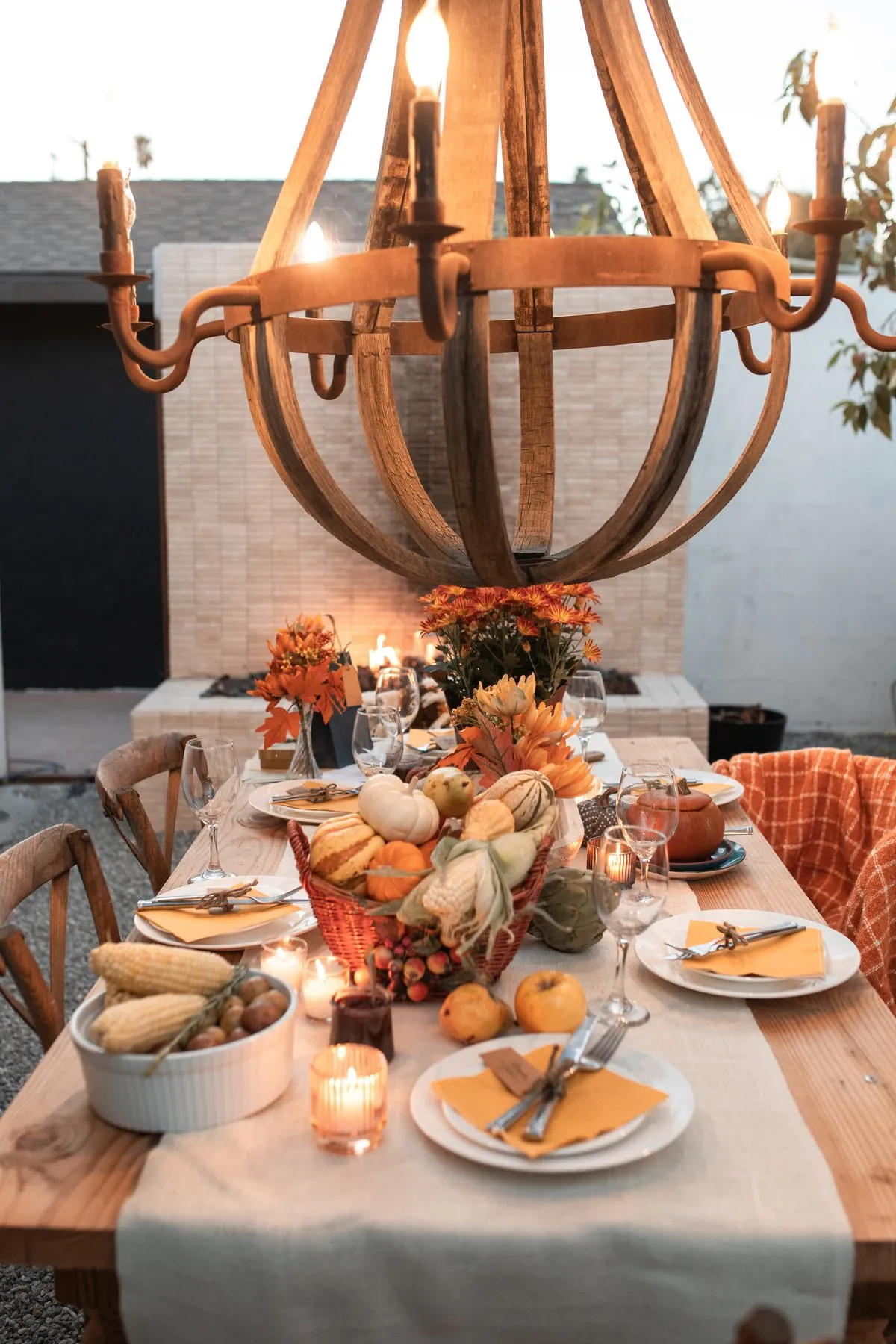
Measure once and write it on your phone: chair-back to chair-back width, table length, and sideboard surface area. Every store decision after that is math, not hope.
2. Let a round table work for you
If you have the choice, a round table beats a rectangle in a small dining room for one practical reason: conversations cross the middle, so eight people talk to eight people instead of shouting down a corridor. Setting it is simpler too. A 48-inch round seats four to five with a single lazy Susan in the center — the single greatest small-table invention ever made — and your centerpiece footprint shrinks to an 8-inch circle. On round tables, skip the runner entirely; a centered round arrangement looks more deliberate than any linen strip.
3. One narrow runner instead of a big centerpiece
A classic table runner is usually 14 to 16 inches wide, and on a 30-inch-deep table that leaves two 7-inch slivers for plates and glasses. In a small room, either buy a runner in the 10–12 inch range or cheat: two overlapping scarves, or a strip of unbleached canvas cut from a fabric remnant. The runner’s job is to define a long, thin line for the good stuff — candles, pumpkins, greenery — so the eye reads “styled” while the plates keep their territory.
| Runner option | Width | Plate space on a 30-inch table | Typical cost |
|---|---|---|---|
| Standard runner | 14-16 inches | Two 7-inch slivers | $10-$25 |
| Small-room runner | 10-12 inches | Full plate zones | $10-$20 |
| Two overlapping scarves | Layered | Full plate zones | $0 (owned) |
| Cut canvas strip | 10-12 inches | Full plate zones | $0-$10 |
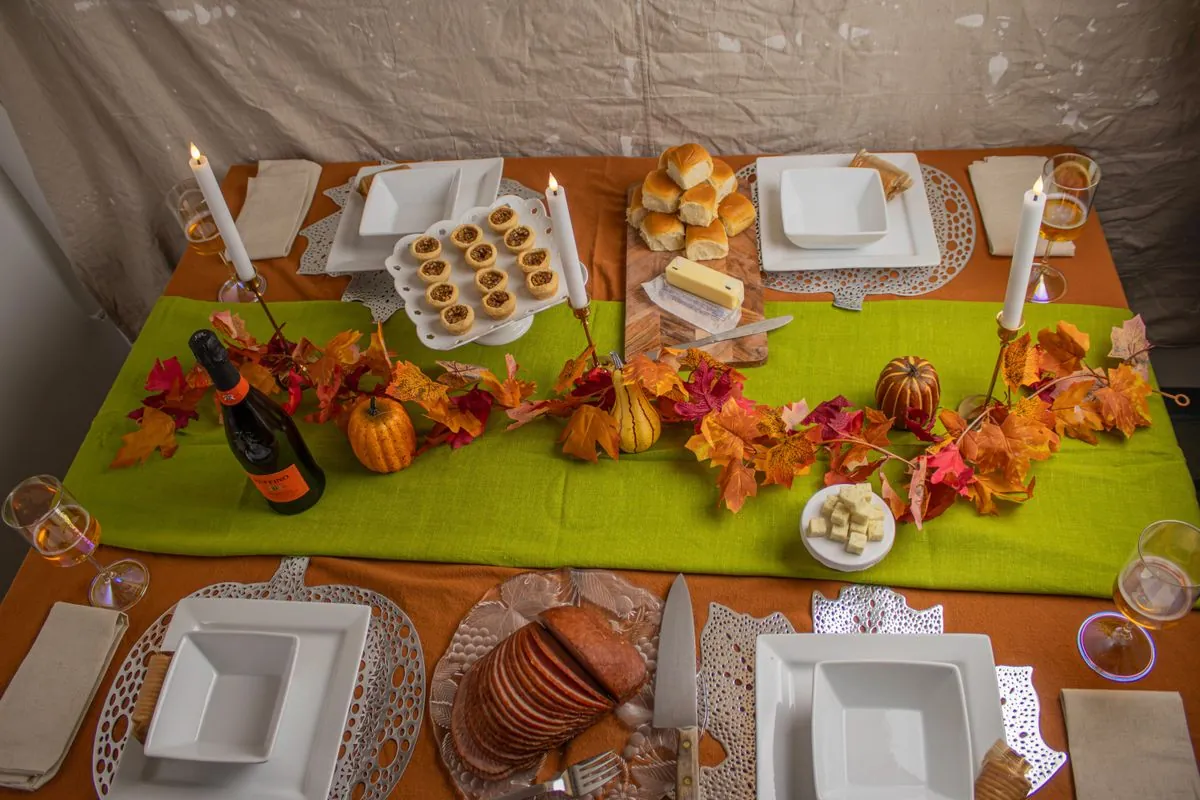
We tested runner widths and fabrics in our fall table runner guide — the short version: 12 inches, cotton, and no fringe in a small room.
4. Keep the centerpiece low
Height is the sneaky killer. A tall centerpiece doesn’t just block faces — it visually fills the room, and in a small dining room the room is already full. Keep arrangement height under 12 inches, or go the opposite way with a few tall, thin stems and nothing in the middle height band. Anything between chin height and eye level gets moved out the moment I catch myself talking to a bouquet instead of a human.
5. Build a centerpiece from the grocery store
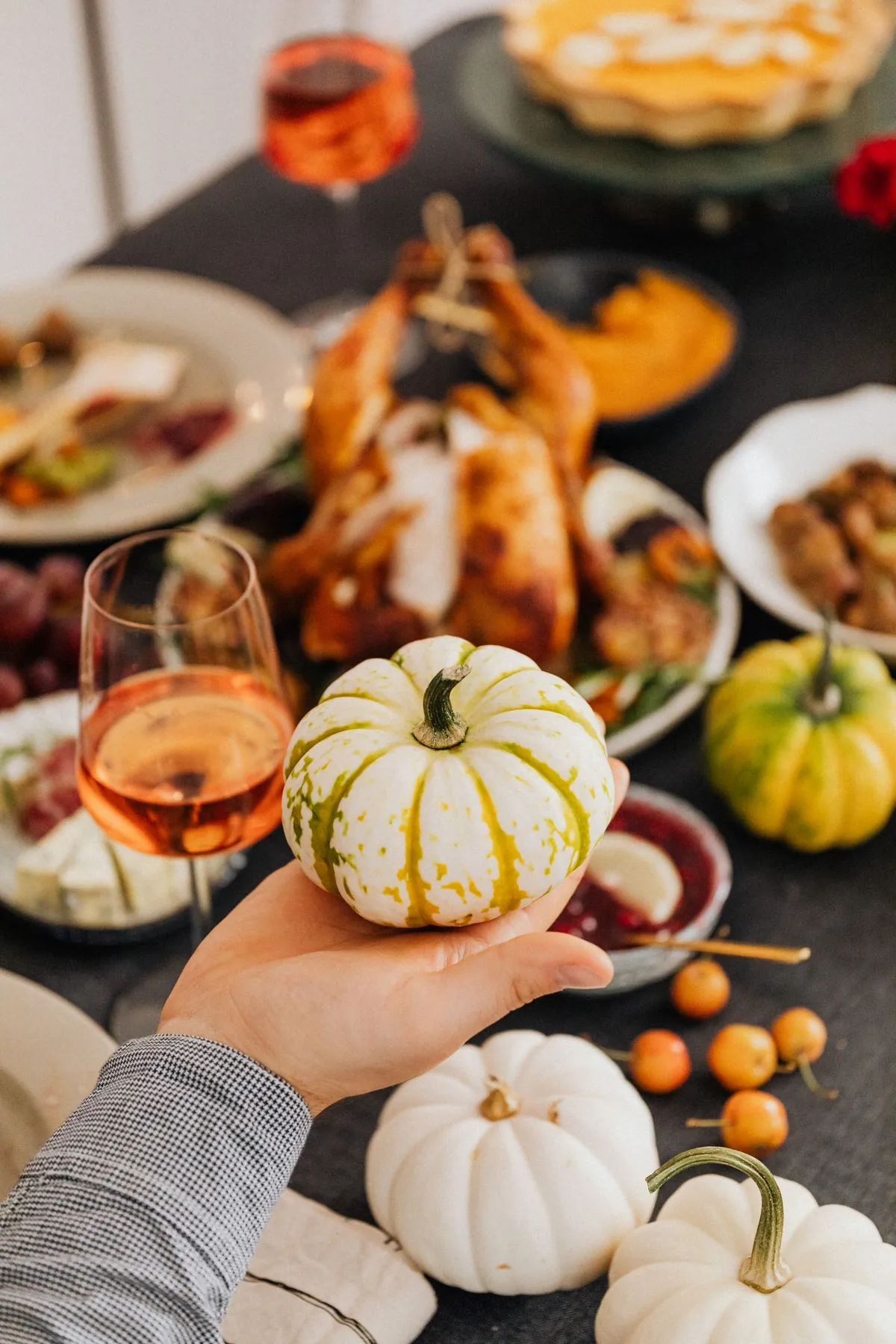
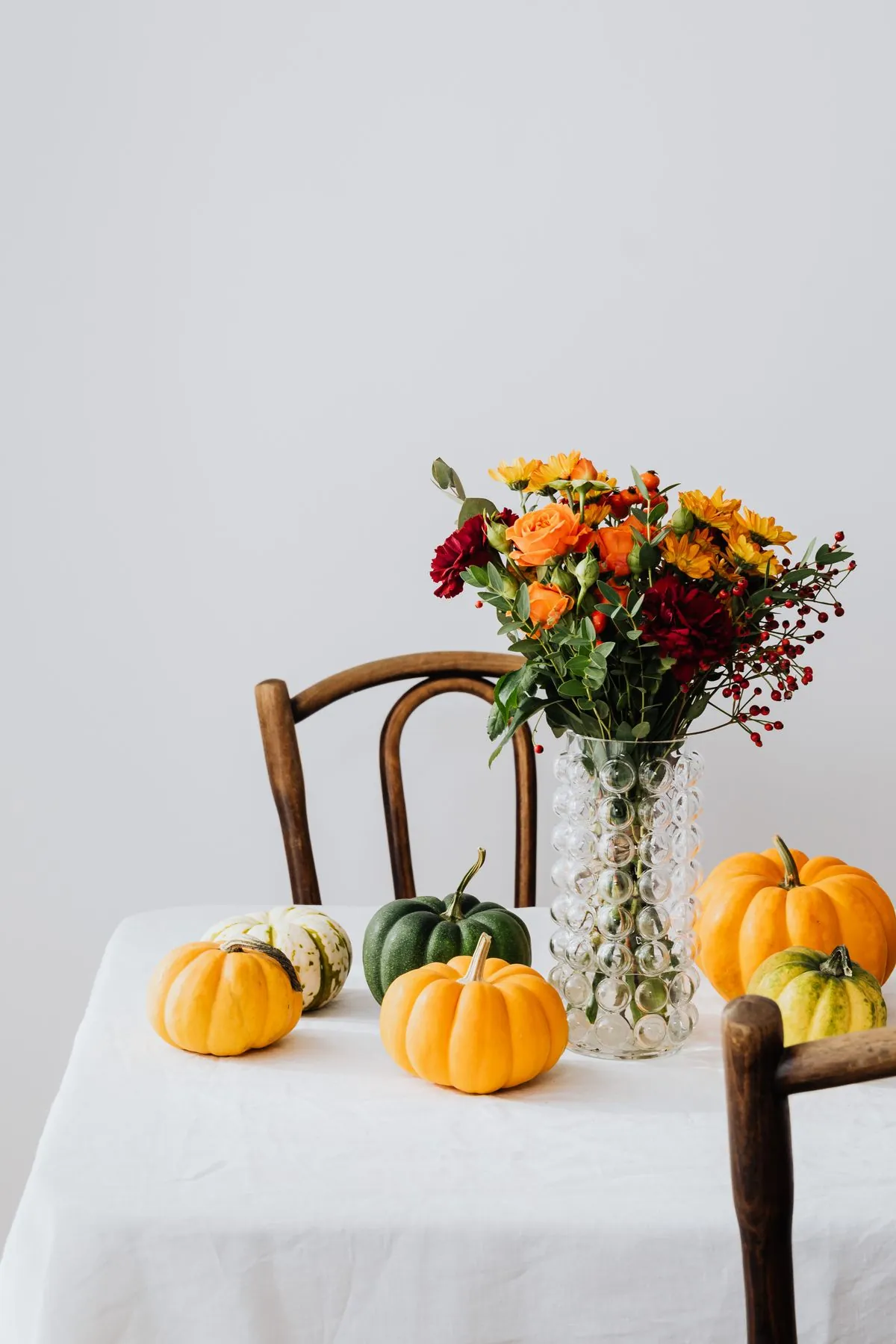
The best small-room centerpiece I ever made cost $14 and fifteen minutes: two bunches of supermarket mums, three mini pumpkins, a jar from the recycling bin. Cluster the flowers low in the jar, line the pumpkins along the runner, done. Store-bought arrangements are built for big buffet tables — huge footprints, huge prices. A small table wants small components in a tight line, which is exactly what the flower bucket and the produce shelf sell you.
| Component | Quantity | Typical cost | Time |
|---|---|---|---|
| Supermarket mums | 2 bunches | $6-$12 | 5 minutes clustered low |
| Mini pumpkins | 3 | $1-$5 | Line along the runner |
| Recycled glass jar | 1 | $0 | Instant vase |
| Whole centerpiece | 6 pieces | $10-$20 | About 15 minutes |
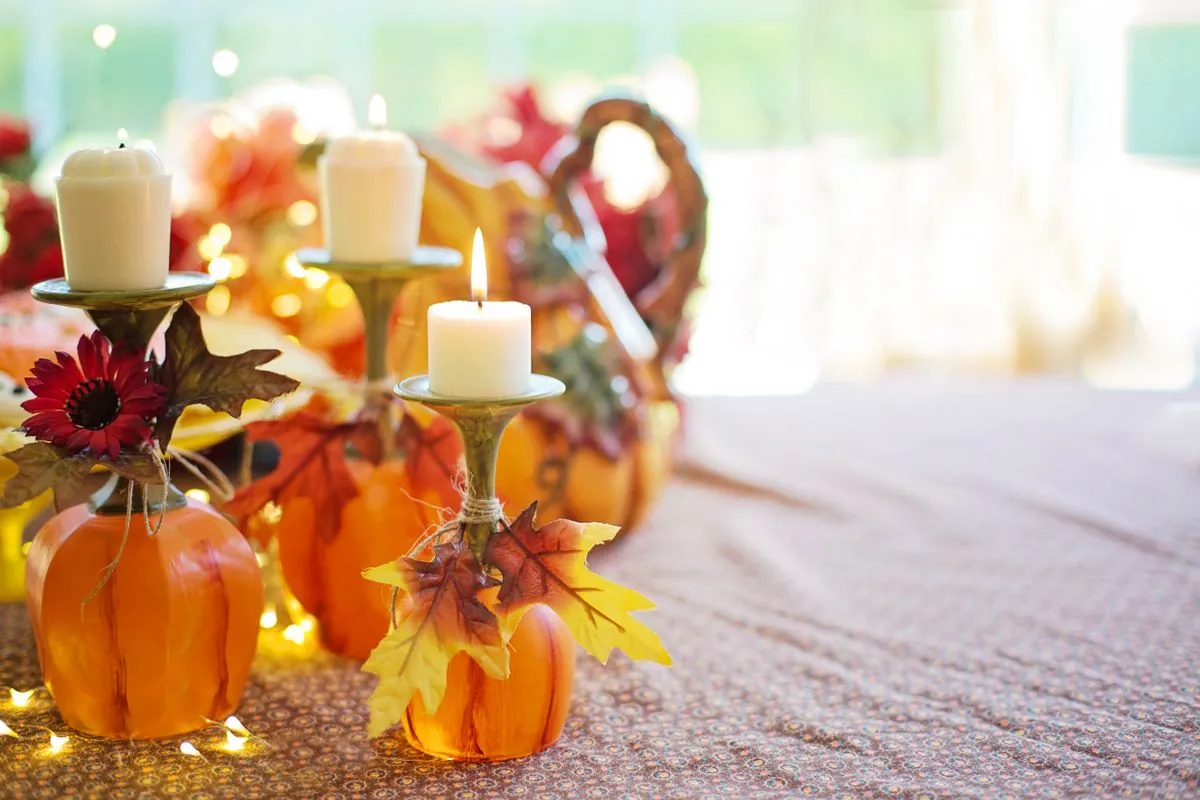
6. Two taper candles, not a candelabra
Candles are the highest-impact, lowest-cost mood upgrade on this list, but scale matters. In a small room, a pair of tapers in low brass or ceramic holders — flames starting around 12 inches above the table — beats any multi-arm candelabra, which eats width and drips wax on passing plates. If open flames near elbows make you nervous (it does me, with this crowd), flameless tapers on a timer give you the same vertical line with zero risk.
| Option | Footprint | Flame height | Typical cost |
|---|---|---|---|
| Two tapers, low holders | Narrow pair | About 12 inches above table | $10-$25 |
| Multi-arm candelabra | Eats table width | Drips wax on passing plates | $30-$60 |
| Flameless tapers on timers | Narrow pair | Same vertical line, zero risk | $15-$35 |
As an Amazon Associate, Herpickery earns from qualifying purchases.

- Pack of 8 dresses a small main table and the kids’ table from one box
- Two remotes with timer: same warm glow, same hour, zero matches
- 3D flickering wick reads as real from across a small dining room
Prices change often — check the current listing. We only feature candles we’d put on our own crowded table.
7. Mix the plates you already own
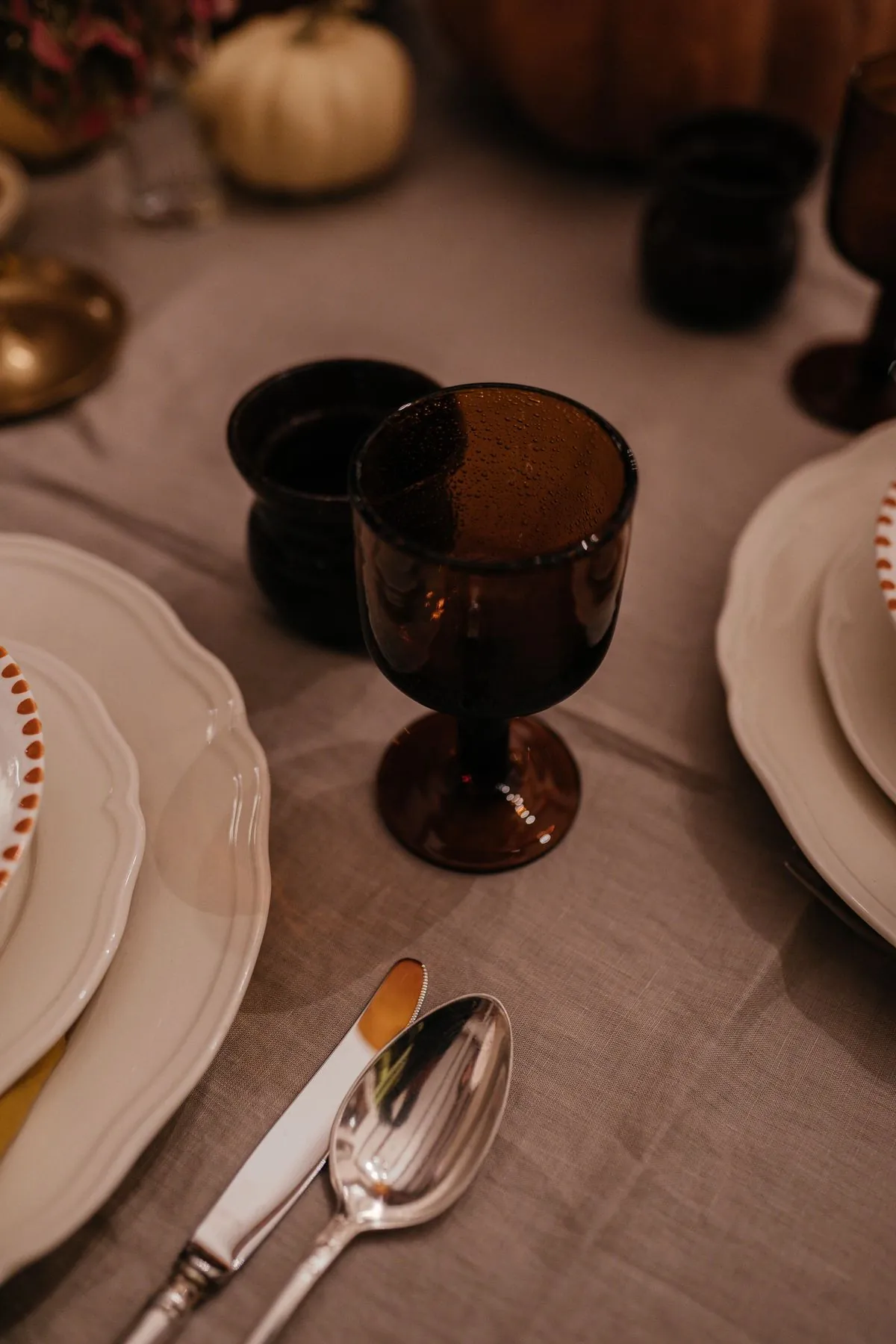
You do not need a service for twelve, and you especially don’t need to store one. Mismatched settings — a plain white dinner plate, a patterned salad plate from another set, a colored glass — photograph better than uniform stacks and cost nothing today. The rule that keeps it looking intentional instead of accidental: repeat each pattern at least twice around the table, and keep one element (the napkin, say) identical at every seat. If you own charger plates, leave them in the cabinet this week — they add two inches of diameter per seat, which across six seats is a foot of table you no longer have.
8. The 30-second napkin knot
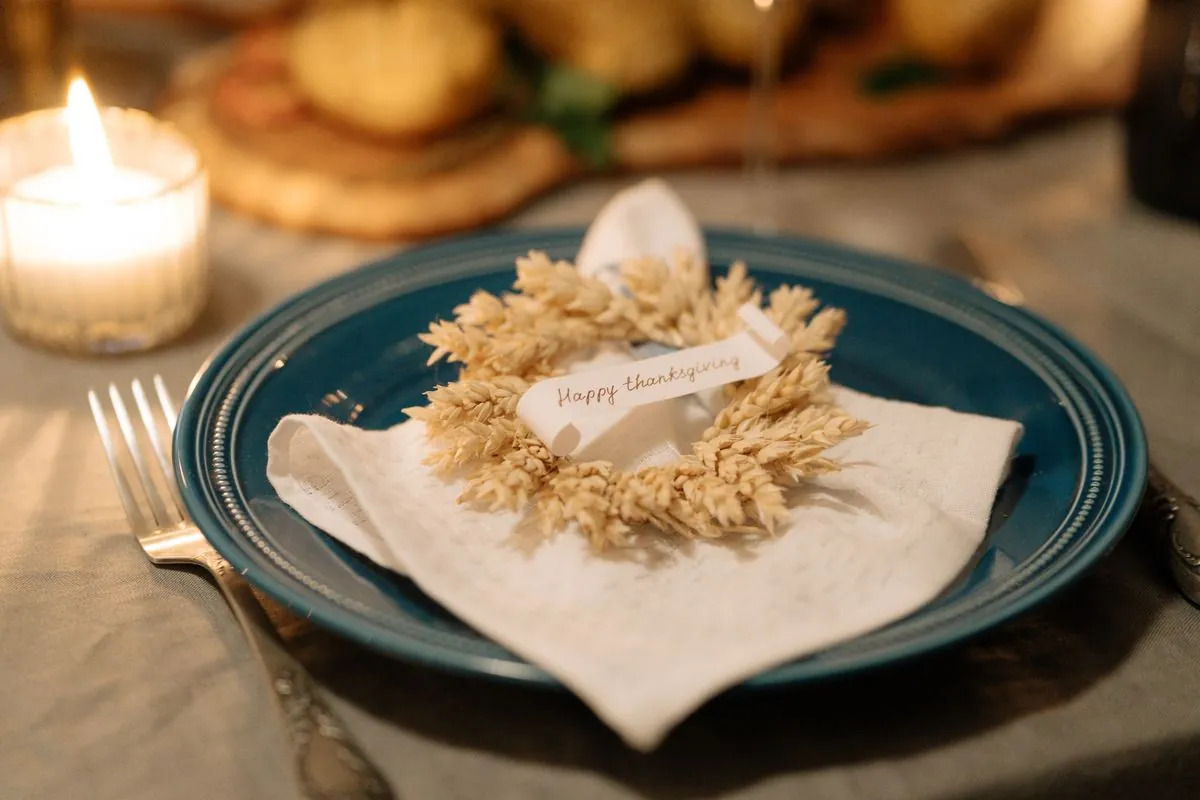
Elaborate napkin folds flatten in transit and eat table width when they stand upright. The knot fold takes half a minute: drape the napkin through a napkin ring, fluff the ends, lay it across the plate. That’s it. It sits low, survives being set down by guests who don’t care about your art direction, and a $12 set of cloth napkins in one warm color — rust, olive, cream — quietly ties the whole table together.
As an Amazon Associate, Herpickery earns from qualifying purchases.

- Holiday plaid carries the table from Thanksgiving straight through December
- 18 x 18 oversized folds into a full knot with real presence on the plate
- 100% cotton, machine washable — no paper-napkin landfill after dessert
Prices change often — check the current listing. One set of plaid covers two holidays, which is the correct math for a small cupboard.
9. Maple-leaf place cards that double as favors
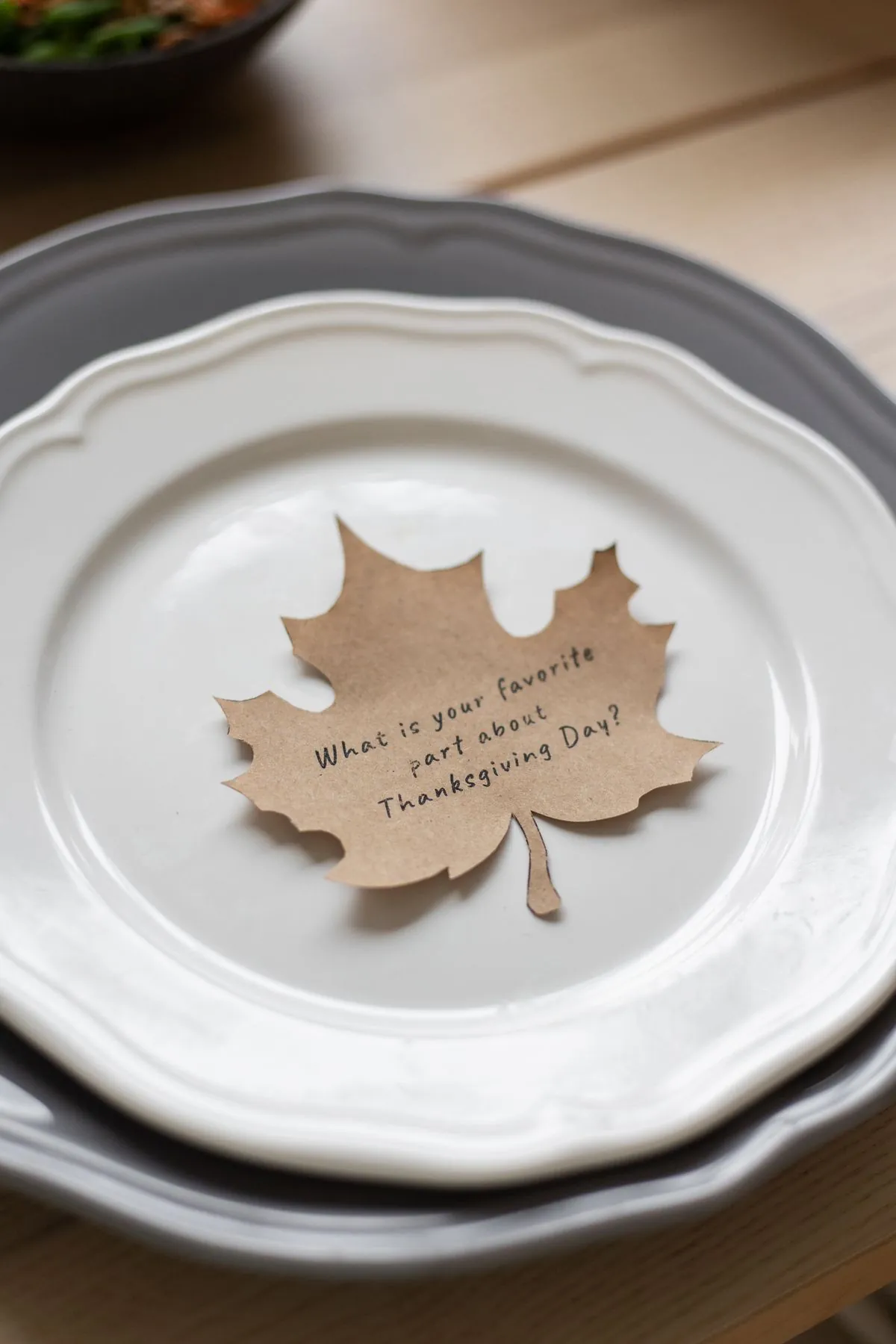
Place cards earn their footprint twice in a small room: they prevent the awkward “who sits where” shuffle at the door, and a pretty one leaves with the guest. Write names on small maple leaves — paper or gold-inked real ones — or on kraft cards slipped into a sprig of wheat. Both versions cost a few dollars, sit flat on the plate where a centerpiece never could, and make a table of six look arranged rather than assembled.
| Version | Cost for a table of 6 | Where it sits | Doubles as |
|---|---|---|---|
| Paper maple leaf, inked name | Under $5 | Flat on the plate | Guest keepsake |
| Kraft card in a wheat sprig | $5-$10 | Flat on the plate | Guest keepsake |
| Kraft tent card, hand-lettered | $5-$10 | Flat on the plate | Keepsake and mini menu |
As an Amazon Associate, Herpickery earns from qualifying purchases.

- One pack covers place cards, menus, and kids’-table crafts for years
- 80 lb coverstock cuts clean and holds a tent-card fold without flopping
- Printable or hand-lettered — gold pen pops against the kraft brown
Prices change often — check the current listing. Cards like these have survived three of our holiday dinners.
10. Serve from the sideboard, not the table
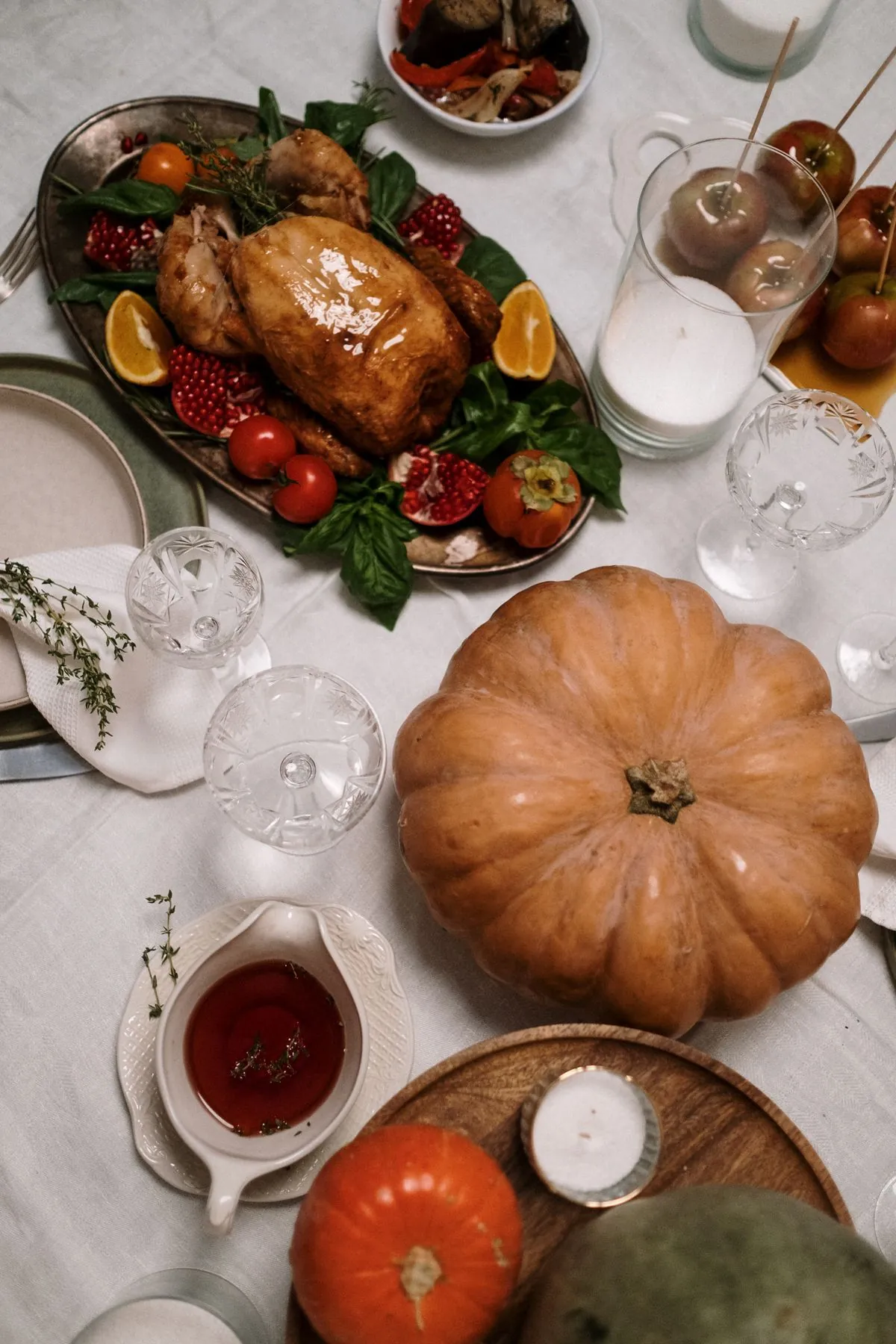
In a small dining room the serving dishes are the real space thieves — six platters can eat a third of a 60-inch table. Set up a serving station on the sideboard, console, or even a cleared kitchen counter, plate the proteins there, and let dishes travel family-style. The table keeps: plates, glasses, the centerpiece line, and two passing bowls. Everyone’s arms get a vacation, and the table still looks abundant because the abundance is vertical (stacked plates, tiered stands) instead of spread out.
| Station | What lives there | Limit |
|---|---|---|
| Table | Plates, glasses, centerpiece line | Two passing bowls max |
| Sideboard | Turkey platter, stacked sides | Six dishes fit stacked |
| Kitchen counter | Overflow dishes, desserts | Clear it before guests |
11. Move drinks off the table
A drinks setup is the quietest table-crowder: bottles, ice bucket, eight glasses, and a poured-red-wine ring on your runner. Give beverages their own station — windowsill, console, or a small folding table in the hall — with glasses stacked, a marker for names on cups, and the bottles there. Stage it before guests arrive and you’ll never play bartender mid-dinner. Guests refill without crossing the room, and your decorated table line stays decorated instead of becoming a bar back. In my house the windowsill station has quietly become the most popular seat in the apartment, which tells you something.
12. Layer the light before guests arrive
One overhead fixture is the small-room tell. Twenty minutes before anyone arrives: overhead light to its lowest setting or off, two lamps switched on in the surrounding rooms, candles lit on the table. The candles and warm bulbs pull the walls back and make a small room feel like an ember instead of a box. This costs nothing and outperforms every centerpiece on this list — I have watched guests walk in and literally exhale.
| Time before guests | Action | Cost |
|---|---|---|
| 20 minutes out | Overhead to lowest or off | $0 |
| 15 minutes out | Two lamps on in surrounding rooms | $0 |
| 5 minutes out | Table candles lit last | $10-$25 if buying tapers |
13. Forage one branch, cut it short
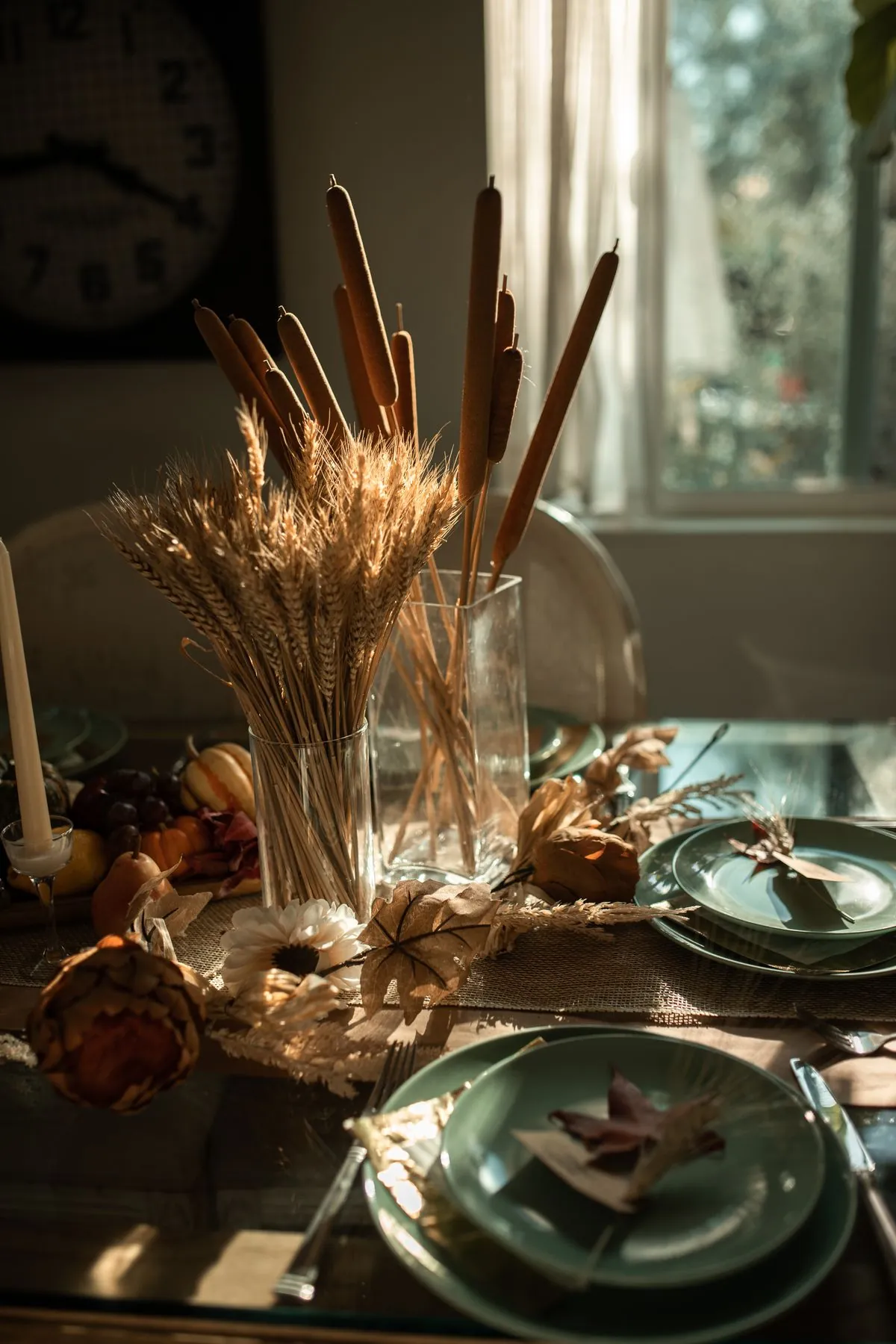
A single branch — eucalyptus, magnolia, or whatever your street is dropping for free — laid flat down the runner line does more than a $40 arrangement, and costs a walk around the block. The critical word is short: cut the branch into two or three segments so it hugs the 10-inch runner zone instead of sprawling toward plates. Tuck in two or three mini pumpkins and a candle pair, and the table is finished before the oven is even preheated.
14. Edit each place setting to three pieces
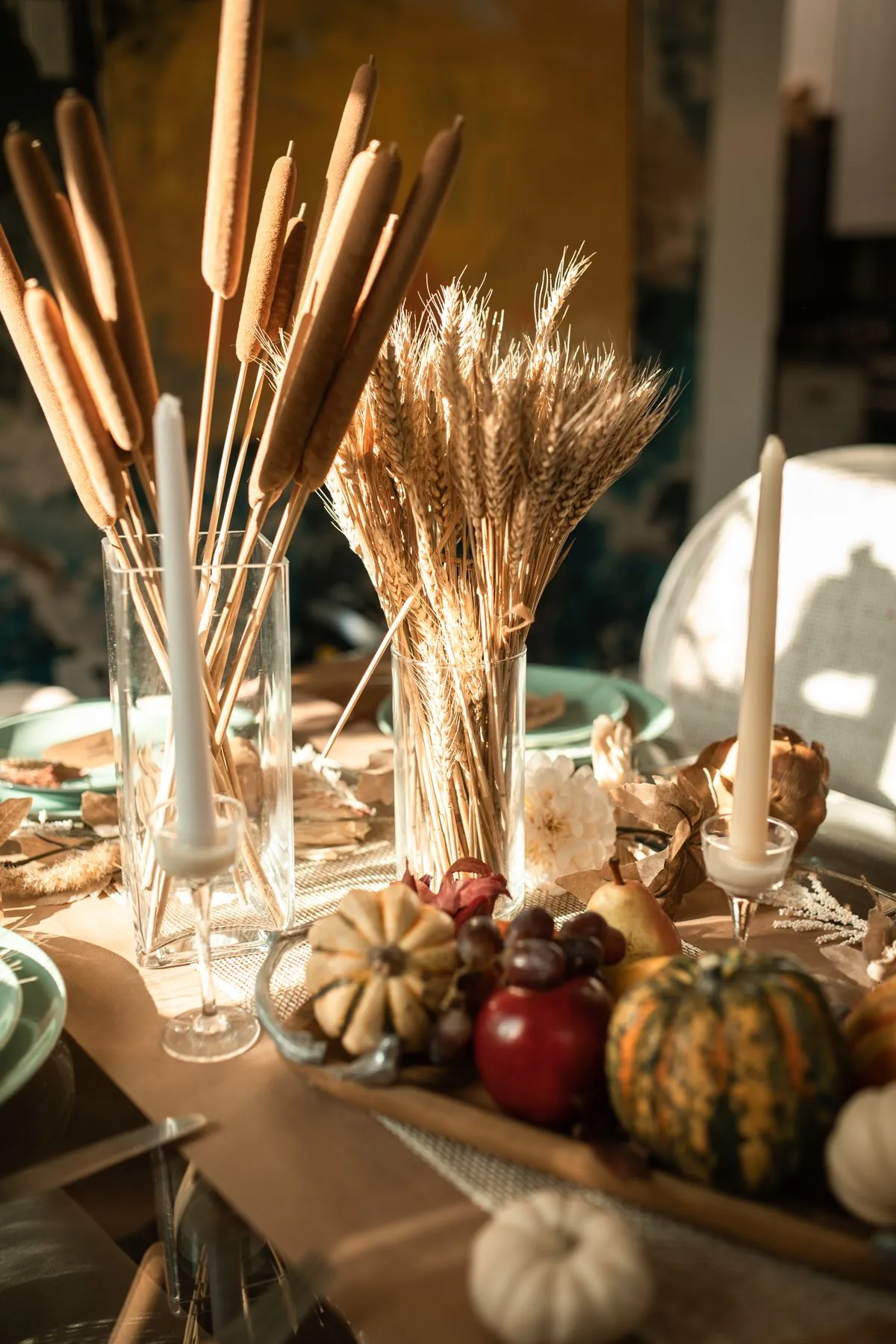
Every extra piece on a place setting — charger, bread plate, two forks, both wine glasses — multiplies across the guest count. In a 10×11 room, six guests × five pieces = thirty objects competing for the same table. Edit to three: dinner plate, napkin, one glass. Add the salad fork only if you’re actually serving salad. A place setting this clean reads as modern and confident, and your guests’ elbows silently thank you.
| Pieces per setting | Objects for 6 guests | Verdict in a 10×11 room |
|---|---|---|
| 5 pieces | 30 objects | Crowded elbows |
| 4 pieces | 24 objects | Still heavy |
| 3 pieces | 18 objects | The small-room standard |
15. Swap two chairs for a bench
A bench on one long side of the table buys back six to eight inches of floor clearance versus two chair backs, seats an extra person in a squeeze, and slides fully under the table between courses so nobody plays traffic cop. Cushions soften the hard-seat complaints — two pillows from the living room, which is exactly where our cozy fall living room ideas say the spare texture should come from anyway. Bench side also becomes the unofficial kids’ row, which leads directly to the next idea.
| Seating option | Floor clearance gained | People seated |
|---|---|---|
| Two dining chairs | Baseline | 2 |
| One bench | 6-8 inches more | 3 in a squeeze |
| One bench, slides under | 6-8 inches plus walkway | 3, and nobody plays traffic cop |
16. Give the kids their own table
The kids’ table is not a demotion — in a small dining room it’s load relief. Four children at the main table cost you two feet of table edge and a constant supply of spilled cider; four children at their own card table cost you one corner of the room and a roll of paper. Set it low, cover it in kraft paper with crayons, and let them decorate their own “centerpiece.” We keep a whole tested setup — three budget tiers, cleanup plan included — in our Thanksgiving kids’ table ideas guide.
| Where 4 kids sit | Main-table edge used | Mess contained by |
|---|---|---|
| All 4 at the main table | About 2 feet | Nothing – good luck |
| 2 at the table, 2 on the bench | About 1 foot | Bench-side rules |
| All 4 at a card table | 0 inches | Kraft paper and crayons |
17. Warm metals in threes
If the table feels flat after all the editing, the fix isn’t more objects — it’s a little shine. Three small brass or copper pieces, grouped at odd heights along the runner (a candlestick, a tiny bowl, a bell), catch candlelight and warm up the whole color palette without adding bulk. The group-of-three rule keeps it from looking like shelf clutter migrated to dinner, and the warm-metal glow bridges the gap between your white plates and the amber candlelight. Thrift stores are the correct price point; nothing here needs to be bought new.
18. The twenty-minute version
It’s Thursday morning, the turkey is still frozen in places, and you’re reading decorating ideas. Do only this: clear everything off the table except plates, glasses, and napkins; run one strip of anything (scarf, canvas, kraft paper) down the middle; line up five small pumpkins and one candle pair along it; kill the overhead light and turn on two lamps. Twenty minutes, under $15 if you have to buy the pumpkins, and nobody at the table will know there was ever a version of this article with eighteen ideas in it.
And if you’d rather plan the whole thing with a budget in hand, here’s what each tier of this list buys you in a small room:
| Budget | What you buy | What the room feels like |
|---|---|---|
| $0 — the foraged tier | Fabric-strip runner, foraged branch cut short, five mini pumpkins from the pantry, candles you already own | Styled on a budget of a walk around the block; nobody guesses it cost nothing |
| Under $25 — the texture tier | One set of cloth napkins, grocery-store flowers, a pack of kraft place cards | The table becomes touchable and personal — names on plates, cloth instead of paper |
| Under $60 — the glow tier | Everything above, plus flameless tapers with a timer and one brass candlestick from the thrift store | The layered light does its thing: the small room reads as an ember, and dinner runs itself |
The 10-point small-dining-room Thanksgiving checklist
- ☐ 24 inches of table edge per guest measured
- ☐ 24–30 inches of clearance behind pulled-out chairs
- ☐ Centerpiece under 10 inches wide, under 12 inches tall
- ☐ Runner 10–12 inches (or a fabric strip cheat)
- ☐ Two taper candles in low holders, flames tested
- ☐ Place settings edited to three pieces
- ☐ Serving station set up OFF the table
- ☐ Drink station moved to windowsill or console
- ☐ Bench or kids’ table handling the overflow
- ☐ Overhead light dimmed, two lamps on, candles lit last
Screenshot this list — it’s the whole article in one frame.
Small dining room Thanksgiving FAQ
How do you set a Thanksgiving table in a small dining room?
Give each guest 24 inches of table edge, keep the centerpiece under 10 inches wide and 12 inches tall, edit each place setting to three pieces (plate, napkin, glass), and serve family-style from a sideboard instead of the table. Then move drinks and the kids’ table out of the room entirely.
What do you put in the middle of a small Thanksgiving table?
A narrow line of low things: a 10–12 inch runner or fabric strip, a row of mini pumpkins, two taper candles in low holders, and one short cluster of grocery-store flowers. The one-third rule applies — decoration occupies at most a third of the table’s width, leaving a full third for food and a third for place settings.
How many people can you seat at a 60-inch table for Thanksgiving?
A 60″ × 30″ rectangle seats six adults comfortably — one per long side section and one per end — or eight if two of them are children sharing the ends. Beyond eight, move guests to a bench (which buys six to eight inches) or start a kids’ table rather than compressing place settings.
Should a Thanksgiving centerpiece be tall or short?
Short — under 12 inches tall. Tall centerpieces block conversation and visually fill a small room that’s already full. The exception: a few tall, thin stems in a slim vase, which read as vertical line rather than mass. Avoid everything in the chin-to-eye-level band.
Is a round or rectangle table better for a small dining room?
Round, when you have the choice. A 48-inch round seats four to five, gives every guest sight lines to everyone else, holds one lazy Susan, and needs no runner — a single centered arrangement finishes it. Rectangles win only when a bench or wall-side placement is essential.
How do you keep a small Thanksgiving table from looking crowded?
Subtract, don’t add: serving dishes and drinks off the table, place settings at three pieces, one narrow decorated line instead of a wide centerpiece, and dim layered light so the eye stops measuring the walls. Crowding is 80% logistics and 20% decor.
More from Herpickery
- Thanksgiving kids’ table ideas that keep little hands busy — three budget setups, crayon-proof
- Fall table runner ideas for every table shape — widths, fabrics, and the fringe warning
- Cozy fall living room ideas on a budget — 15 updates, five of them free
- Browse all Fall Decor
- Browse all Cozy Home
We only link products we’d actually set our own crowded tables with. Amazon links above are affiliate links — if you buy through them, Herpickery earns a small commission at no extra cost to you.
Thanksgiving hosting tool: turkey thaw planner
🦃 When should you start thawing your turkey?
Free tool from our Thanksgiving hosting guide — enter your bird’s weight and dinner date:
Thawing time needed:
Latest safe start:
Recommended start:
Full thaw-time chart and method guide: Turkey Thaw Calculator
Thanksgiving hosting tool: turkey roast time planner
🦃 When does the turkey go in the oven?
Free tool — enter your bird’s weight, stuffed or not, and dinner time:
Roasting time:
Put turkey in oven at:
Take it out (165°F thigh):
Full roast-time chart, temperature rules and FAQs: Turkey Roast Time Calculator
[…] candles have their place — our Thanksgiving small-dining-room guide recommends them for crowded tables — but on a formal Christmas table, real flame is the upgrade. […]
[…] the arrival of guests rather than the street view, the same weather logic applies indoors — the small-dining-room table plan handles the seating crunch, and the expensive-looking Christmas table handles the moment everyone […]
[…] dinner table picks up where brunch ends, the New Year’s Eve table plans for hour six, and the small-dining-room seating plan solves any squeeze in […]
[…] Thanksgiving Table Setting for a Small Dining Room […]
[…] 18 Thanksgiving Table Setting Ideas for Small Dining Rooms – Herpickery […]
[…] Thanksgiving Table Setting in a Small Dining Room: the adult end of the same room […]
[…] The per-setting number is not the whole story, because the options do different jobs. A tablecloth protects a wood finish from hot dishes; a runner does not. A placemat gives each guest a boundary; a runner gives the table a spine. The combination most people actually land on is a plain cloth as the base layer and a runner on top, which costs about $45 once and then only the runner gets replaced when the season changes — the same base-plus-accent logic as dressing a small dining room for Thanksgiving. […]
[…] code for your site Before you roastTurkey thaw calculator — when to start thawing Holiday tableThanksgiving table setting for a small dining room Kids’ tableThanksgiving kids’ table ideas Fall season15 cozy fall living room […]