
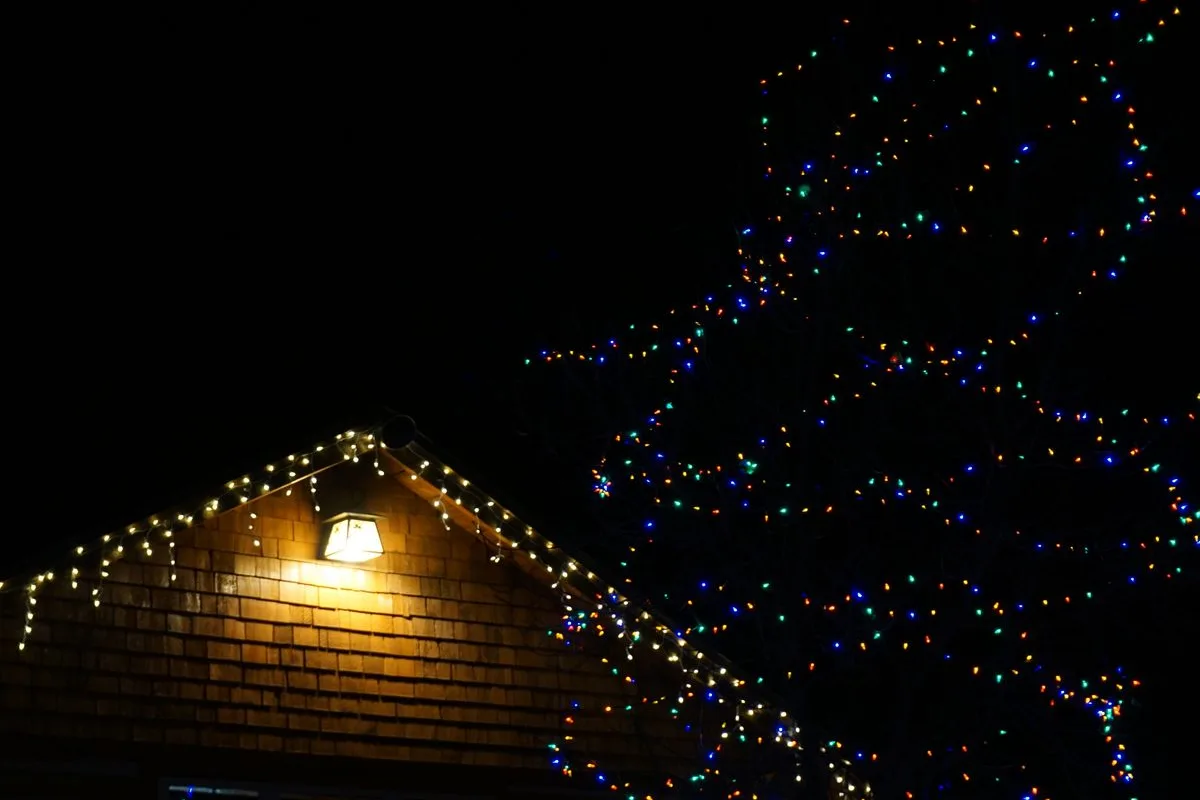
The year we went all-in on outdoor lights, I plugged nine incandescent strands into one garage outlet, admired the glow for exactly four days, and then stood in the dark listening to the breaker click while holding a string of lights and a healthy sense of irony. The house looked incredible. The garage door opener never stood a chance — it shared that circuit, and the opener lost.
The fix took ten minutes and one kitchen appliance: I mapped which outlets died together, wrote the number on the breaker panel, and divided 1,440 by the wattage on each box. That division is the whole skill. This page does it with you — per-bulb wattage, the fuse nobody reads, the end-to-end strand limits, and the cost math that explains why we switched to LED and never looked back.
Table of Contents — 12 Ideas
- How many light strings can one outlet handle?
- How many watts do Christmas lights use?
- Why does the plug’s fuse matter more than the wall?
- How do I know which outlets share a circuit?
- Are power strips allowed for Christmas lights?
- How many strings can I connect end-to-end?
- LED vs incandescent: what does a season cost?
- Do outdoor lights need a GFCI outlet?
- How many strings does a Christmas tree need?
- Do I need a timer or a smart plug?
- Why do my lights dim or trip the breaker?
- The 60-second outlet load check
1. The 1,440-watt ceiling
How many light strings can one outlet handle?
| Circuit | Total watts | Safe 80% load | Strands at safe load |
|---|---|---|---|
| 15A / 120V breaker | 1,800W | 1,440W | ~288 LED mini or ~57 incandescent mini |
| 20A / 120V breaker | 2,400W | 1,920W | ~384 LED mini or ~76 incandescent mini |
| 15A shared with a fridge or opener | Subtract their tag watts | Under 1,440W | Divide what is left by strand watts |
The ceiling is the circuit, not the outlet face: a standard 15-amp circuit at 120 volts delivers 1,800 watts, and because holiday lights run for more than three hours at a stretch, electricians derate continuous loads to 80% — 1,440 watts per circuit, and treat each outlet as if it owns the whole circuit because you can’t see what else shares it. A 20-amp kitchen circuit raises the ceiling to 1,920 watts safe; a circuit already feeding a fridge or a garage door opener lowers it by whatever those draw.
Divide 1,440 by the wattage printed on the strand’s tag and you get the strand count — 14 incandescent 50-bulb strands, or 288 LED ones. The gap between those numbers is the entire LED revolution, and idea 2 has the per-bulb table; idea 3 explains why your actual limit is usually the 360-watt fuse hiding inside the plug before the wall ever gets involved.
2. Per-bulb wattage (the number on the tag, decoded)
How many watts do Christmas lights use?

Four families cover almost everything sold today: mini incandescent at 0.4 to 0.5 watts per bulb, mini LED at about 0.1 watts, C9 incandescent at 7 watts per bulb, and C9 LED at 0.5 to 0.7 watts. The strand tag prints it exactly — “0.45W/bulb, 50 lights, 22.5W” — and that tag number, not the bulb count, is what the division uses.
| Strand type | Watts per bulb | Watts per 50-bulb strand | Strands on a 1,440W circuit |
|---|---|---|---|
| Mini incandescent (50) | 0.4–0.5W | 20–25W | ~57 theoretical, 14 practical* |
| Mini LED (50) | ~0.1W | 4–5W | ~290 |
| C9 incandescent (25) | 7W | 175W | 8 |
| C9 LED (25) | 0.5–0.7W | 13–18W | ~80–110 |
*The “practical” column for incandescent minis is the fuse limit from idea 3, not the wall. Notice what the table really says: with LED, the outlet stops being the bottleneck and the strand-count limit in idea 6 takes over — the math problem quietly deletes itself.

As an Amazon Associate, Herpickery earns from qualifying purchases.
3. The fuse inside the plug
Why does the plug’s fuse matter more than the wall?
| Plug fuse rating | Watts at 120V | Typical strand type | 25W mini strands per run |
|---|---|---|---|
| 3 amps | 360W | Incandescent mini strands | 14 |
| 5 amps | 600W | Heavier strands | 24 |
| 10 amps (never swap in) | 1,200W | Fire hazard, not a fix | Split into two runs instead |
Every UL-listed strand has a cartridge fuse inside the male plug — usually 3 amps for incandescent minis, 5 amps for heavier strands — and 3 amps × 120 volts = 360 watts per end-to-end run. That’s the number that actually caps the classic white-wire mini strands: a run of 14 strands at 25W hits 350 watts and the fuse does its job on day three, exactly when nobody feels like debugging. The wall’s 1,440 watts never enter the conversation.
The workaround is not a bigger fuse — swapping in a 10-amp cartridge to “fix” tripping is how strand fires start. The workaround is splitting the load: two or three runs, each under the fuse ceiling, each fed from the outlet (or the strip of idea 5) separately. Mark each run with masking tape at the plug — run A, run B — so next year’s setup starts with the map instead of the mystery.
4. Mapping your circuits (one candle, one walk)
How do I know which outlets share a circuit?
Turn on a lamp in the outlet you plan to use, walk to the breaker panel, and switch breakers off one at a time — every outlet that goes dark shares that breaker, and the lamp’s outlet is on the one that kills it. Ten minutes maps the whole floor. Write the result on the panel door or inside a cabinet: “living room + porch + garage door = #14.” The garage door lesson from our December of darkness was exactly this: the opener shared the lights’ circuit and lost, so anything with a motor gets crossed off the lights list.
Two labels matter while you’re at the panel: 15-amp and 20-amp (the number printed on the breaker handle — 1,440 vs 1,920 safe watts), and any breaker marked GFCI, which is doing double duty for the bathroom and, sometimes, the exterior outlets. Kitchens and bathrooms are the worst donors for light duty because their circuits already carry appliances; bedroom and living-room outlets are usually the quietest partners.
The ten-minute circuit map, as steps:
| Step | Action | What it tells you |
|---|---|---|
| 1 | Plug a lamp into the outlet you plan to use | A visible test point |
| 2 | Walk to the panel, switch breakers off one at a time | Every outlet that goes dark shares that breaker |
| 3 | Note the breaker that kills the lamp | That is your lights’ circuit — write it on the panel door |
| 4 | Cross off anything with a motor: garage opener, fridge, space heater | They share the circuit and they lose last time — the opener’s lesson |
| 5 | Read the handle labels: 15 A = 1,440 safe watts, 20 A = 1,920 | Kitchen and bathroom circuits are the worst donors; bedrooms are the quietest partners |
5. Power strips: yes, with rules
Are power strips allowed for Christmas lights?
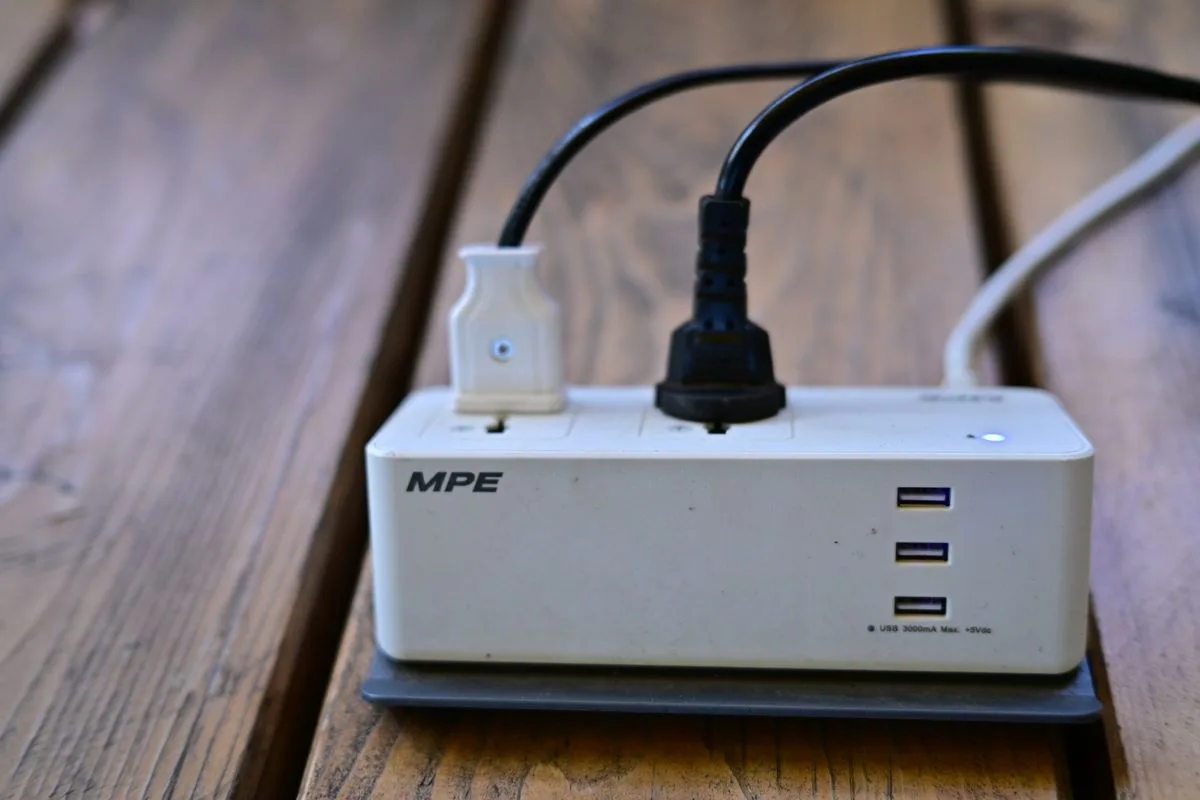
One strip per wall outlet is fine and genuinely useful — it converts one outlet face into six feeds, each feeding its own fuse-limited run, and a surge-protected strip adds a little insurance for the electronics on the same circuit. The strip’s own rating (usually 15 amps / 1,800W printed on the body) becomes the new ceiling for everything plugged into it, and the wall’s 1,440 watts still rule above that.
The move that’s never fine is daisy-chaining: strip into strip, or strip into an extension cord into a second strip. Every layer multiplies resistance at the joints and hides the total load from the one device that could actually trip in time. If one strip’s six sockets aren’t enough, the answer is a second wall outlet or a second circuit map entry — not a strip graveyard behind the couch.
As an Amazon Associate, we earn from qualifying purchases.
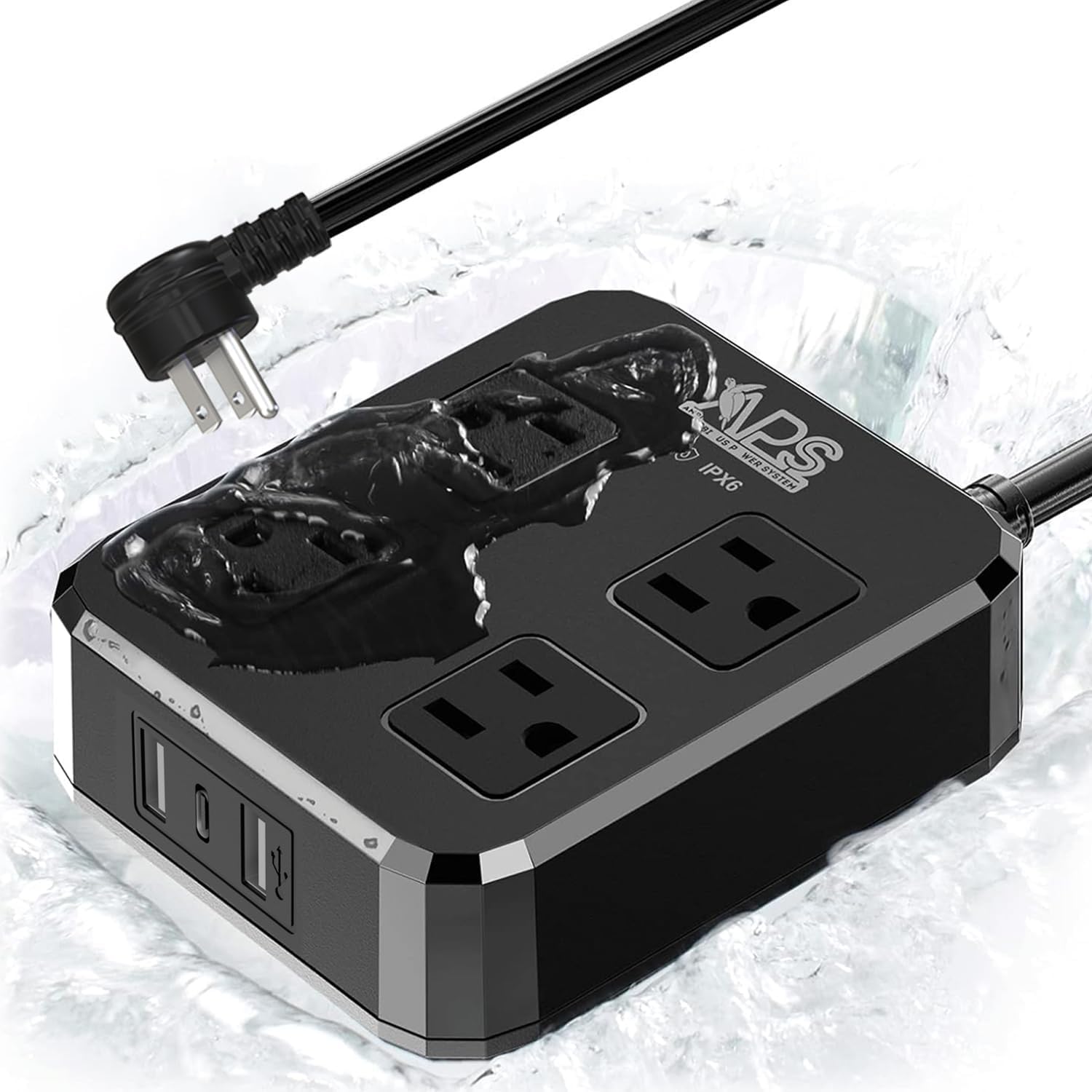
- IPX6 weatherproof shell with spring-loaded outlet covers; 4 AC + 3 USB feeds seven runs or devices from one wall outlet
- Rated 13A / 1,625W printed on the body — under idea 5’s math, the 1,440-watt wall still rules, exactly how the stack should read
- ETL listed, 16AWG cord, resettable breaker and wall-mount keyholes; the 6-ft flat plug keeps the strip near the wall, not the middle of the yard
Price and availability shown on Amazon; listing may change.
6. End-to-end limits (the UL line nobody reads)
How many strings can I connect end-to-end?
| Strand type | Typical UL connect limit | Run watts at limit | Second limit to check |
|---|---|---|---|
| Incandescent mini (50) | 3-5 strands | 75-125W | 360W plug fuse |
| C9 incandescent (25) | 3 strands | 525W | 360-600W plug fuse |
| LED mini (50) | 25+ strands (tag wins) | 100-125W | 360W plug fuse |
| Tag says “connect up to 2100 watts” | Per tag wattage | 2,100W | Wall circuit 1,440W |
The box says it in 6-point type: UL’s connect limit runs 3 to 5 strands for incandescent and up to 25 or more for most LED strands (some LED sets say “connect up to 2100 watts” — read the tag, it wins). The limit exists because every connector joint carries the full current of everything behind it, and connectors are the cheapest part of the strand. Exceeding the connect limit is how warm plugs and melted socket housings happen even when the circuit math looks comfortable.
The two limits stack, not compete: a run must satisfy both the fuse wattage (idea 3) and the strand count (this idea). LED strands clear both hurdles so easily that the honest answer for a modern setup is you will run out of tree, roofline or patience long before you run out of electrical capacity — which is exactly the problem worth having.
As an Amazon Associate, we earn from qualifying purchases.

- 100 warm-white LEDs across 33 feet with male and female plugs — connect up to 3 sets for 128 feet total, safely under LED connect limits
- 8 modes with a memory chip and a 6-on/18-off timer built into the ETL-certified adapter
- IP65-rated wire and bulbs for rooflines and railings; 4-inch spacing spreads light instead of clustering it
Price and availability shown on Amazon; listing may change.
7. What a season actually costs
LED vs incandescent: what does a season cost?
Cost = watts × hours × days ÷ 1,000 × your rate. At 6 hours an evening for 45 nights (270 hours) and $0.14 per kWh, ten 50-bulb strands tell the whole story: ten incandescent minis (250W) burn 67.5 kWh — about $9.45; the same ten in LED (50W) burn 13.5 kWh — about $1.89. Step up to ten C9 incandescent strands (1,750W) and the season costs roughly $66; the LED C9 equivalent is about $5.70.
| Setup (10 strands, 6 h × 45 nights) | Total watts | kWh / season | Cost at $0.14/kWh |
|---|---|---|---|
| Mini incandescent ×10 | 250W | 67.5 | ~$9.45 |
| Mini LED ×10 | 50W | 13.5 | ~$1.89 |
| C9 incandescent ×10 | 1,750W | 472.5 | ~$66 |
| C9 LED ×10 | 150W | 40.5 | ~$5.70 |
One number decides the upgrade: the C9 row. Incandescent C9 strands aren’t just a cost line — 1,750 watts eats the entire 1,440-watt circuit by themselves, while the LED version leaves 1,290 watts for everything else you own. The $60 saved per season is real, but the freed capacity is what actually changes what your house can wear in December.
8. Outdoor outlets and the GFCI rule
Do outdoor lights need a GFCI outlet?
Code requires exterior receptacles to be GFCI-protected, and December is exactly the scenario GFCI exists for: wet ground, damp cords, metal ladders. Test it before install day — press the test button, watch it trip, press reset — because a GFCI that failed silently in July announces itself in January. Strand tags mark outdoor-rated sets “indoor/outdoor”; indoor-only strands outdoors crack their insulation in freeze cycles, and that crack is the fault a GFCI will eventually catch.
Plug connections get one job: stay off the ground. A “drip loop” — the cord dips below the plug before rising to the outlet — keeps water running down the cord instead of into the connection, and weatherproof cord covers over every mid-run join cost a coffee and end the ritual of drying connectors with a hair dryer. The National Christmas Tree Association’s care guide makes the same checklist point from the greenery side: inspect every set before it goes up, use only strands rated for outdoors, and retire anything that fails the test.
9. The tree’s own wattage math
How many strings does a Christmas tree need?
The strand-count formula lives in the ornament and lights guide — roughly 100 bulbs per vertical foot for a classic glow — but the outlet math adds a constraint the guide doesn’t: the tree shares its circuit with whatever room it stands in. Ten LED strands (50W) barely register; ten incandescent strands (250W) plus a warm floor lamp plus the TV’s standby draw starts to matter on a 15-amp circuit that also runs the media console.
The tree’s real advantage is the 1-to-2 watt strand: at LED density, even a 7.5-foot tree wearing 1,000 bulbs costs about 10 watts — less than the router next to it. That’s the quiet case for converting the tree first, roofline second: the tree is on the circuit you live with daily, and LED makes its draw effectively invisible.
10. Timers and smart plugs (the cheap automation)
Do I need a timer or a smart plug?
| Option | Typical cost | Schedule through outage | Load ceiling |
|---|---|---|---|
| Mechanical timer | A few dollars | No, drifts and resets | The outlet’s 1,440W |
| Smart plug, 10A rated | About $15 | Yes, saved in app | 1,200W |
| Smart plug, 15A rated | $15 and up | Yes, saved in app | 1,800W |
| Outdoor smart plug, weatherproof lid | $15 and up | Yes, saved in app | Match its printed amp rating |
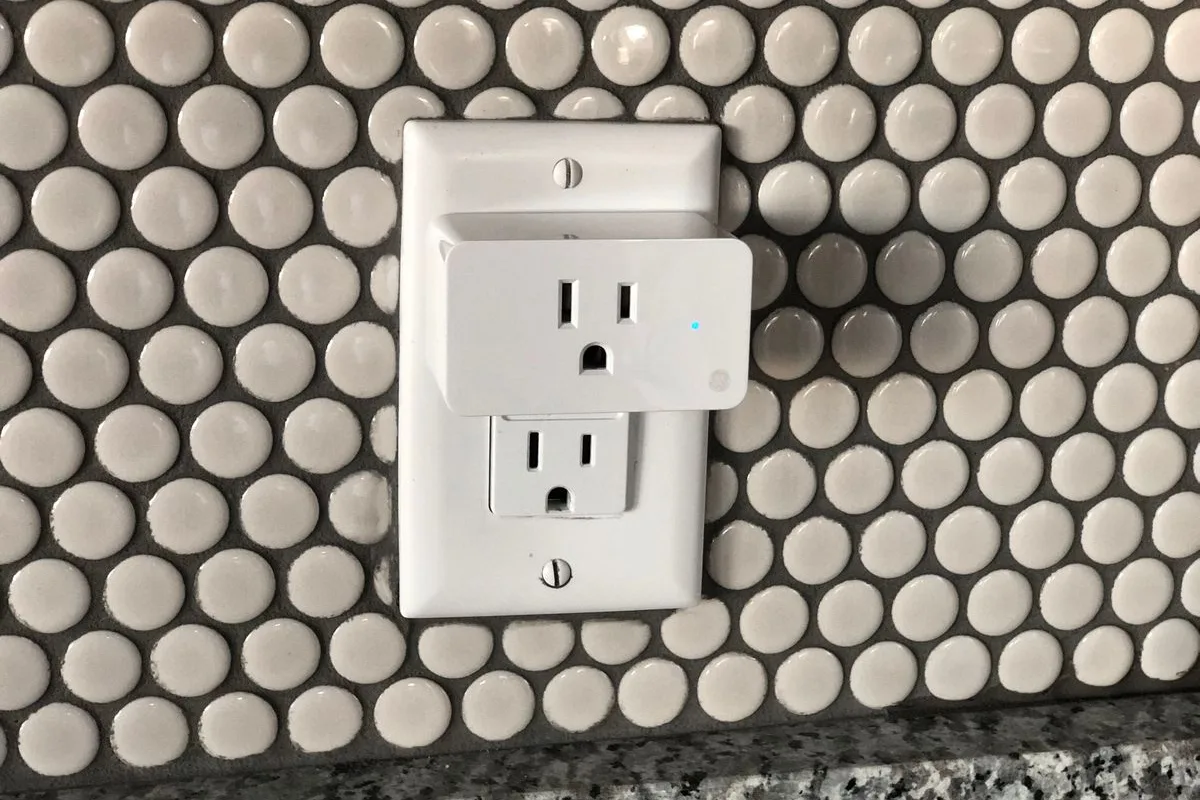
Yes — not for safety but for arithmetic and sanity: the 6-hour evening schedule from the timer math guide cuts the season’s cost by roughly two-thirds versus lights that burn till someone remembers, and it ends the “did I turn the porch lights off?” loop entirely. Mechanical timers cost pocket change but drift and reset with the outlet; smart plugs keep schedule through outages and let you turn the whole roofline on from bed when the neighbors’ kids walk past.
One spec matters when choosing: the plug’s rated load. A smart plug rated 10 amps carries 1,200 watts — fine for LED everything, marginal for a full C9 incandescent fleet. And outdoor-rated smart plugs (with the little weatherproof bubble lid) are the difference between a December of working timers and one February trip to replace a corroded unit.
As an Amazon Associate, we earn from qualifying purchases.

- Two independently controlled outlets rated 15A / 1,875W — the full circuit ceiling, comfortable even for a C9 incandescent fleet
- Schedules live in the app (no drift, no post-outage resets) with Alexa and Google voice control
- IP64 weatherproof bubble lids, 300-ft Wi-Fi range, ETL certified with a 2-year warranty
Price and availability shown on Amazon; listing may change.
11. Diagnosis: dim strands and clicking breakers
Why do my lights dim or trip the breaker?
Dimness has two culprits: a strand near the end of a long run sharing its voltage (long incandescent chains drop voltage and the far end glows amber — LED is effectively immune), or a dying socket on one bulb dragging its neighbors down in a series circuit. The breaker-click story is almost always arithmetic: something else on the circuit — the fridge, the opener, the space heater someone hid in the office — joined your lights, and together you crossed the trip point.
The 5-minute diagnosis: unplug one run at a time until the breaker holds, and the last run unplugged was the straw. Then check that run’s fuse (idea 3), its strand count (idea 6), and what else woke up on its circuit (idea 4). Warm plugs, faint plastic smell or a plug face that’s changed color are not diagnosis items — that strand retires on the spot, and the spares you bought after reading idea 2 cover the gap.
Dim strands and clicking breakers, translated:
| Symptom | Cause | The fix |
|---|---|---|
| Far end of a long run glows amber | Voltage drop down a long incandescent chain | LED is effectively immune |
| One bulb drags its neighbors down | Dying socket in a series circuit | Swap the bulb; retire the strand if it persists |
| Breaker clicks off | Somewhere on the circuit the fridge, opener, or a hidden space heater joined your lights and crossed the trip point | Unplug one run at a time until the breaker holds — the last unplugged was the straw |
| Warm plugs, faint plastic smell, discolored plug face | Not diagnosis items | That strand retires on the spot |
12. The 60-second check before you plug in
The 60-second outlet load check
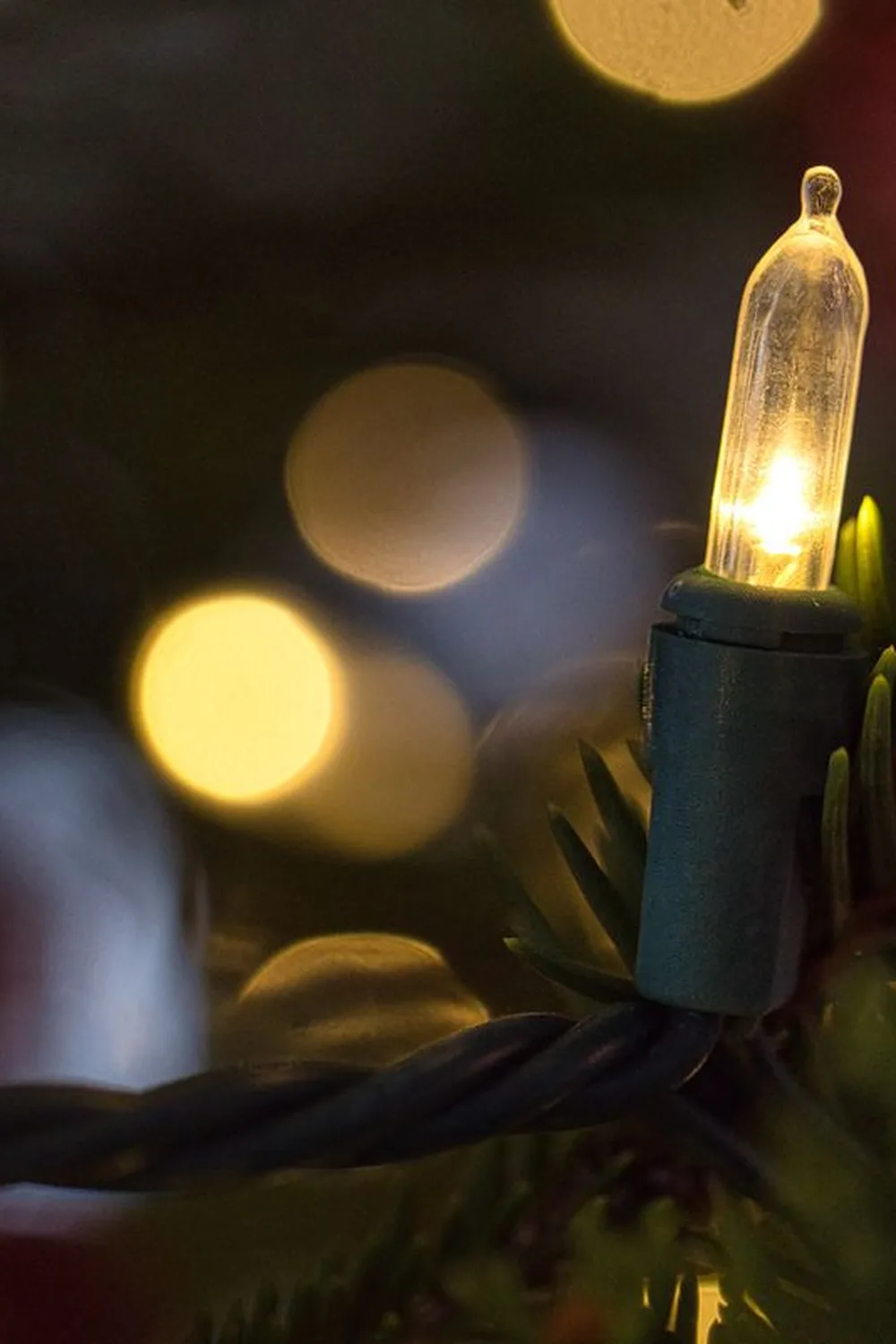
Run this before the first strand goes in, and never think about it again until January: read the strand tag and total the watts, divide into 1,440, keep the end-to-end runs under both the fuse ceiling and the UL connect limit, confirm the GFCI trips and resets, and put the timer on the whole arrangement. Sixty seconds at the outlet replaces the standing-in-the-dark breaker ritual from the top of this page — ask me how I know.
Outlet Load: The 5-Point Checklist
- ☐ Tag wattage totaled; under 1,440W per circuit (1,920W on 20A)
- ☐ Each end-to-end run under the plug fuse ceiling (360–600W) and UL connect limit
- ☐ One power strip per outlet; no strip-into-strip anywhere
- ☐ GFCI tested (trip + reset); drip loops and cord covers on outdoor joins
- ☐ Timer/smart plug scheduled 6 hours; warm plugs retired on sight
Related Reading
- Christmas Lights Cost Calculator: what those watts cost per season
- How Many Ornaments and Lights Does a Christmas Tree Need?
- Stair Garland Math: How Much Garland for a Banister
- Light Timer Schedules: The 6-Hour Math
- How Much Water a Real Tree Actually Drinks
- Christmas Tree Stand Math: Trunk Diameter, Water Capacity, Stability
- Christmas Tree Footprint Math: Floor Space, Skirt Size and the Gifts Underneath
Last updated: November 22, 2026. The garage door opener has its own breaker now, and it keeps them.
[…] house — and at 4 to 5 watts per strand, the electrical side is a rounding error, which the outlet wattage math confirms from the other direction. Buy one extra strand; the strand you return is cheaper than the […]
[…] sockets, one-third the energy — the only change is a $10 device deciding instead of you (see the outlet wattage math for the full per-strand numbers this table builds […]