
My first apartment had a radiator parked exactly where a fireplace should have been, and twenty-two-year-old me hung our two stockings from the valve anyway. By Christmas Eve the toe of mine smelled like hot dust, the paint under the second one had gone tacky, and my roommate’s backup plan — duct tape — lasted about four hours before gravity won. Santa’s route that year ended at a bookshelf, which, it turns out, was the correct answer all along.
This is the list I wish I’d had that December: fifteen ways to hang stockings with no mantel in sight, each one matched to what the hardware can actually hold. Because here’s the part every other guide skips — a filled stocking is not decoration weight. Candy, oranges, a paperback, and two rolled-up pairs of socks add up to 3–8 lb of concentrated leverage, and the difference between a 1 lb adhesive hook and a screw into a stud is the difference between a display that lasts until January and a 2 a.m. crash you hear from bed.
Table of Contents
- Mount a peg rail on any wall — the closest thing to a mantel
- Build a faux mantel from a floating shelf
- Use weighted stocking holders on any ledge
- Run a tension rod across the window
- Turn a wooden ladder into the display
- String a clothesline between two hooks
- Brick or tile? Use masonry anchors
- Command hooks, done right — the weight math
- Over-the-door hooks on the bedroom doors
- Style them out of the bookshelf
- The line behind the sofa
- Kids’ stockings on the headboard
- The hall tree already has the hardware
- A cabinet bar in the kitchen
- Build the forever station
Every idea below sorts into three buckets: zero-drill (renter-safe, gone by January), one hardware-store trip (screw or anchor, 30 minutes), and build once, reuse forever. Each one lists what the hardware realistically holds, so you can match it to how hard your family stuffs a stocking.
1. Mount a peg rail on any wall — the closest thing to a mantel
A 30-inch peg rail screwed into two studs is the nearest you can get to a mantel without owning one: five stockings, one row, fifteen minutes of work. Into studs, that rail holds 30 lb or more — every filled stocking you will ever hang, plus the garland you drape over the top. Paint it the wall color for a built-in look, or leave it raw and let greenery do the dressing.
| Rail length | Pegs | Stockings | Load into studs |
|---|---|---|---|
| 24 in rail | 4 pegs | 3 stockings | 30 lb+ |
| 30 in rail | 5 pegs | 5 stockings | 30 lb+ |
| 36 in rail | 6 pegs | 6 stockings | 30 lb+ |
| Peg spacing | 8-10 in apart | Hang by felt loops | 15 min install |
Space the pegs 8–10 inches apart if you’re buying unfinished, and hang stockings by their felt loops so the toes all face the same way. One detail that makes it photograph like a designer room: vary the stocking heights by an inch or two rather than hanging them dead level. The rail stays up all year for coats and hats, which is exactly how you justify it to yourself in March.

2. Build a faux mantel from a floating shelf
Mount a floating shelf at mantel height — 48 to 54 inches off the floor — screw it into two studs, and you have a mantel top without the fireplace: garland and candles on top, stockings hanging from hooks under the front edge. A 36-inch hardwood shelf driven into studs carries 40 lb or more, so the garland on top and four stockings below never register as load.
| Shelf size | Mount | Stockings under edge | Realistic load |
|---|---|---|---|
| 24 in hardwood | Two studs | 2-3 stockings | 30 lb+ |
| 36 in hardwood | Two studs | 4 stockings | 40 lb+ |
| 36 in hardwood | Toggle bolts | 4 stockings | 25 lb+ per side |
| Hook rail setback | 1/2 in from edge | Any size | Hardware hidden |
The trick that makes this look real instead of improvised: screw a slim hook rail (or a row of small screw eyes) into the underside of the shelf, set back half an inch from the front edge. Stockings hang in shadow so the hardware disappears, and the shelf edge reads as pure mantel. If your wall has no studs where you want the shelf, use toggle bolts rated 25 lb+ per side — the shelf is short enough that two anchors carry it fine.
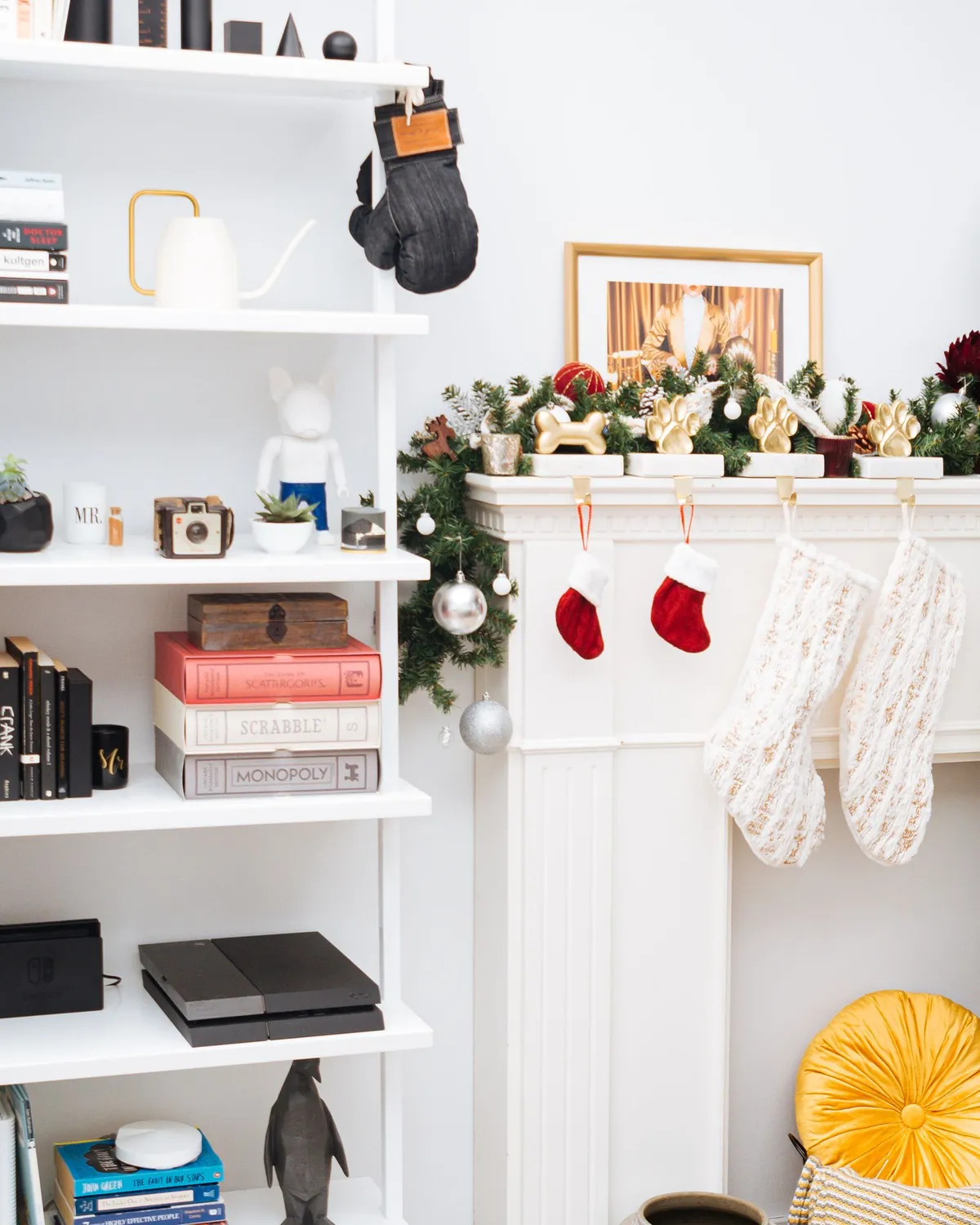
3. Use weighted stocking holders on any ledge
Stocking holders are not mantel-only equipment: any ledge with about an inch of overhang — a console table, a sideboard, the top of a bookcase, a piano — takes them exactly the same way. The weighted base grips the edge and hangs a 2–4 lb stocking off the front, with zero wall contact of any kind, which makes this the cleanest zero-damage option for renters and the fastest one on this list.
| Set size | Total stocking load | Best ledge | Risk |
|---|---|---|---|
| 2 holders | 4-8 lb | Console table | Low |
| 4 holders | 8-16 lb | Sideboard or bookcase | Low with real mass |
| 4 on wobbly table | 8-16 lb | Light IKEA side table | May tip forward |
| Ledge requirement | 1 in overhang | Any surface | Zero wall damage |
Two rules keep it working. First, check the ledge: a wobbly IKEA side table will tip forward with four loaded stockings leaning on its edge, so use something with real mass. Second, spread holders across the full ledge rather than clustering them at one end — the same physics that tips a bookcase with a heavy top shelf works here. This is also the only method that survives a roommate who rearranges furniture weekly, because the “installation” moves with the table.

As an Amazon Associate, Herpickery earns from qualifying purchases.

- Set of 4 weighted metal holders with snowflake tops — no wall contact, no strips, no holes
- Grips any ledge with an inch of overhang: mantel, console table, bookcase or piano top
- Hangs a 2–4 lb filled stocking off the front edge — the zero-damage renter option
4. Run a tension rod across the window
A spring tension rod sized to the window frame holds 10–20 lb spread across its length — four empty stockings, no problem at all. Hang them against the glass and you get a silhouette the whole street can see; add a short strand of battery lights around the frame and the display works from inside and outside at once. It’s the highest drama-per-dollar method here.
| Rod type | Total load | Stockings | Test before use |
|---|---|---|---|
| Strong spring rod | 10-20 lb | 4 stockings | Water jug in middle |
| Friction-fit shower rod | Not recommended | Slips under load | Insufficient spring force |
| Weight spread evenly | 10-20 lb | 4 across the span | Bunching defeats the rod |
| Take-down time | 10 seconds | Zero marks | Frame forgets it happened |
Do three things before trusting it. Measure the inside of the frame and buy a rod that presses in with real spring force, not a friction-fit shower curtain rod. Test it with a jug of water hung from the middle before the stockings go up. And distribute weight evenly — all four stockings bunched at one end is the one way to defeat a tension rod. When the season ends, the rod comes out in ten seconds and the window forgets it happened.

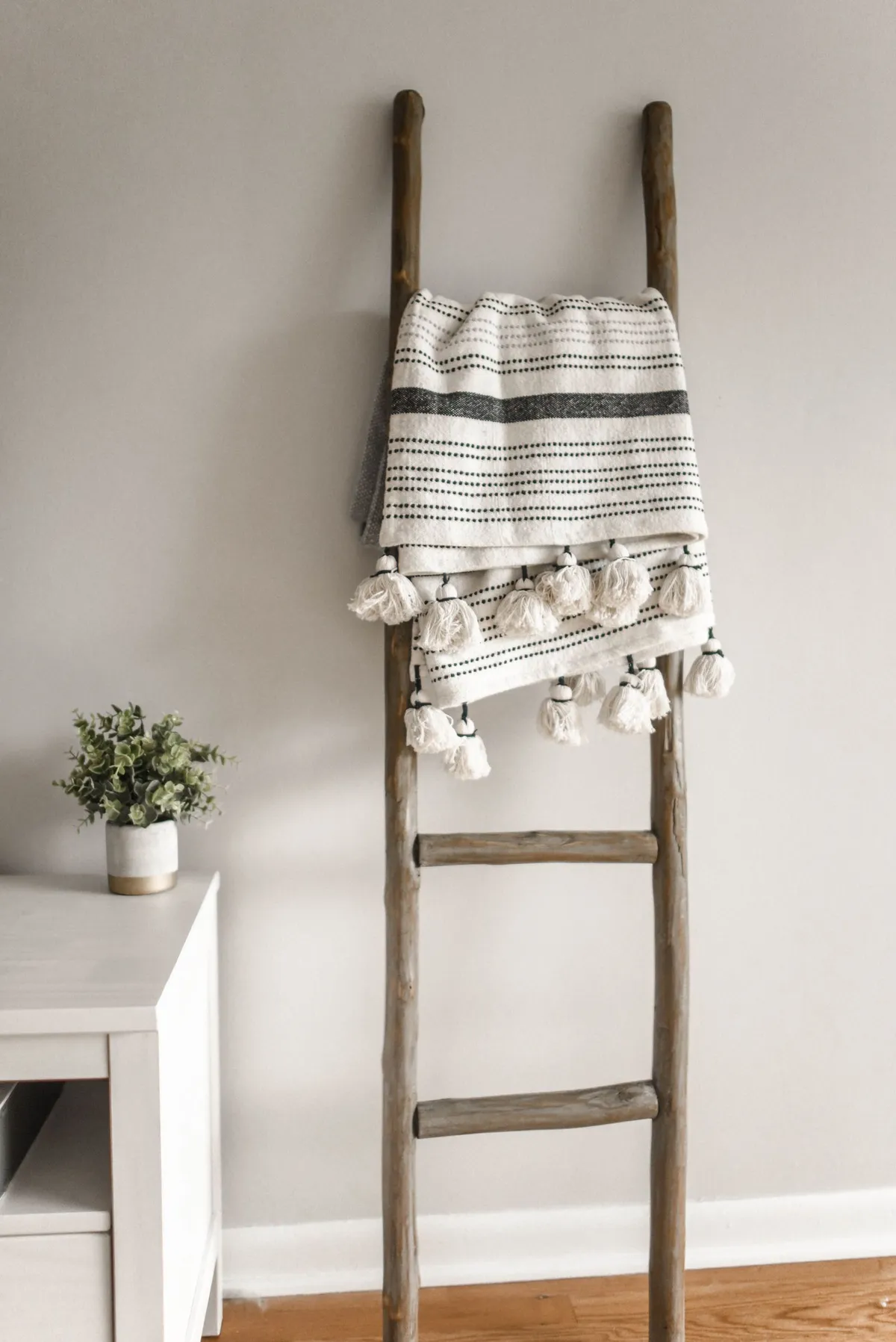
Turn a wooden ladder into the display
A ladder leaned about 15 degrees against the wall carries weight down through its own rails into the floor, not off the wall — that’s the physics reason it holds filled stockings with no anchors at all. One stocking per rung, anti-slip pads on both rails, and the whole thing is stable enough for a family of over-stuffers. It’s also the display guests photograph most, because it looks collected rather than installed.
| Ladder option | Height | Stockings | Typical cost |
|---|---|---|---|
| New decorative ladder | 5 ft | One per rung | $30-$60 |
| Thrift-store step ladder | 3-4 ft | One per step | $10-$25 |
| Leaning angle | 15 degrees | Weight goes to floor | No anchors needed |
| Rail protection | Anti-slip pads | Both rails | Spares paint and floor |
Wire a bit of greenery along the side rails to make it read as intentional, and give each family member their own rung so nobody’s stocking migrates overnight. Two cautions from experience: keep it out of the main walking path (the bottom rung catches ankles), and check the wall contact point — a rubber pad at the top protects paint better than bare wood ever will. A 5-foot decorative ladder runs $30–60 new; a thrift-store step ladder does the same job with more charm.
As an Amazon Associate, Herpickery earns from qualifying purchases.

- 6 tiers (5 dowels + bottom rung) at 70.9″ tall × 16.9″ wide — one stocking per rung, quilt on top
- Solid bamboo with a brown farmhouse finish and protective feet that spare your floors
- Assembles in under 5 minutes; leaned at 15 degrees, the weight goes to the floor, not the wall
String a clothesline between two hooks
Two screw hooks into studs, a length of 1/8-inch jute or macramé cord pulled tight, and wooden clothespins: the clothesline is the highest-capacity method in this list, because the cord shares the load between both ends instead of asking one hook to carry everything. Tighten it until it hums when you pluck it, and it will hold six filled stockings without visible sag on Christmas morning.
| Component | Spec | Capacity |
|---|---|---|
| 2 screw hooks | Into studs, 1 in vertical offset | 30 lb+ each |
| 1/8 in cord | Jute or macrame, pulled tight | 6 filled stockings |
| Tension check | Cord hums when plucked | No visible sag |
| Wooden clothespins | Clips plus name tags | Greenery sprigs too |
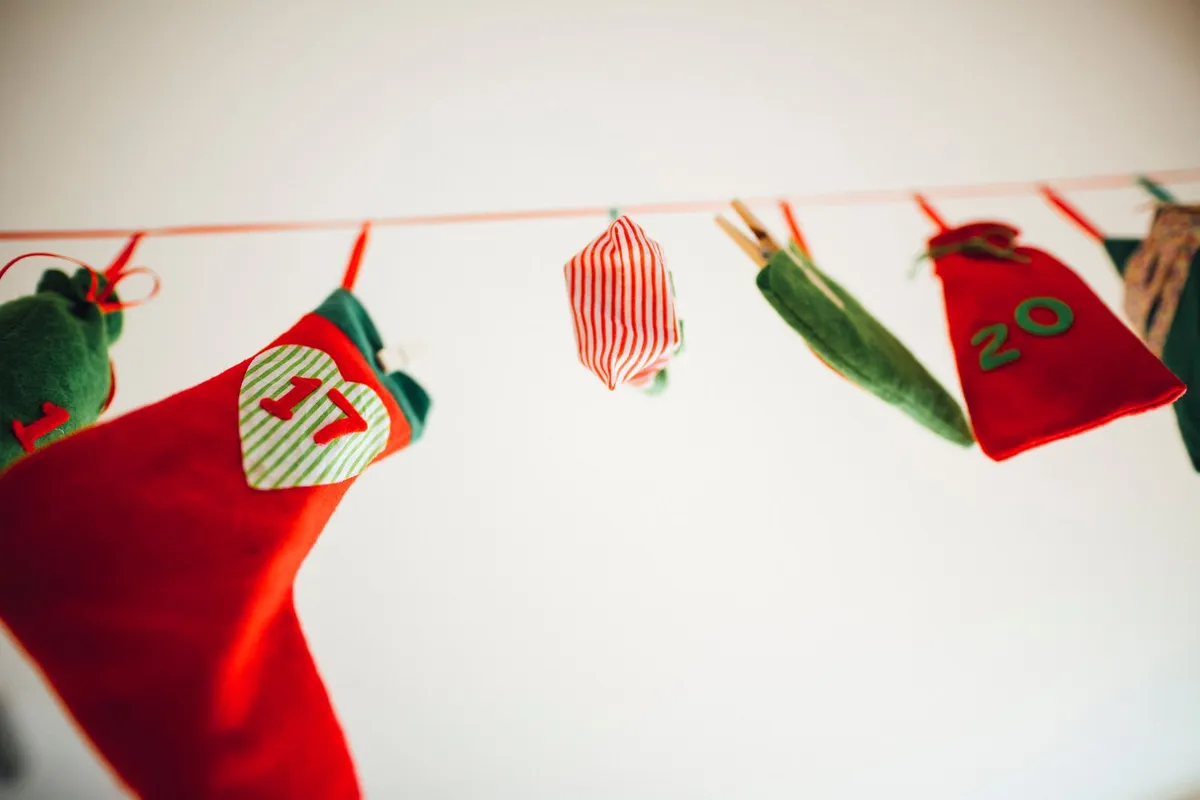
This is also the most forgiving method for imperfect walls — the hooks are an inch apart vertically at most, so both can usually land on studs even in older apartments with irregular framing. Tie the cord off with a bowline at each end so retightening on the 20th is a ten-second job. And keep the clothespins: they hold name tags, tiny greenery sprigs, and next year, the advent calendar you were going to buy.
Brick or tile? Use masonry anchors
A single sleeve anchor in brick or fired tile holds 40 lb or more — more than any drywall option on this page — but it costs you a hammer drill and a fifteen-minute window of commitment. For renters, skip straight to idea 8. For anyone with a stone chimney breast, an exposed brick wall, or a tiled kitchen run, this is the forever method: two anchors, a wooden rail between them, and stockings for the next twenty years.
| Surface | Anchor type | Load per anchor | Hole depth rule |
|---|---|---|---|
| Brick | Sleeve anchor | 40 lb+ | Sleeve + 1/4 in |
| Fired tile | Sleeve anchor | 40 lb+ | Sleeve + 1/4 in |
| Rail between 2 anchors | Wooden rail | 20 years of reuse | Set at mantel height |
| Tool required | Hammer drill | 15 min commitment | Bit must match sleeve |
The drill bit has to match the anchor sleeve exactly, and the hole depth matters more than the torque — 1/4 inch deeper than the sleeve is the rule of thumb. Blow the dust out before setting the anchor. The upsell nobody regrets: set the anchors once at mantel height and leave the rail up year-round as a plant or art rail, so the drilled holes earn their keep in all twelve months.
Command hooks, done right — the weight math
Command hooks hold a filled stocking only if you respect the printed number: small hooks hold 1 lb, medium 3 lb, large 5 lb, and the adhesive strip needs a full hour to cure before you load it. A felt stocking stuffed with candy and a paperback walks right past that 1 lb line, so the fix is arithmetic, not brand loyalty — for anything over 5 lb, use two hooks per stocking (one at the loop, one under the heel) and the load splits between them.
| Hardware | Realistic load | Surface | Leaves a mark? |
|---|---|---|---|
| Command mini hook | 1 lb | Drywall, tile, glass | No |
| Command medium hook | 3 lb | Drywall, tile | No |
| Command large hook | 5 lb | Drywall, painted wood | No |
| Two hooks, one stocking | 8–10 lb shared | Drywall | No |
| Screw hook into a stud | 30 lb+ | Drywall into stud | 1/8-inch hole |
| Drywall anchor + screw | 10–25 lb | Any drywall spot | Small hole |
| Masonry sleeve anchor | 40 lb+ | Brick, fired tile | Drilled hole |
| Tension rod | 10–20 lb total | Window, door frame | No |
| Over-door hook | About 10 lb | Door top edge | No |
| Weighted stocking holder | 2–4 lb each | Any 1-inch ledge | No |
One more rule the package doesn’t print: adhesive hooks fail by peeling, not breaking, so press the strip for a full 30 seconds and pull the tab warm — a hairdryer on cold mornings — when removal day comes. And never trust a Command hook above a radiator or heater; heat softens the adhesive at exactly the moment you’re not watching. Higher-rated clear steel hooks — some claim up to 44 lb per hook on smooth tile and glass — genuinely outperform fabric strips, but treat the printed number as a ceiling measured on an ideal surface; on painted drywall, assume half.
As an Amazon Associate, Herpickery earns from qualifying purchases.

- Rated up to 44 lb per hook on smooth hard surfaces — 22–44 lb depending on the wall
- Rustproof stainless steel with waterproof glue — tough enough for bathroom and kitchen tile
- No drill, no residue: peel, press 30 seconds, and remove later by warming the pad
Over-the-door hooks on the bedroom doors
An over-the-door hook set needs zero wall contact and holds about 10 lb per hook — one stocking on each kid’s door turns Christmas morning into a treasure hunt and keeps the living room walls clean for the big display. Square-top stockings sit best on the flat hook; measure the door gap first (most interior doors are 1 3/8 inches) so the hanger doesn’t rattle.
| Spec | Number | Note |
|---|---|---|
| Load per hook | About 10 lb | One stocking per door |
| Interior door thickness | 1 3/8 in | Measure gap to stop rattle |
| Two-pack cost | $10-$15 | Stores flat 11 months |
| Best placement | Closet doors | Flat against wood, out of traffic |
The underrated version: put the over-door hooks on closet doors instead, where the stockings hang flat against wood and out of the hallway traffic. Kids get a stocking at their own altitude, parents get the mantel-look wall in the living room, and nobody’s jammie-clad sprint on the 25th collides with a display at shin height. Total cost runs $10–15 for a two-pack, and it stores flat in eleven months of the year.
Style them out of the bookshelf
Shelf edges take S-hooks or small spring clips, one stocking per shelf, staggered across the unit so the eye travels. Two rules keep it safe: keep each shelf edge under about 3 lb of hanging weight, and park the heaviest books on the bottom shelf so the whole case’s center of gravity stays low. A loaded bookcase is already near its design limit — stockings are the last straw, not the first.
This is my favorite method for apartments because it needs no new hardware at all: the S-hooks cost about $6, and a bookshelf with a tree beside it (as in the photo) already reads as the festive corner of the room. Add one string of warm lights along the front edges and the stockings glow after dark — the cheapest upgrade with the biggest photographic payoff on this page.

The line behind the sofa
The wall behind the couch is the most-photographed bare stretch in any living room, and furniture has already claimed it from foot traffic — which makes it free real estate for stockings. Run two screw hooks or a slim rail just below the sofa-back height, hang the row of stockings, and the couch hides the hardware completely while the display frames the room from the exact angle every photo gets taken.
Measure before you commit: the stocking toes should clear the sofa back by 3–4 inches so nothing rubs fabric on fabric, and the hooks should sit above the sightline when you’re seated. If the sofa floats in the middle of the room, this idea flips into the tension rod from idea 4 — run the rod between the sofa back and the wall gap, and the stockings hang in the slot where nobody walks.

Kids’ stockings on the headboard
A stocking looped over a wooden headboard post is the first thing a kid sees on Christmas morning, before anyone has navigated to the living room — no wall, no hardware, no arguments about whose turn it is to touch the display. Felt loops fit posts up to about 2 inches square, and the method costs literally nothing if the stockings already have hanger loops.
One safety note worth printing: keep battery tea lights and string lights out of reach of the mattress edge, and never drape electric lights where a kid sleeps — the headboard version of this idea works best with the stockings alone, and the bedroom’s glow comes from a lamp across the room. For bunks and metal frames with no posts, idea 9’s over-door hook on the bedroom door covers the same instinct.

The hall tree already has the hardware
A coat rack or hall tree is engineered to carry 10 lb winter coats on every peg, so 4 lb stockings are a rounding error. Clear the coats to the bedroom closet for December, wire a short garland around the frame, and the entryway does double duty: stockings by day, a decorated welcome for every guest all month. Nothing to drill, nothing to buy beyond the garland.
This is the method that solves the “no wall space” complaint, because hall trees live exactly where stockings should — near the door Santa doesn’t use but the family does. Hang stockings on the pegs at their normal coat height, add a basket underneath for the overflow of wrapped gifts, and the entry becomes the drop zone and the display in one piece of furniture you already own.
A cabinet bar in the kitchen
Over-cabinet-door hooks or two small hooks under the upper cabinets put stockings exactly where breakfast happens — and since Christmas morning coffee is the busiest spot in the house, the display gets more views than anything on the living room wall. Tile backsplashes take adhesive hooks well if you clean the spot with rubbing alcohol first; painted cabinet wood takes them better than laminate.
| Surface | Hardware | Prep or note | Stocking weight |
|---|---|---|---|
| Tile backsplash | Adhesive hook | Clean with rubbing alcohol | Ounces (mini felt) |
| Painted cabinet wood | Adhesive hook | Grips better than laminate | Ounces (mini felt) |
| Under upper cabinets | 2 small hooks | One per family member | Ounces (mini felt) |
| Over cabinet doors | Over-door hooks | No counter space used | Candy cane only |
Scale down on purpose here: the mini felt stockings made for this setup are also the ones that photograph best, and they weigh ounces, not pounds, so even the gentlest adhesive hook holds them for weeks. Hang one per family member across a cabinet run, tuck a candy cane in each, and the kitchen joins the decoration scheme without occupying a single inch of counter.
Build the forever station
If this is your house for the next decade, skip everything temporary: a curtain rod with finials between two wall brackets, mounted into studs at mantel height, is a stocking station that comes back every December with five minutes of effort. Level it once, mark the bracket holes on painter’s tape, and next year’s install is two screws into marks you already made. The rod carries 20 lb+ spread across its length — stockings, garland, and the name banner, all on one rail.
| Component | Spec | Capacity or effort |
|---|---|---|
| Curtain rod with finials | 48-54 in off floor | 20 lb+ across length |
| Metal wall brackets | 2, screwed into studs | Real metal, not friction-fit |
| Bracket marks | Painter’s tape template | 2 screws next year |
| Yearly re-hang | 5 minutes of effort | Stockings, garland, banner |
Choose a rod with real metal brackets rather than the friction-fit kind, and pick a finish that matches your existing hardware so it reads as architecture rather than a December add-on. Between seasons the rail holds nothing but its own good looks — some families run artwork clips on it all year, which quietly turns the Christmas purchase into the hallway gallery system you were going to buy anyway.
What this actually costs
| Budget | What it buys | What you get |
|---|---|---|
| Under $25 — the renter | Tension rod + clips, or a Command hook pack + two felt stockings | A full display with zero holes, gone by January |
| Under $60 — the upgrade | Peg rail + screw hooks into studs, plus a garland to dress it | Looks built-in, holds 30 lb, reusable every year |
| Under $120 — the faux mantel | Floating shelf + brackets, stocked garland, weighted holders, one good ladder | A mantel that isn’t — and nobody asks where the fireplace went |
Before you hang: the setup checklist
The 12-point stocking setup
- ☐ Weighed one filled stocking on the kitchen scale, then picked hardware rated 2× over
- ☐ Found the studs and marked them with painter’s tape before any screw went in
- ☐ Peg rail or shelf checked with a level — twice
- ☐ Command strips pressed 30 seconds and cured a full hour before loading
- ☐ Tension rod tested with a water jug before the stockings went up
- ☐ Ladder leaned at 15 degrees with rubber pads on both rails
- ☐ Nothing flammable within 3 feet of any heat source — radiators included
- ☐ Battery candles only near fabric; no electric lights where kids sleep
- ☐ Toe of every stocking clears the floor by 6 inches
- ☐ Names on the clips or tags, not embroidered — stockings outlive the family lineup
- ☐ Cardstock insert cut from a cereal box to keep each stocking propped open
- ☐ Photo of this year’s layout saved for next year’s ten-minute re-hang
Related reading
For the rest of the December house: our porch decorating ideas that survive rain, the Christmas table that looks expensive, and the brunch table you set up the night before. After the 25th, the New Year’s Eve table that survives until midnight takes over, and the small dining room Thanksgiving setup covers the crowded-table problem year-round. More in Cozy Home.

Last updated: November 13, 2026
[…] the rest of the small-space December: our stocking ideas when you don’t have a fireplace (the hardware table pairs with the wall tree), the porch that survives rain, and the Christmas […]
[…] 15 Christmas Stocking Ideas When You Don’t Have a Fireplace […]