
My first December as a renter, I decorated like an owner: two drywall anchors for the garland, one molly bolt for the wreath, and a determined shove for the stocking hooks. The display looked fantastic until the move-out walkthrough, when my landlord ran a finger along the wall and found six craters I had spackled at 11 p.m. the night before — badly. The repair line on my deposit statement cost more than the entire decorating budget had. The tree had been free fun; the walls were the expensive part.
Here is the redo, done properly: what every no-nail fastener can honestly hold on painted drywall (half the printed number), what your decorations actually weigh, which surfaces reject adhesive completely, and the removal ritual that keeps the walkthrough friendly. One rule runs the whole article — the load table is a contract with your deposit.
Table of Contents — 12 Ideas
- What can renters hang without nails?
- How much weight can a damage-free hook really hold?
- How much does Christmas decor actually weigh?
- Do adhesive hooks work on textured walls and wallpaper?
- How do you hang a garland on a rental wall?
- Where does the tree go in a small rental?
- Can I hang lights in a rental window without damage?
- How do I hide light cords without stapling them?
- Do tension rods and over-door hooks damage anything?
- How do I remove hooks without peeling paint?
- What if the paint peels anyway?
- The renter’s no-nail shopping list
1. The three rules of renter decor
What can renters hang without nails?

Three rules decide everything. Rule one: the surface is the contract — smooth painted drywall accepts damage-free adhesives, textured and wallpapered surfaces mostly don’t, and wood trim belongs to tension and pressure, not glue. Rule two: the honest load is half the printed load, because the rating was earned on a clean test wall, not on eleven-year-old eggshell paint over contractor mud. Rule three: any hook with a lever arm multiplies weight — a wreath on an out-sticking hook pulls with three times its own heft at the adhesive line.
Inside those rules, almost the entire holiday catalog is available to you: wreaths under 2 lb, garlands in 2 lb stretches, stockings on a mantel-less ledge, window lights, door decor, and a tree that stands on its own feet or on a cabinet. What stays off the list is the stuff that genuinely needs anchors: a 7.5-foot tree hung on a wall bracket, heavy advent arrangements, anything a toddler can yank. If an item can be leaned, hooked on a door, or stood on furniture, it never touches an adhesive at all — the cheapest fastener is gravity.
2. The honest load table
How much weight can a damage-free hook really hold?
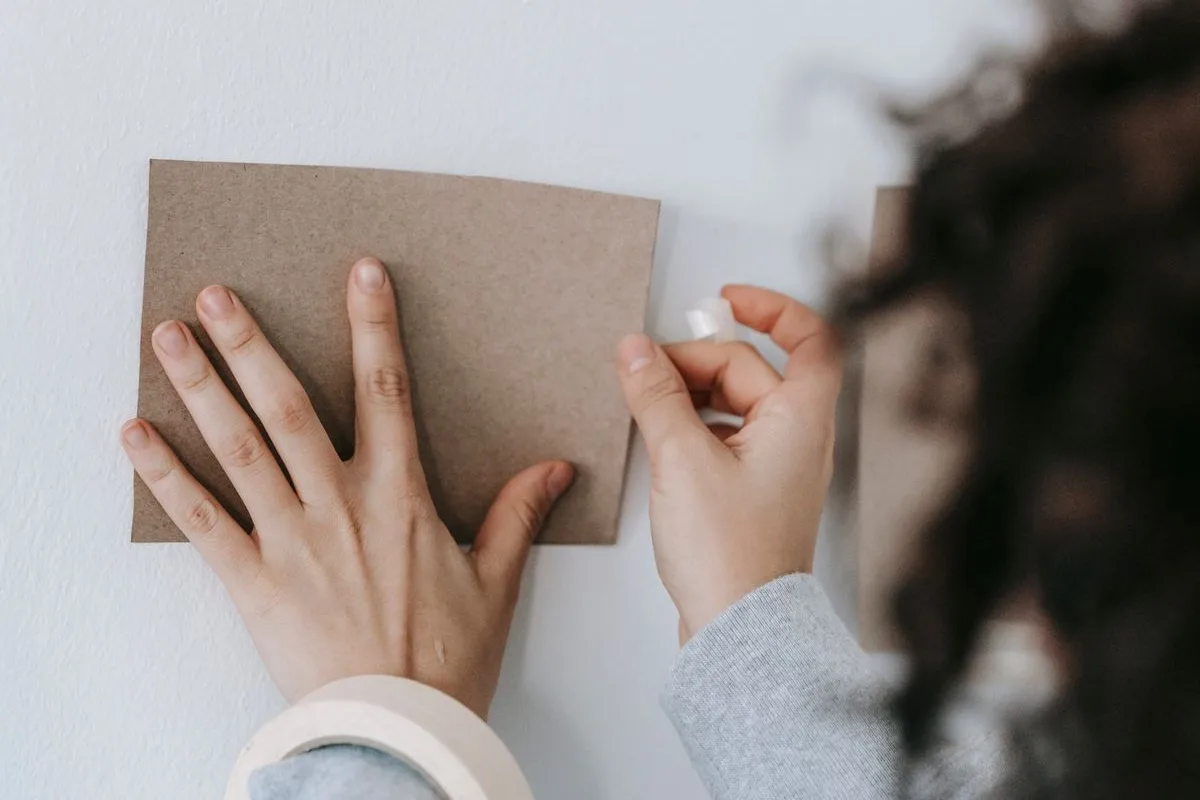
The printed rating is a laboratory number: fresh paint, clean drywall, room temperature, a straight pull. Your rental gives the adhesive none of those guarantees, so the working rule is to trust half the label on painted drywall — and a quarter of it on paint older than five years or applied by the cheapest bidder. Pressure matters as much as weight: press the whole strip for a full 30 seconds, then wait an hour before hanging anything, because the bond strengthens as the adhesive flows into the paint’s microscopic texture.
| Fastener | Printed rating | Trust on painted drywall | Honestly holds |
|---|---|---|---|
| Mini adhesive hook (1 hook) | 1 lb | 0.5 lb | Window candle, single stocking (empty), light strand end |
| Medium adhesive hook | 3 lb | 1.5 lb | Wreath up to 24″, stocking with stuffers, 9 ft garland stretch |
| Large adhesive hook | 5 lb | 2.5 lb | Two garland stretches meeting, heavy wreath, light-string bundle |
| Adhesive strip pair (no hook) | 12 lb (pair) | 6 lb | Small framed art swap — the strongest legal move in a rental |
| Picture hook (brass nail) | 20 lb | tiny hole, patchable | Only if your lease allows “small nail holes” — check clause 4 |
| Drywall anchor + screw | 25-50 lb | rental-grade no | Nothing in December is worth the crater. Skip it. |
The table’s quiet hero is the strip pair: two adhesive strips rated 12 lb as a pair, applied to the back of a lightweight frame or a foam wreath form, hold six honest pounds with no lever arm at all — the load sits flat against the wall instead of hanging off a hook. That geometry is why professional renters hang wreaths on strips, not hooks, whenever the wreath has a flat back.
As an Amazon Associate, we earn from qualifying purchases.

- Large strips with a printed 5 lb (2.2 kg) rating – plan the honest working load at half of that, per the table above
- 20 replacement strips that turn any flat-backed wreath or frame into a strip pair – the 12 lb pair trick from the table, without buying new hooks
- Stretch-release tabs pull straight down for clean removal – the idea 10 ritual works on every strip
Price and availability shown on Amazon; listing may change.
3. What your decorations actually weigh
How much does Christmas decor actually weigh?
| Decoration | Typical weight | Honest fastener | Where it lives |
|---|---|---|---|
| 24 in artificial wreath | 1-2 lb | Medium hook (3 lb rated) or strip pair | Wall or door |
| 9 ft artificial garland | 1.5-2.5 lb | Two medium hooks in 2 lb stretches | Wall or alcove rod |
| Empty stocking | 0.3 lb | Mini hook (1 lb rated) | Mantel ledge or shelf |
| Stocking, filled | up to 2.5 lb | Medium hook, hung on a shelf edge | Bookcase or ledge |
| Single light strand | 0.5-1 lb | Mini hooks or cord clips | Window or headboard |
| Window candle | under 0.5 lb | Mini hook or suction cup | Glass, full rating |
| 4 ft potted tree | 15-20 lb | None – floor or cabinet only | Corner or cabinet top |
| Fresh greens mantel arrangement | up to 4 lb | None – sits on the mantel itself | Shelf or bookcase top |

Nobody weighs a wreath until it’s sliding down the wall with a hook attached. The numbers that matter: a 24-inch artificial wreath runs 1 to 2 lb, a 9-foot artificial garland about 1.5 to 2.5 lb depending on pine-tip density, an empty stocking 0.3 lb that balloons to 2.5 lb once the kids add a book and a chocolate orange, a single light strand 0.5 to 1 lb, and a window candle under 0.5 lb. Every one of those fits an honest half-rated hook with room to spare — which is the actual point of the table in idea 2.
The things that blow the budget are the ones with mass in the middle: a 4-foot potted tree is 15 to 20 lb, a decorated mantel arrangement with fresh greens can hit 4 lb before the candlesticks, and a “lightweight” felt advent calendar gains a pound as the pockets fill. Those live on floors, cabinets and shelving — surfaces that take weight without complaint. If a decoration needs both hands to lift, the wall is not its home, and no adhesive rating will argue you out of that.
4. Surfaces that reject adhesive
Do adhesive hooks work on textured walls and wallpaper?

Adhesive bonds to surface area, and texture is the enemy of area. Orange-peel and knockdown drywall cuts real contact by more than half, wallpaper loses its own face when the strip pulls off, and fresh paint within 30 days hasn’t cured enough to share its strength. The test costs one cheap hook: press it in a low corner behind a door, wait 24 hours, remove per the ritual in idea 10, and inspect. If the hook peels clean and the paint stays put, your walls are a yes. If either fails, your walls are a lean-and-tension household — and the rest of this article still covers you.
| Surface | Best no-nail fastener | Verdict |
|---|---|---|
| Smooth painted drywall | Damage-free adhesive hooks and strips | Full yes — the load table applies |
| Textured drywall | Strip pairs on flat decor backs; hooks only after the corner test | Halve the honest load again |
| Wallpaper | Nothing adhesive; tension rods and door hooks only | Wallpaper tears with its backing — never test it |
| Tile and glass | Suction cups | Full yes in kitchens and baths |
| Wood trim and door frames | Tension, wedges and over-door hooks | Full yes — pressure, not glue |
| Brick and plaster | Brick clips that grip without drilling | Yes for the fireplace wall, if it’s real brick |
The wallpaper verdict is absolute for a reason: wallpaper adhesive lets go in sheets, and a strip that releases cleanly from paint takes wallpaper’s printed face with it. Repainting is $40 of your money; re-papering is a professional line item billed to your deposit. There is no wreath in the world worth that sentence.
5. Garland without nails
How do you hang a garland on a rental wall?

Divide the garland route into 2 lb stretches and give each stretch its own medium hook — for a 9-foot garland that’s two hooks, for 18 feet four. Never ask one hook to carry a continuous run, because the run’s full weight plus the sag angle concentrates at the first hook, and the lever-arm rule triples the effective pull. Hook the garland’s wire spine, not the tips; tips pull out and shed needles down the wall.
The no-adhesive alternative that rental pros use is compression, not glue: a tension rod inside the window frame or between two walls in an alcove carries the garland on its own spring, leaves zero residue and comes down in ten seconds. On a mantel-less fireplace, a garland wrapped around a tension rod between the two mantel-corbels — or laid along a picture ledge — reads as built-in decor. And the zero-effort option: swag the garland across the front of a bookshelf or a curtain rod bracket that’s already installed. The stair garland length math applies unchanged to walls — measure, multiply by 1.5 for the drape, buy that length.
Four ways to get a garland up without touching the deposit, ranked by what each one asks of the wall — the first row is the hook math from Section 2, the rest borrow hardware the wall already has:
| Method | Carries | Works on | Damage risk |
|---|---|---|---|
| Medium hooks in 2 lb stretches | 9 ft = 2 hooks, 18 ft = 4 | Painted drywall, tile, glass | None if each tab pulls straight down |
| Tension rod in frame or alcove | Full garland length, no dividing | Two smooth parallel surfaces | Zero — spring pressure only |
| Picture ledge (already installed) | Full run, laid on top | Any wall with an existing ledge | Zero — nothing new mounted |
| Swag over shelf or curtain brackets | 9–12 ft swag between anchor points | Hardware already in the wall | Zero — weight rests on the fixture |
| Mounting putty, light garlands only | Felt, paper or ribbon styles under a few ounces | Wood trim, tile, glass, painted mantels | Rolls off clean with press-and-lift |
As an Amazon Associate, we earn from qualifying purchases.

- Reusable, non-toxic putty for light flat-backed decor – felt garlands, paper advent calendars and stocking prints under a few ounces
- Grips surfaces adhesive strips will not trust: wood trim, tile, glass, painted mantels and door frames
- Rolls off clean with a slow press-and-lift – zero residue, zero paint lift, zero deposit drama
Price and availability shown on Amazon; listing may change.
6. The tree in a small rental
Where does the Christmas tree go in a small rental?

The tree is the one decoration that never argues with the wall, so the question is pure floor math. A 4.5-foot slim tree needs a footprint of about 3 square feet plus a walk-around arc; a 2-foot tabletop tree needs one cabinet top. The corner behind the sofa, the alcove by the entry, the landing at the top of the stairs — every rental owns at least 3 square feet of dead December space, and the tree footprint math page sizes the full range from tabletop to 7.5 feet.
Two upgrades make a small rental tree feel intentional instead of compromised. First, the basket: a woven basket around the stand hides the plastic, adds texture and, on hardwood floors, keeps the tree from walking. Second, elevation: a tree on a sturdy cabinet or an unused bench sits at eye level, stays out of toddler and cat trajectories, and makes a 3-foot tree read as a statement instead of an apology — the cabinet photo in idea 3 is exactly the move. If a cat lives in the unit, add the anchor rules from the cat-proofing guide before the first ornament goes on.
7. Windows: the renter’s free wall
Can I hang lights in a rental window without damage?
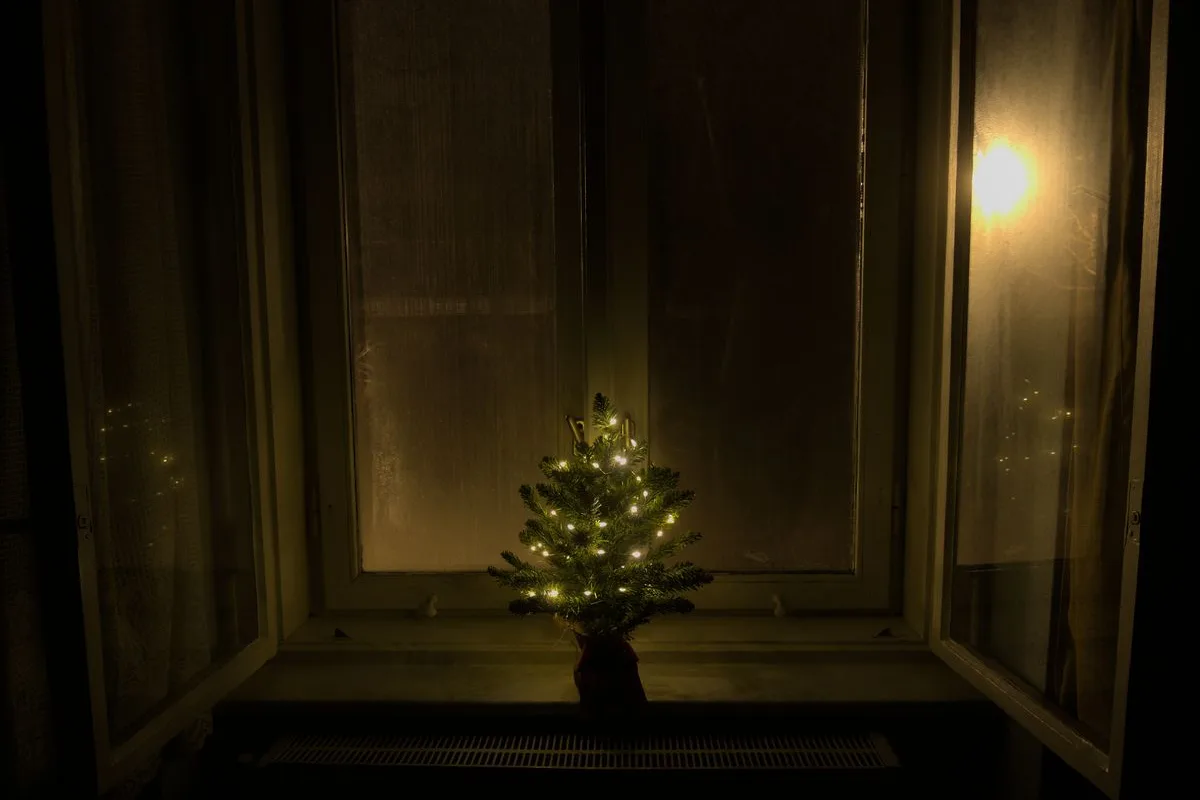
Glass is the renter’s best surface because suction cups grip it at full rated strength — no halving, no corner test, no curing time. The complete window playbook, sized and load-tested, is in the window and door lights guide: outline math at 1.1 times the perimeter, suction hooks at an honest half-rating, and the cord-routing rule that keeps every sash closable. Battery strands with built-in timers finish the job without a single cord crossing the frame — the 6-hour timer math applies to window displays exactly as it does to trees.
The bonus window trick costs nothing: a light strand coiled loosely inside a glass vase or lantern on the sill reads as a designed display from the street and asks zero fasteners of any kind. Pair it with the tiny tree on the sill and the window becomes the whole ground-floor show — which matters in a walk-up, where the neighbors’ view of your decorating is exactly one pane wide.
8. Cords without staples
How do I hide light cords without stapling them?
| Cord method | Typical cost | Holds | Best for |
|---|---|---|---|
| Adhesive cord clips | $4-8 per pack | Light strands, under 1 lb runs | Headboard runs, window outlines |
| Removable cord covers | $8-15 per kit | Full cord drops to the floor | Visible wall runs in white or brown |
| Furniture routing | $0 | Any cord it can hide | Behind sofas, shelf backs, rug edges |
| Battery strands with timer | $10-20 per strand | Zero outlet dependence | Displays far from any outlet |
| Staples | 40 deposit deductions | Never – bites insulation | Nothing in a rental, ever |
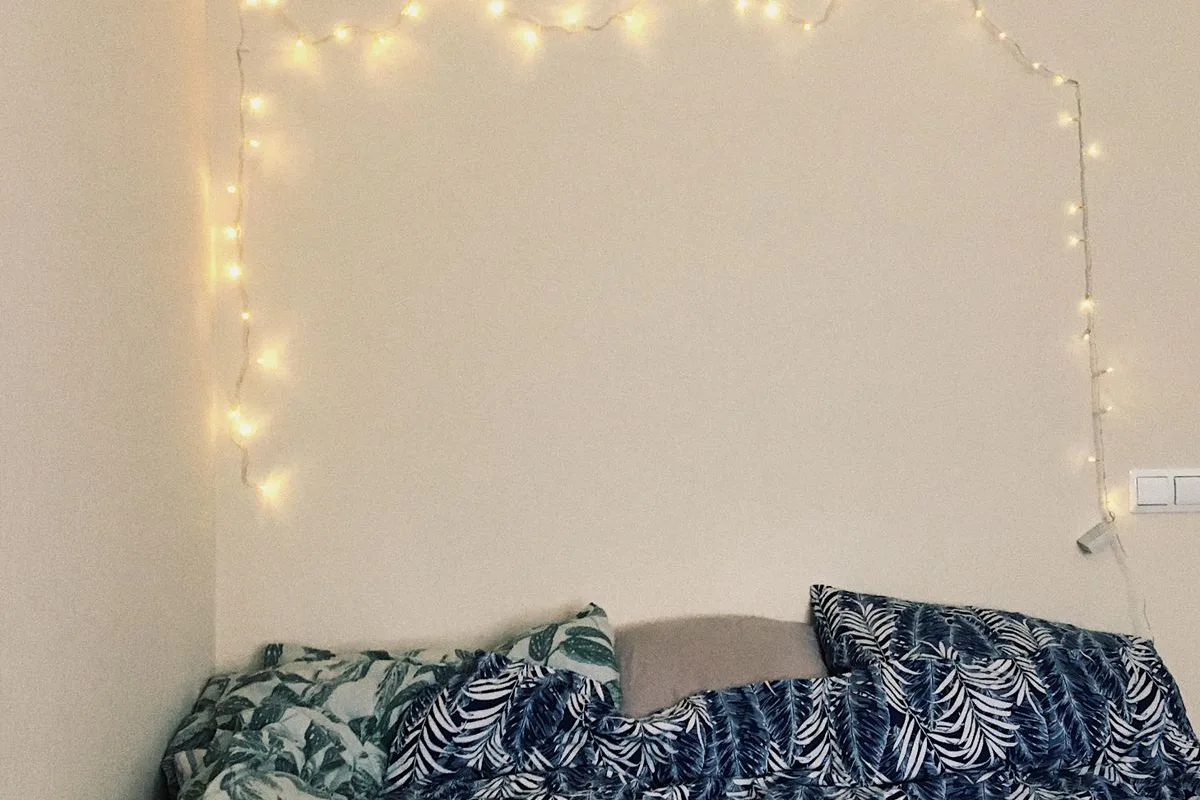
The stapler is the one tool a renter’s December must never touch — a staple every 8 inches along a cord is 40 tiny deposit deductions and a genuine fire-safety downgrade, because staples can bite insulation. The no-damage toolkit instead: adhesive cord clips (a hook in miniature, rated under 1 lb but cords are light), removable cord covers in white or brown that stick with the same damage-free strips as hooks, and furniture routing — cords that run behind sofas, down shelf backs and under rug edges need no fastener at all.
Where the cord meets the outlet, two habits finish the job. First, no cord under a door or a window sash — the compression from idea 5’s tension rod argument cuts insulation just as happily as a staple does, and the outlet wattage guide explains why a pinched run is the one failure that starts warm. Second, battery strands for the displays furthest from any outlet: a bedroom headboard run like the photo above is a 5-minute adhesive-clip job when the lights carry their own batteries and their own timer. For exterior-grade runs, Family Handyman’s guide to hanging Christmas lights covers the clip spacing the pros use on gutters and rooflines.
9. Compression decor: rods, doors and shelves
Do tension rods and over-door hooks damage anything?
| Compression method | Holds | Best for | Worst-case damage |
|---|---|---|---|
| Spring tension rod (5-10 lb rated) | Garland, light strand, stocking display | Window frames, alcoves, mantel-less fireplaces | Pad shine that wipes off; scuff if over-tightened |
| Over-the-door hook (10-20 lb rated) | Wreaths, stocking trios, slim door-hung tree | Entry doors on the door’s own structure | None inside the hook range |
| Brick clip (no-drill grip) | Garland on a real brick fireplace wall | Brick openings 2-8 in, genuine brick only | None if sized correctly |
| Existing floating shelf | Whatever it held before, plus tinsel | Mantel-less bookcase tops and styled shelving | Nothing new – gravity only |

Compression is the only force your landlord can’t bill you for. A spring tension rod rated 5 to 10 lb holds a garland, a light strand or a hanging stocking display inside any window frame or alcove; the rubber pads leave a shine that wipes off, and an over-tightened rod’s worst accident is a small paint scuff at pad level. Over-the-door hooks carry 10 to 20 lb on the door’s own structure — wreaths, stocking trios, even a slim tree-hung-from-the-door trick for the narrowest entries — and the entryway guide builds a whole welcome display from that single hardware piece.
Shelving and furniture count as compression too, in the sense that gravity is the only fastener: styled shelves, a mantel-less bookcase top, the cabinet tree from idea 3. The honest limit is the shelf’s own rating — a floating shelf anchored by the previous tenant holds what it held before you moved in, plus tinsel. The full wreath-on-a-door playbook, including the gap and closing-force math for doors that bite, arrives with the next article on hanging a wreath without damage.
10. The removal ritual
How do I remove hooks without peeling paint?
Every damage-free strip has a release tab printed with an arrow, and every deposit disaster starts with ignoring it. The ritual, in order: pull the tab straight down along the wall — never out toward you — while pressing the hook’s body against the wall with a fingertip, so the strip stretches instead of levering the paint. Keep pulling until the strip releases; a stretch of 6 to 12 inches is normal. If the tab snaps mid-pull, work dental floss behind the remaining adhesive in a sawing motion, warmed first by a hair dryer on low for 30 seconds.
Two timing rules protect the paint. Removal should happen at room temperature — cold adhesive grabs paint with the strip, so January teardown in an unheated hallway is the classic self-inflicted wound; warm the room or the strips first. And an unopened hook that has survived the season can simply stay on the wall until next December: the adhesive cures but the release tab keeps working, and next year’s decorating starts 90 seconds ahead of schedule.
The same ritual, condensed into a trouble-shooting table — pin it inside the cleaning cupboard door in November and January teardown loses its teeth:
| Situation | The move | Why it works |
|---|---|---|
| Every planned removal | Press the hook body to the wall, pull the tab straight down along the surface | The strip stretches 6–12 in instead of levering paint off |
| Tab snaps mid-pull | Hair dryer on low for 30 seconds, then saw dental floss behind the adhesive | Warm adhesive releases paint; floss slices what is left |
| January teardown in a cold hallway | Warm the room or the strips before touching a tab | Cold adhesive grabs paint and pulls it off with the strip |
| Unopened hooks that survived the season | Leave them on the wall until next December | Cured adhesive still releases on the tab — next year starts 90 seconds ahead |
As an Amazon Associate, we earn from qualifying purchases.

- Two 250 g tubes of white mending paste for nail holes and hook scars – the move-out insurance if a hook ever bites the wall
- Kit includes sandpaper, a spreader and nozzle tips – squeeze, smooth, sand, then touch up with paint
- Dries to a paintable finish that blends into the wall before the landlord’s walkthrough
Price and availability shown on Amazon; listing may change.
11. The paint-peel contingency
What if the paint peels anyway?
Sometimes the wall wins despite the ritual — the paint lifts in a coin-sized circle with the strip, or an old hook from the previous tenant finally lets go and takes company. The response sequence, fastest to slowest: a magic eraser for scuffs, a dab of color-matched paint from a $7 sample pot for small peels, and spackle-sand-paint for anything down to the mud. A weekend repair kit runs about $25 — spackle, a putty knife, sanding sponge, the paint sample — and it is the cheapest insurance against a $200 deduction, which is roughly what “walls: repainting required” costs on a move-out statement.
Two record-keeping habits close the loop. Photograph every wall the day you move in, date-stamped, because damage you can prove pre-dates you is damage you don’t pay for — including the previous tenant’s craters. And photograph your own walls the evening after teardown, while the room is clean and bright: a set of “wall, post-decoration, undamaged” photos has ended more deposit arguments before they started than any receipt in a folder. If the lease allows small nail holes, note the clause number; if it doesn’t, the entire load table in idea 2 just became your lease compliance strategy.
12. The kit and the checklist
The renter’s no-nail shopping list
The whole renter display runs on five purchases, most under $15: a mixed pack of damage-free hooks (sizes 1 to 5 lb, at least six hooks), adhesive strip pairs for flat-backed decor, one tension rod for the garland alcove or window, a roll of adhesive cord clips, and the repair kit from idea 11 that you hopefully never open. Add a wreath via over-door hook, lights via the window playbook, and a tree via floor or cabinet, and the apartment is decorated from door to sill with nothing printed on the move-out statement.
| Kit item | Typical price | Quantity to buy | Covers |
|---|---|---|---|
| Mixed damage-free hook pack (1-5 lb) | $10-15 | 6+ hooks | Wreath, garland stretches, stockings |
| Adhesive strip pairs (refill) | $5-8 | 1 pack | Flat-backed wreaths and frames |
| Spring tension rod | $8-15 | 1 | Garland in window or alcove |
| Adhesive cord clips | $4-8 | 1 roll | Light strands without staples |
| Over-the-door hook | $8-15 | 1-2 | Door wreath, entry display |
| Wall repair kit | $20-30 | 1, unopened | Insurance for the walkthrough |

The renter’s December checklist — save it, then walk the walkthrough with confidence:
- ☐ Corner test hook installed and inspected (24-hour wait)
- ☐ Load table applied: every hook carries half its printed rating or less
- ☐ No adhesive on wallpaper, texture, or paint newer than 30 days
- ☐ Garland split into 2 lb stretches, one hook each
- ☐ Tree on floor or cabinet, basket base, 3 sq ft of dead space found
- ☐ Windows done with suction cups at full rating (glass never halves)
- ☐ Cords: no staples, no door gaps, no sash crush points
- ☐ Teardown scheduled at room temperature, tabs pulled straight down
- ☐ Move-in photos on file; teardown photos taken the same evening
- ☐ Repair kit in the closet, unopened, taunting no one
Ornament counts for the small tree, and the math for lighting it, live in the ornament and lights guide — a 3-foot tree wants about 35 ornaments and one 33-foot light strand, which is the smallest satisfying number in the whole hobby.
Related Reading
- Window and Door Lights Without Nails or Damage
- Wreath on a Door Without Damage: Gap, Weight, Hook Math
- Christmas Tree Footprint Math: Floor Space, Skirt Size and the Gifts Underneath
- Stair Garland Math: How Much Garland for a Banister
- Light Timer Schedules: The 6-Hour Math
- Christmas Card Display Math: Cards, Ribbon and Wall Space
Last updated: November 25, 2026. The walls in this article’s photos belong to a rental, and the deposit came back whole.