
My second apartment had a standard 8-foot ceiling and my ambition had a 7.5-foot tree. I bought it anyway, reasoned the box number away, and spent setup night with a star topper pressed flat against the plaster like it was being arrested. The tree stayed up all December bent slightly to one side — the “leaning for charm” era of my life — and I took the topper off every time I vacuumed.
Tree height is the easiest Christmas math and the most often skipped, because the box sells you a number that is already wrong: the tree that fits your room is box height minus the stand, minus the topper, minus a 6-inch breathing gap — and the ceiling fan counts too. This page runs the full vertical audit: the formula, a ceiling-by-ceiling table, what to do when the tree is already home and too tall, the topper and fan rules, and the tabletop and slim-tree escape hatches.
Table of Contents — 12 Ideas
- How tall of a tree for an 8-foot ceiling?
- Topper clearance: the 6-inch floor, the 12-inch comfort
- What height tree for a 7-foot ceiling?
- The tree is already home: cut the bottom, not the top
- Ceiling fans and chandeliers: the spin zone
- Sloped ceilings and attic rooms
- Slim and half trees: height won’t shrink, spread will
- Tabletop trees: buying back 30 inches of height
- Measuring before you buy: the two-tape test
- When the tree shrinks: redoing the ornament math
- Vaulted and 10-foot ceilings: going big safely
- The height checklist
1. How tall of a tree for an 8-foot ceiling?
How tall of a Christmas tree fits an 8-foot ceiling?
The 8-foot ceiling is the standard American room and the standard tree trap, because 7.5-foot trees are sold by the millions to people with 96 inches of air: the formula is ceiling − 6″ gap − stand (2–3″) − topper (6–12″) = maximum tree height, which means an 8-foot ceiling fits a 6.5-foot tree with a topper, or a 7–7.25-foot tree without one. A 7.5-foot tree on a stand clears a bare 8-foot ceiling by about half an inch — the topper has nowhere to go but sideways.
| Ceiling | Height budget (−6″ gap) | Max tree with topper | Max tree without |
|---|---|---|---|
| 7 ft (84″) | 78″ | 5.5 ft | 6 ft |
| 8 ft (96″) | 90″ | 6.5 ft | 7–7.25 ft |
| 9 ft (108″) | 102″ | 7.5 ft | 8 ft |
| 10 ft (120″) | 114″ | 8.5–9 ft | 9 ft |
The “6-inch gap” is not caution theater: trees settle, toppers tilt in a draft, and the day you carry a ladder in to water-adjust the star is the day you want clearance to look up without headbutting drywall. Skip the gap and every other number on this page still works — you just spend December flinching.
2. Topper clearance: the 6-inch floor, the 12-inch comfort
How much space do you need between tree topper and ceiling?
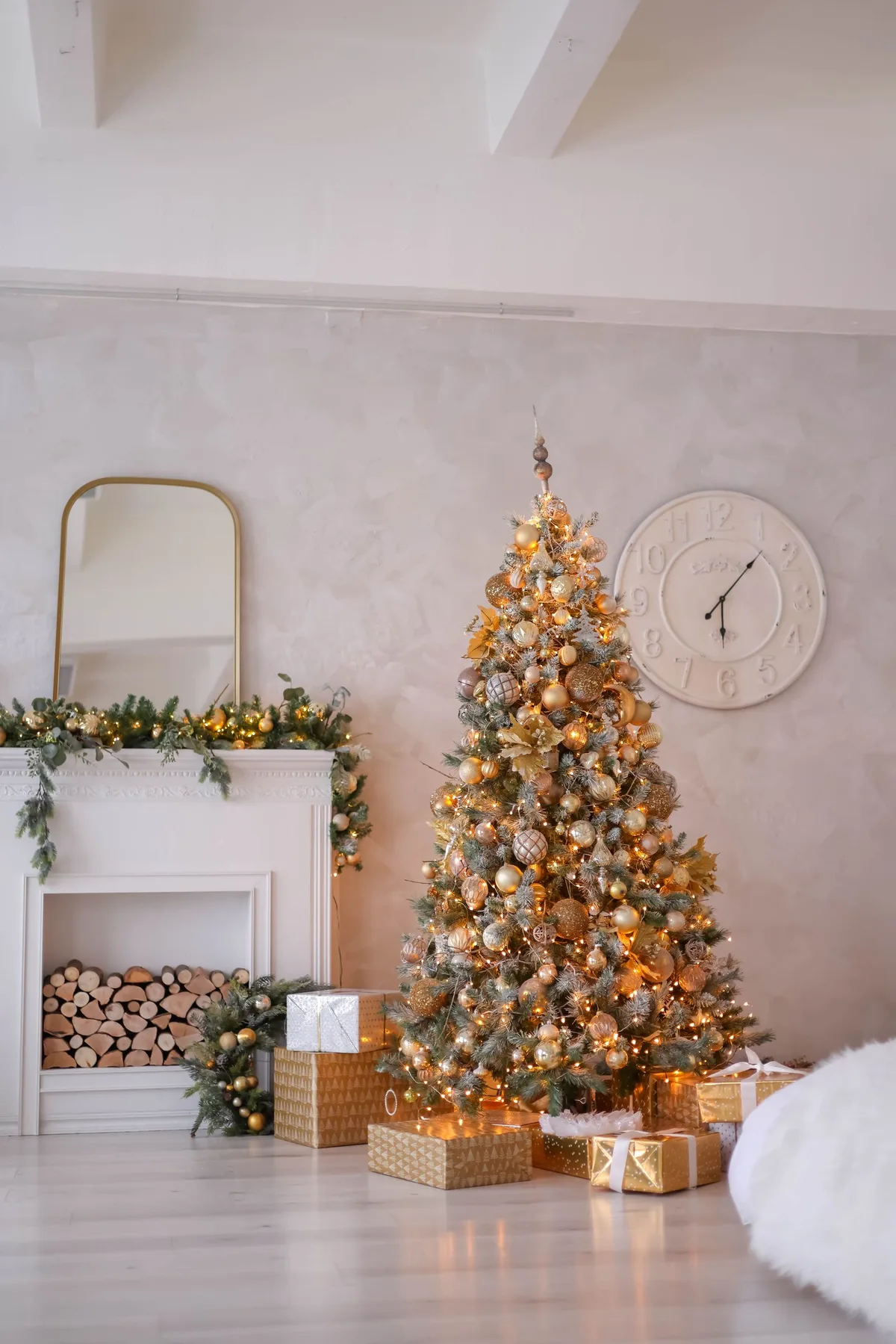
Toppers are the part everyone measures last and regrets first: leave at least 6 inches between the topper’s highest point and the ceiling — 12 inches if you own a ladder-averse household or a ceiling fan — because toppers add 6 to 16 inches depending on type, and the tall ones arrive bent or leaning by Boxing Day. A star that touches the ceiling reads as an error in every photo; a star with a foot of air reads as a finished room.
| Topper type | Typical added height | Ceiling clearance needed |
|---|---|---|
| Bow or ribbon cluster | 4–8″ | 6″ minimum |
| Classic star (10–12″) | 8–12″ | 6″ minimum, 12″ comfortable |
| Lighted star / projection | 10–14″ | 12″ (light needs air to read) |
| Angel figurine | 8–16″ | 12″ |
| Branch and floral spray | 12–16″ | 12″+ — it tilts and sways |
The budget trick: if the tree already fits tight, swap a tall angel for a low bow — you recover 6 to 8 inches of air without touching the tree. A lighted topper needs its 12 inches doubly, because the glow reads best with dark space above it; pressed against paint, it just makes a bright smudge on the ceiling.
As an Amazon Associate, we earn from qualifying purchases.

- 3D hollow star stands 9.8″ tall — inside the 6–16″ topper budget the table above assumes
- Built-in LED throws rotating cool-white snowflakes across the ceiling above the tree
- 9.2 ft plug cord reaches the wall outlet without daisy-chaining extensions up the trunk
Price and availability shown on Amazon; listing may change.
3. What height tree for a 7-foot ceiling?
What height Christmas tree fits a 7-foot ceiling?
Basement dens, older cottages and ground-floor conversions run 84 inches from floor to plaster, and the tree choice gets genuinely tight: a 7-foot ceiling fits a 6-foot tree without a topper or a 5.5-foot tree with one — and the compact-topper swap (a bow instead of an angel) is what turns a cramped 5.5-footer into a finished-looking 6-footer. The classic mistake is buying a 6.5-foot “apartment” tree for a 7-foot ceiling; the label means narrow, not short, and the tip still lands in the plaster.
If the room’s proportions demand more tree than the ceiling allows, go up with it instead: a 4-foot tree on a 30-inch console reads 6.5 feet tall to the eye, with the topper at a comfortable 6.9 — see the tabletop math in idea 8. The floor stays clear, the footprint guide’s tape-oval test gets easier, and the tree sits at eye level where the ornaments actually show.
| 7-foot ceiling setup | Tree height | Topper | Where the tip lands |
|---|---|---|---|
| No topper planned | 6 ft (72 in) | None | 12 inches of air — the honest max |
| Topper wanted | 5.5 ft | Compact bow instead of an angel | Finished-looking 6-footer |
| Classic mistake | 6.5 ft “apartment” tree | Any | Label means narrow, not short — tip in the plaster |
| Room demands more tree | 4 ft on a 30-in console | Yes | Reads 6.5 ft; topper at a comfortable 6.9 |

4. The tree is already home: cut the bottom, not the top
Can you cut the bottom off a Christmas tree to make it shorter?
Yes, and it’s the only trim that helps: a real tree can lose 6 to 12 inches from the bottom — cut the trunk’s base with a saw, re-drill the center hole for the stand’s spike, and the tree stands shorter with no visible change — while cutting or bending the top destroys the tree’s shape permanently. The bottom cut comes with a bonus: a fresh cut across the base is exactly what the tree wanted anyway, because sap seals a cut trunk within hours and blocks water uptake. You’re not shortening the tree, you’re repotting it.
The redo math: measure the current tree-top-to-ceiling gap, subtract 6 inches, and cut that much off the base (12 if a fan hangs over). Re-drill the center hole plumb — the stand’s spike needs a straight channel or the tree leans, which brings back the anchor math from our pet-proofing guide. Artificial trees are the opposite: sections pull apart, so a 7.5-footer becomes a 6-footer by leaving the top section in the box — never by forcing the tip down, which creases the PVC and reads as a shrug forever.
The shorten-it decision as a table — bottom cuts are the only trim that helps, real or artificial:
| Situation | The move | The catch / bonus |
|---|---|---|
| Real tree, flat ceiling | Measure the top-to-ceiling gap, subtract 6 in, saw that much off the base, re-drill the spike hole plumb | Bonus: a fresh cut reopens water uptake the sap had sealed |
| Ceiling fan over the spot | Same math with 12 in instead of 6 | Re-drill straight or the tree leans |
| Artificial tree | Leave the top section in the box — a 7.5-footer becomes a 6-footer | Never force the tip down; creased PVC reads as a shrug forever |
5. Ceiling fans and chandeliers: the spin zone
How much clearance does a tree need from a ceiling fan?
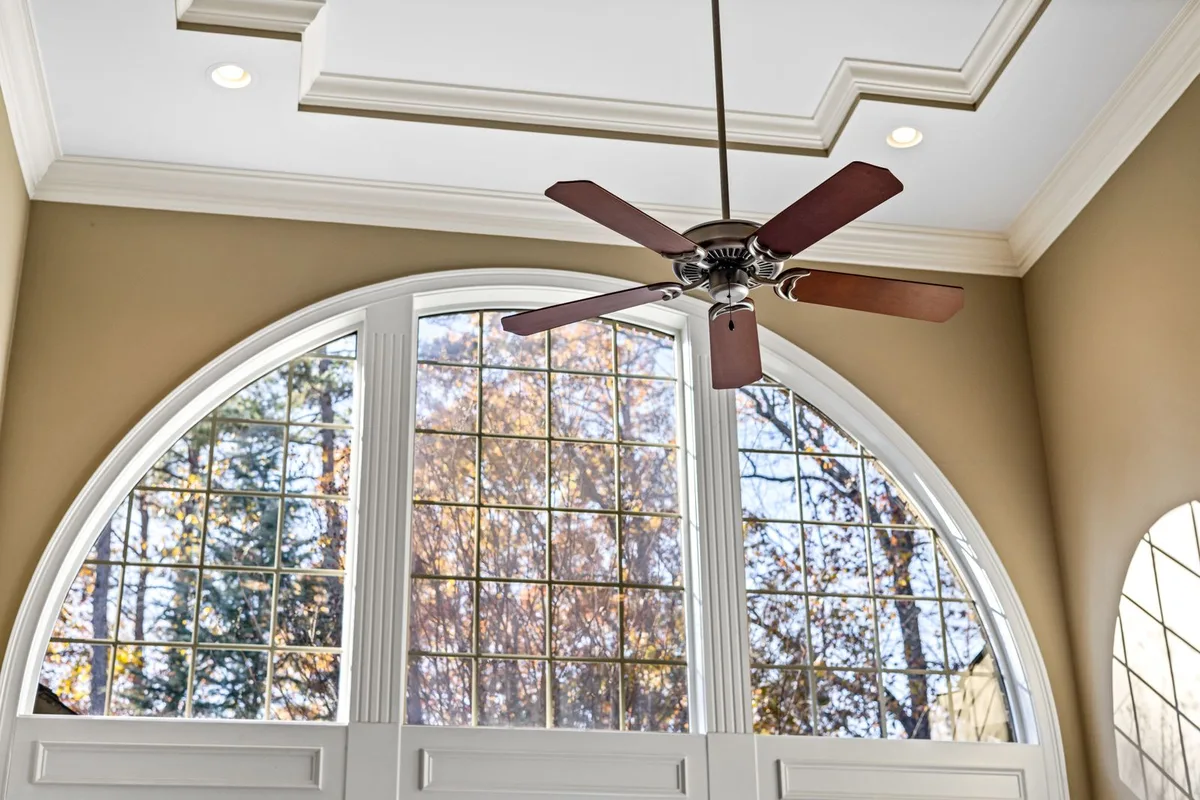
The fan is the hazard the tree chart never mentions, because blades sit 8 to 12 inches below the ceiling and wobble another inch or two in motion: a tree under a fan needs its topper to clear the blades by 12 inches, and the fan stays off while the tree is decorated beneath it — a spinning blade takes the star, the angel, and the top third of the branches in one pass. Measure from the floor to the lowest blade edge, not to the ceiling, and run the height formula against that number instead.
Placement beats policing: the tree spot and the fan rarely occupy the same vertical air, since fans hang over seating and trees live in corners — check the blade’s swing circle (a 52-inch fan sweeps a 52-inch circle) against the tree’s spread oval before you commit to the corner. If the only good spot sits under the fan, a tabletop tree (idea 8) drops the whole problem by two feet, and the fan gets its winter off, which the heating bill approves of anyway.
| Overhead fixture | Where it sits | The rule |
|---|---|---|
| Ceiling fan | 8–12 in below the ceiling, wobbles 1–2 in in motion | Topper clears the lowest blade by 12 in; fan stays off all season |
| Chandelier | Hangs into the airspace | Measure floor to the lowest crystal, not to the ceiling |
| 52-in fan swing circle | Sweeps a 52-in circle | Check it against the tree’s spread oval before committing to the corner |
6. Sloped ceilings and attic rooms
What if the ceiling is sloped or vaulted?
A sloped ceiling measures tall at one end of the tree spot and short at the other, so the audit changes shape: measure the vertical height at the tree’s exact center point and at the point where the top quarter of the canopy will reach, and size the tree against the smaller number — the tree claims a vertical cylinder, not a wedge, and the cylinder must clear the slope everywhere. In a half-story or attic room, that usually means the tree migrates to the tall side of the slope and the seating takes the low side.
Knee walls complicate the floor plan too: a 3-foot knee wall steals the bottom of the slope for furniture, and a tree tucked against it leans its spread into rising drywall. The fix is the same oval from the footprint guide, run twice — once on the floor, once mentally at the topper’s height. Vaulted ceilings are the opposite gift: a 9 or 10-foot tree in a true vault reads majestic, with the caveat that every watering and topper adjustment now happens on a ladder (idea 11’s safety rules earn their keep).
The sloped-ceiling audit, condensed to four measurements:
| Measurement | How |
|---|---|
| Height at tree center | Vertical tape at the tree’s exact center point |
| Height at canopy top-quarter | Vertical tape where the top quarter of the canopy will reach |
| Size against | The smaller of the two numbers — the canopy claims a vertical cylinder, not a wedge |
| 3-ft knee wall nearby | Run the footprint oval twice: once on the floor, once mentally at topper height |
7. Slim and half trees: height won’t shrink, spread will
Do slim trees help with low ceilings?
Slim trees solve the wrong number if you buy them for height: a slim tree is the same height with half the spread — a 7-foot slim still needs 7 feet of air — so it fixes crowded floors, not crowded ceilings. What slim does give a low-ceilinged room is placement freedom: a 6-foot slim (26–32″ spread) fits corners and beside-door gaps where a full-profile 6-footer (44–52″) would fight the furniture, and that freedom is often what lets the smaller tree earn the room’s best spot.
Half trees — flat-backed, made to sit against a wall — cut the footprint to nearly zero and keep full height, which makes them the quiet winner for hallways and narrow dens with standard ceilings. The honest ranking for a 7-foot ceiling: tabletop first (idea 8), 6-foot full-profile or slim second, half tree if the wall is the room. The ceiling doesn’t care which; it cares about the top 6 inches.

8. Tabletop trees: buying back 30 inches of height
Are tabletop trees better for low ceilings?
Yes, and the math is the best deal in the room: a tree on a table buys its surface height for free — a 4-foot tree on a 30-inch console stands 6.5 feet to the tip with the topper already included, fits a 7-foot ceiling with a foot to spare, and puts the ornaments at eye level where they finally get seen. The table is not a compromise; it’s a stage. Eye-level trees read bigger than their height because every bauble is in the sightline instead of the last foot being a ceiling-shaped guess.
| Table height | Tree height | Tip height (topper incl.) | Ceiling that fits |
|---|---|---|---|
| 18″ (side table) | 4 ft | ~5.4 ft | 6 ft+ |
| 24″ (bench) | 4 ft | ~5.9 ft | 6.5 ft+ |
| 30″ (console) | 4 ft | ~6.4 ft | 7 ft+ |
| 30″ (console) | 5 ft | ~7.4 ft | 8 ft+ |
Two rules make tabletop work: weight (a decorated 4-footer plus a real tree’s water stand can hit 40 pounds, so the table needs a solid back or a wall-anchored position) and stability (the same pet-proofing anchor logic applies — a table tree is one tail-swipe from the floor in a dog house). The footprint it claims is surface you weren’t using, which in a small apartment is the cheapest floor space there is.
As an Amazon Associate, we earn from qualifying purchases.

- 4 ft tall, 28.7″ wide — the exact tree in the tabletop table above (30″ console → ~6.4 ft tip)
- Pre-lit with multicolored LEDs and 11 lighting modes, so the light string math is already done
- Hinged branches with a folding cross-shaped metal stand — sets up in minutes, stores flat
Price and availability shown on Amazon; listing may change.
9. Measuring before you buy: the two-tape test
How do you measure a room for a Christmas tree?
The whole audit is two tape measurements and one memory trick: measure floor-to-ceiling at the tree’s exact spot (not the room’s average), then floor-to-blade if a fan hangs over, and write both numbers on your phone next to the formula — ceiling − 6″ − stand − topper = max tree. Do it before the showroom, not after; tree lots at dusk are where optimism buys 7.5-footers. The floor oval from our footprint math guide is the second half of the same audit — height and spread fail separately, and both fail quietly at the store.
The standing trick that outperforms the tape: bring a painter’s tape roll and mark the ceiling spot where the topper will land, then step back and look. Six inches of imagined air is easy to respect on tape and impossible to respect in a showroom’s 20-foot display hall — which is exactly why every lot tree looks short. Photograph the tape mark; the photo travels to the lot and argues on your behalf.

10. When the tree shrinks: redoing the ornament math
Where do the ornaments go on a shorter tree?
Choosing the right height usually means choosing a smaller tree than last year, and the decorating math changes with it: ornament and light counts scale with usable height — about 10–12 ornaments and 100 lights per vertical foot at balanced density — so a 6-foot tree takes roughly 65 ornaments and 600 lights, not the 80-and-800 your old 7.5-footer drank. The full per-foot formula is in our ornament count guide; the short version is that the tree you save in inches pays for its own trim.
Density redistributes, too: a shorter tree shows its whole vertical range from the sofa, so the deep-branch ornaments that filled a tall tree’s dark middle now sit visible on the outer rows — fewer ornaments, more seen. The topper that loses its ceiling clearance can also come down a rung: a large bow wired into the top third of the canopy reads as intentional styling, and it keeps the star for rooms with better air.
11. Vaulted and 10-foot ceilings: going big safely
What size tree for a 10-foot or vaulted ceiling?
Tall ceilings are the one place the formula relaxes: a 10-foot flat ceiling fits a 9-foot tree with a topper and a foot of air, and a true vault fits whatever your ladder skills and watering arm can maintain — the practical ceiling is not plaster, it’s the height you can decorate and water without staging a circus. A 9-footer’s tip sits 9.5 feet up with the stand; topper work happens at 10 feet, on a ladder, holding a star, in December.
Ladder rules, then, are part of tree math: use a ladder rated for your weight with the top two steps off-limits, keep three points of contact, and never lean sideways to place a topper — move the ladder. The American Ladder Institute’s safety guidance is the reference here, and its most useful line for tree season is simple: overreaching causes more ladder falls than ladder defects. A topper-wiring pole (a light grabber with a hook) does the last 18 inches from the ground and skips the top-step temptation entirely.
| Work height | Tool | The rule |
|---|---|---|
| Stand and mid-tree work | Step ladder | Top two steps off-limits; three points of contact |
| Topper at 9–10 ft | Ladder rated for your weight | Never lean sideways to place a topper — move the ladder |
| The last 18 inches | Topper-wiring pole (light grabber with a hook) | Skips the top-step temptation entirely |
As an Amazon Associate, we earn from qualifying purchases.

- 500 lb rated steel frame with lock-open buckle — over-built for topper duty on purpose
- Wide anti-slip pedals and a handgrip keep three points of contact while you wire the star
- Folds to 1.6″ deep for the closet between December waterings; 41″ open height covers stand and mid-tree work
Price and availability shown on Amazon; listing may change.
12. The height checklist
What do I check before buying a Christmas tree?
The vertical audit compresses into a five-line checklist that fits in a phone note, and it runs in order because each number feeds the next: measure the ceiling at the spot, subtract the fan if there is one, subtract 6 inches of gap, subtract the stand and the topper, and the remainder is the tree you’re allowed to buy. The checklist below is the same list with the common numbers pre-filled — print it or screenshot it for the tree lot.
Every number from this page, in the order you’ll need it at the lot:
- ☐ Measure floor-to-ceiling at the tree’s exact spot (and floor-to-blade under a fan)
- ☐ Apply the formula: ceiling − 6″ gap − stand (2–3″) − topper (6–16″) = max tree
- ☐ 8-ft ceiling → 6.5 ft tree with topper; 7-ft ceiling → 5.5–6 ft; 9-ft → 7.5 ft
- ☐ Real tree too tall? Bottom cut 6–12″, re-drill the spike hole, water better
- ☐ Artificial too tall? Remove the top section — never bend the tip
- ☐ Low ceilings: tabletop on a 24–30″ surface buys the height back at eye level
- ☐ Tall ceilings: ladder rated for your weight, top two steps off-limits, no side leans
Frequently Asked Questions
How tall of a Christmas tree fits an 8-foot ceiling?
A 6.5-foot tree with a topper, or a 7 to 7.25-foot tree without one. The formula is ceiling minus a 6-inch gap, minus the stand (2–3 inches), minus the topper (6–12 inches). A 7.5-foot tree technically touches an 8-foot ceiling with no topper and no room to spare.
How much space do you need between tree topper and ceiling?
At least 6 inches, or 12 inches if a ceiling fan hangs above or you use a lighted topper. Toppers add 6 to 16 inches depending on type — bows are the shortest, branch sprays and angels the tallest.
Can you cut the bottom off a Christmas tree to make it shorter?
Yes — a real tree can lose 6 to 12 inches from a bottom cut. Saw the trunk base, re-drill the center hole for the stand’s spike, and the tree stands shorter with no visible change. The fresh cut also reopens water uptake. Never cut or bend the top; artificial trees shrink by removing their top section instead.
How much clearance does a tree need from a ceiling fan?
The topper must clear the lowest fan blade — not the ceiling — by 12 inches, and the fan should stay off while the tree is beneath it. Blades sit 8–12 inches below the ceiling and wobble in motion, so measure floor-to-blade and run the height formula against that number.
Are tabletop trees better for low ceilings?
Yes — a 4-foot tree on a 30-inch console stands about 6.5 feet with the topper included and fits a 7-foot ceiling with room to spare. The tree also sits at eye level, where the ornaments are actually visible. Anchor the table in pet households.
What size tree for a 10-foot ceiling?
A 9-foot tree with a topper and a foot of air. The practical limit on vaulted ceilings isn’t the plaster — it’s the height you can decorate and water safely from a ladder, which is why 7.5 to 9 feet is the honest range for most households.
Related Reading
Last updated: November 18, 2026. The 7.5-foot tree and the 8-foot ceiling have since reconciled — at 6.5 feet.