
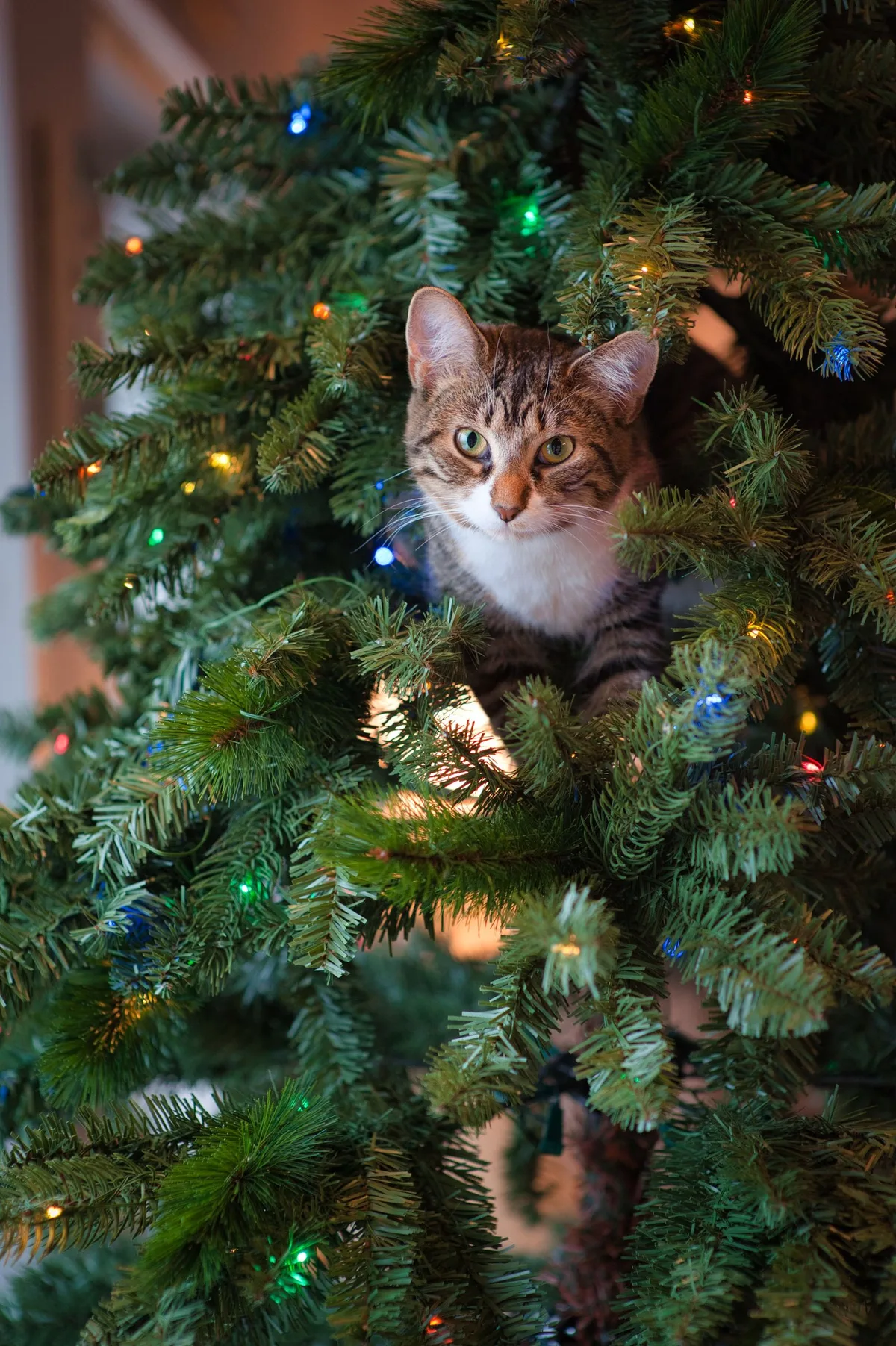
The year my rescue cat discovered the tree, she treated it less like a decoration and more like a climbing gym with paid admission. I know this because I heard it: a soft jingle, a pause, then the slow-motion crackle of a 6-foot Fraser fir describing a perfect arc toward the television. The tree landed ornament-side down. The cat landed on the windowsill, grooming, like a gymnast sticking the dismount.
Pet-proofing a Christmas tree is not a battle of wills — it’s three pieces of physics and a week of routine. The tree tips because a side force at height beats the base’s counter-weight, so you fix the math with anchors, ballast, and placement. The cat climbs because the tree is the best perch in the room, so you make the tree boring and the alternatives better. This page runs the full numbers: the tipping formula, three anchoring methods compared, the two-zone decorating rule, a toxicity cheat table, and the first-week training protocol that ends the war for good.
Table of Contents — 12 Ideas
- Why cats climb the tree (and why yelling fails)
- The tipping math: how much force actually fells a tree
- Wall anchors vs ceiling lines vs base weights
- The fishing-line anchor: invisible and drill-free
- The stand: water, weight, and the bowl you must block
- Placement: the 3-foot launch-pad rule
- The two-zone ornament strategy
- Tree skirt vs box vs barrier at the base
- Deterrents that work (and two to skip)
- Dog-specific rules: the ground floor matters
- The toxicity quick table: needles, berries, water
- The first-week training protocol
1. Why cats climb the tree (and why yelling fails)
Why is my cat obsessed with the Christmas tree?
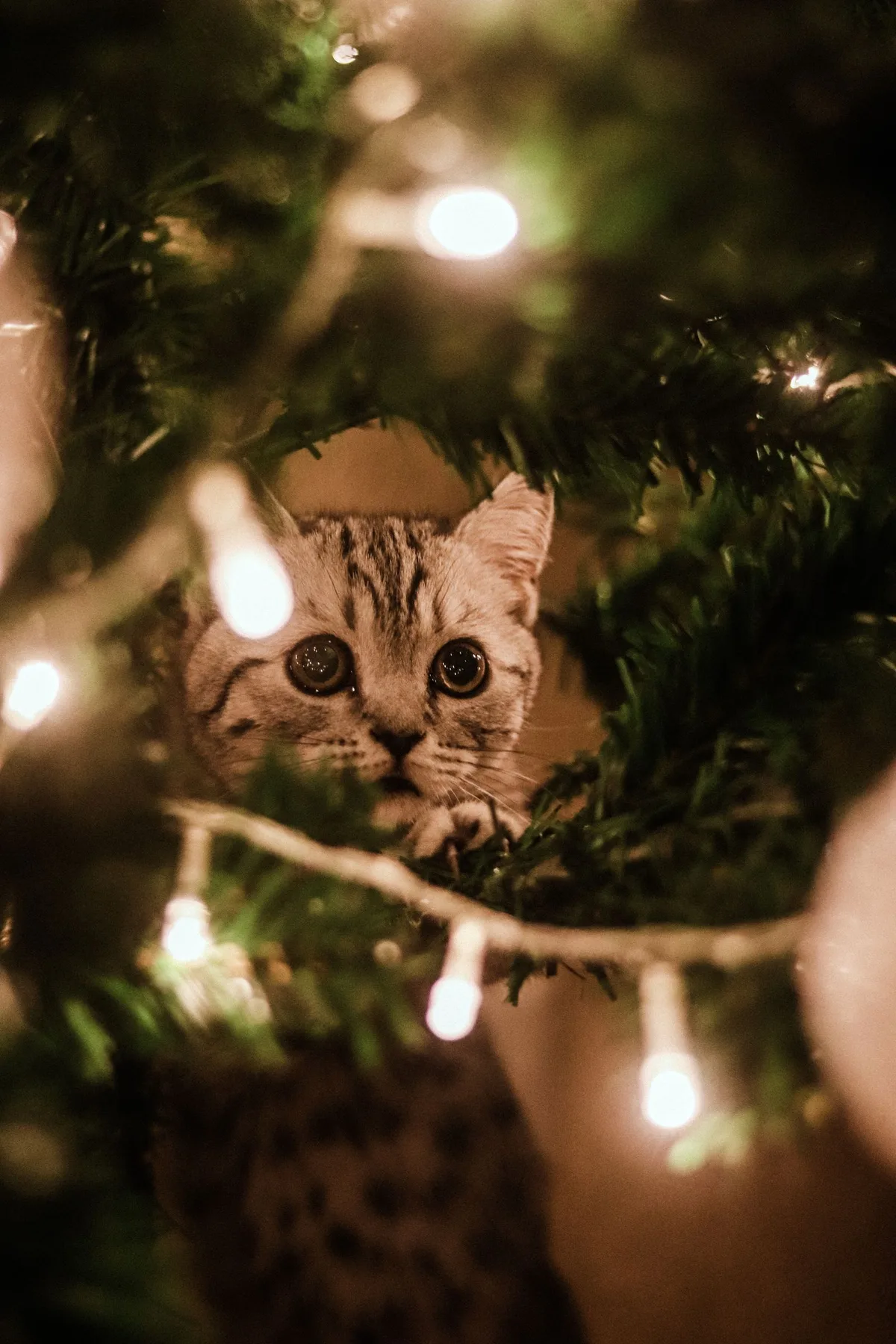
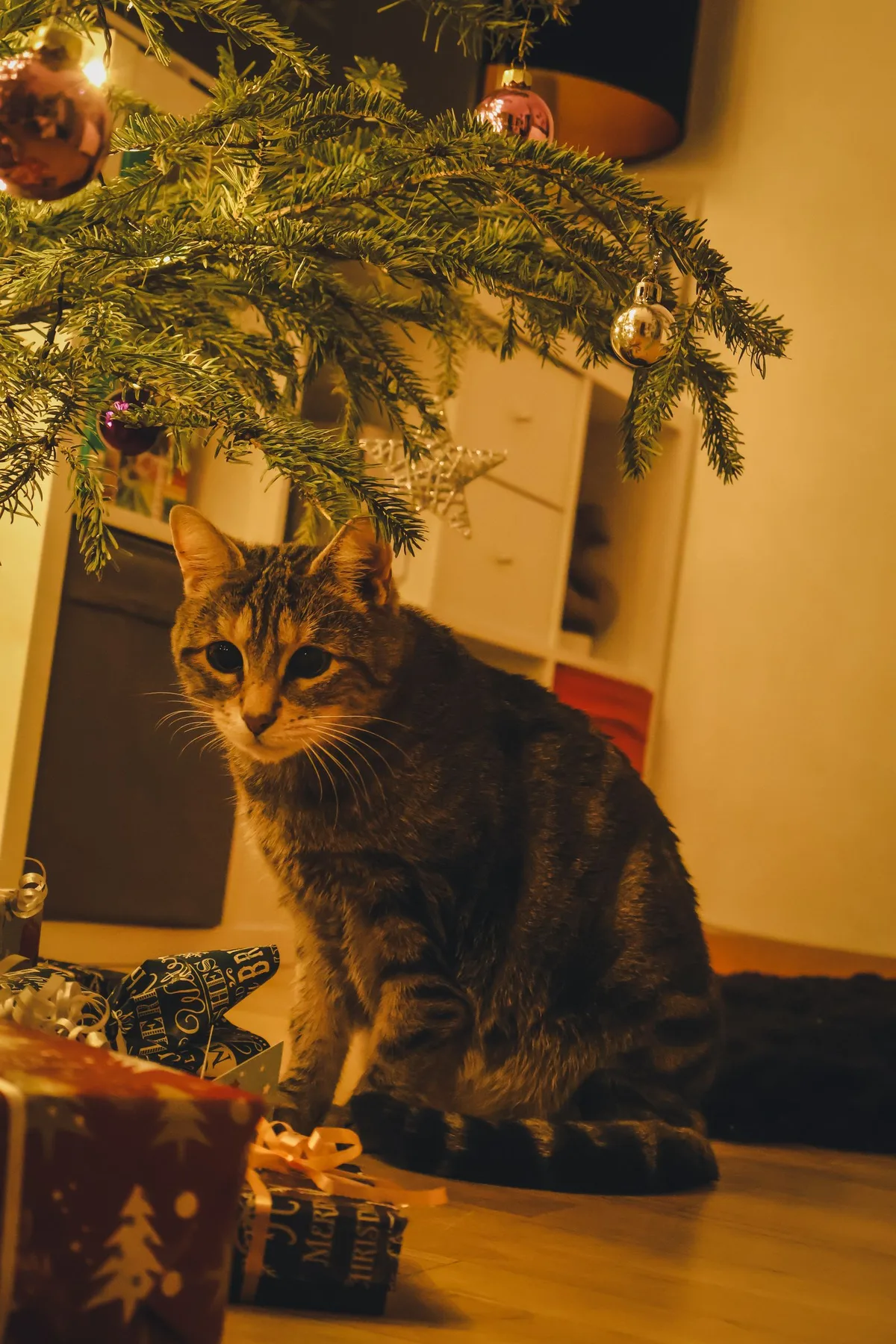
A healthy adult cat clears 4 to 5 feet vertically in a single jump — the tree is not a challenge, it’s an invitation. You can’t train out the instinct; you can only out-design it: a cat climbs the tree because the tree is the tallest, best-textured perch in the room, and every yelp from you is a stamp of approval on the game. Punishment after the fact teaches nothing; the fix is making the climb unrewarding (deterrents below) and making a better perch available elsewhere — a tall cat tree by a window does more than any spray bottle.
The other half of the obsession is the moving toys you hung on it. From a cat’s eye view, the tree is a toy dispenser: baubles that spin, glitter that flashes, ribbon that snaps in the draft from the heater. That’s why the ornament strategy in idea 7 matters as much as the anchor — you’re not defending the tree, you’re removing the bait.
2. The tipping math: how much force actually fells a tree
How do I stop my cat from knocking over the Christmas tree?
The tree tips when side force at height beats the base’s counter-moment — that’s the whole equation, and it’s checkable in one minute: tipping torque = pet weight × horizontal distance of the hang point from the trunk; counter-torque = effective base weight × half the base’s footprint width. Keep counter-torque at twice the worst-case hang, and the tree stays up. A 12-pound cat clinging 18 inches off the trunk applies about 18 ft-lb; a stand with 25 pounds of added ballast spread over a 2-foot base supplies roughly 25 ft-lb on paper — which is why “heavy stand” alone squeaks by, and why the top anchor in idea 3 is the real fix.
The numbers that surprise people: a cat at the top of a 6-foot tree acts on a 4-foot lever arm, so the same 12 pounds applies nearly 48 ft-lb — more than double the floor-level hang. Height multiplies force; that’s why the anchor goes at the top third of the tree, not the bottom. Ballast helps the base, anchors kill the lever.
| Scenario | Lever arm | Tipping torque (12 lb cat) | Verdict |
|---|---|---|---|
| Cat hangs low branch | 18″ | ~18 ft-lb | Heavy stand survives, barely |
| Cat at mid-height | 30″ | ~30 ft-lb | Needs ballast + anchor |
| Cat at the top third | 48″ | ~48 ft-lb | Only a top anchor holds |
| Dog shoulder-check (20 lb) | 12″ | ~20 ft-lb | Wide base + placement fixes it |
One more number worth knowing: a decorated 6-foot artificial tree weighs 40 to 60 pounds with the stand — but that mass sits mostly above knee height once trimmed, so its stability is worse than the raw weight suggests. The anchor is cheap insurance on a top-heavy investment.
3. Wall anchors vs ceiling lines vs base weights
What is the best way to anchor a Christmas tree with pets?
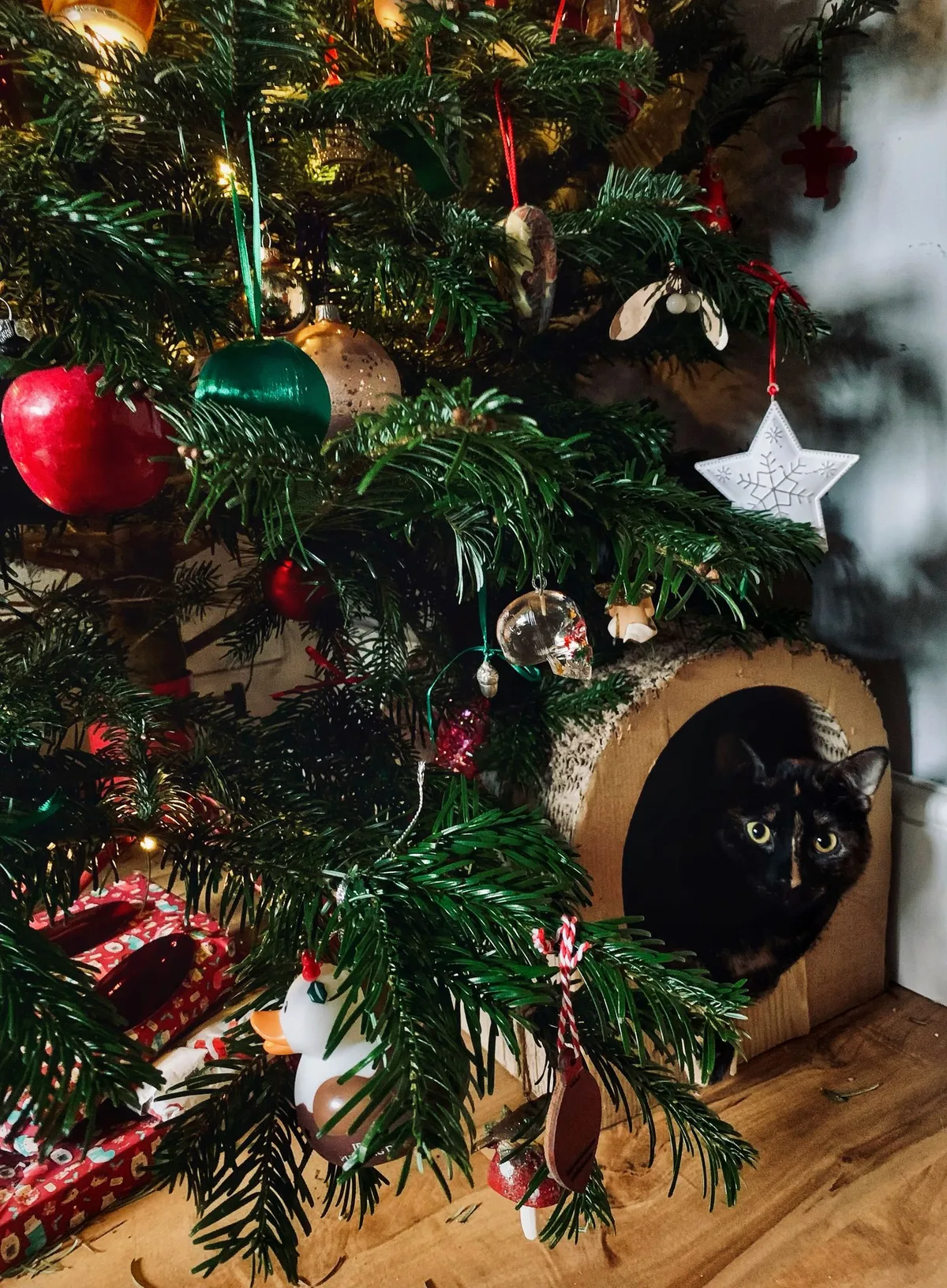
Three methods work, and they stack: the ceiling or wall anchor is the only method that defeats the top-of-tree lever arm, base ballast covers low-hang accidents, and placement covers everything else. A 50-lb-test line from the trunk’s top third to a wall stud or ceiling hook takes ten minutes to rig, holds far beyond any cat’s pull, and disappears against the branches. Base weights help but can’t win alone — the table shows why the pros stack two methods.
| Method | Holds | Drilling? | Visible? | Best for |
|---|---|---|---|---|
| Ceiling hook + line to tree top | 50 lb+ line test | 1 small hook | Near-invisible | Cats who climb to the top |
| Wall stud anchor at top third | 50 lb+ line test | None (hook or screw eye) | Hidden by branches | Rented apartments |
| Base ballast (sandbags, plates) | 25–40 lb added | None | Hidden by skirt | Dog shoulder-checks |
| Wide heavy-duty stand | Stand-rated | None | Visible | Fresh trees up to 8 ft |
The honest ranking for a cat household: ceiling line first, ballast second, and a wider stand as the bonus third. For dogs, reverse it — the shoulder-check is a floor-level event, so ballast and placement do the heavy lifting. A heavy-duty stand with a wider footprint is the single upgrade that helps both species at once.
As an Amazon Associate, we earn from qualifying purchases.

- Fits trees up to 8 ft with 6″ trunks; 19″ base with five eye-bolts
- 1.3-gallon reservoir holds about 10.8 lb of water — hydration and ballast in one
- Steel spike base plate grips the trunk; add 25 lb of ballast for pet households
Price and availability shown on Amazon; listing may change.
4. The fishing-line anchor: invisible and drill-free
How do you anchor a Christmas tree without drilling?
The renter’s method takes ten minutes and survives the strongest cat in the building: tie 50-lb-test braided fishing line around the trunk at the top third of the tree, run it to a wall anchor point on two sides (opposite walls if possible), and tension until the tree stops leaning — the line vanishes against the branches from any seat in the room. Two anchor points beat one because they stop rotation as well as tipping; a tree held at a single point pivots around it like a door hinge.
Anchor points that don’t need drilling: a curtain-rod bracket, a bookshelf bolted to the wall, a radiator pipe, or a heavy picture hook already in a stud. If you do drill, a single ceiling hook rated at 25 pounds or more is the cleanest solution — screw it in before the tree arrives, and the annual setup takes thirty seconds. Use two lines in a V from the same hook for the anti-rotation effect. The test: push the tree firmly at shoulder height. If the top moves more than an inch, re-tension; if the tree rocks as one solid unit, it will survive December.
One trap to skip: elastic cords (“bungee” lines). They hold, but they store energy — a cat’s final shove converts the stretch into a whip. Braided fishing line or polyester twine is static; static wins.
5. The stand: water, weight, and the bowl you must block
Is Christmas tree water safe for pets?
The water bowl under a fresh tree is the one hazard pets will actually drink from, and it needs blocking on day one: plain water with a cut fir is mildly upset-stomach territory, but stand additives — aspirin, sugar, commercial preservatives — turn it into a genuine poison risk, and the ASPCA recommends blocking access entirely. The fix costs nothing: cover the stand’s water reservoir with a sheet of cardboard cut in a star or circle, slit to fit around the trunk, and hide it under the tree skirt. Refill through the gap with a turkey baster.
The stand is also your ballast budget. Water adds real weight — a gallon is 8.3 pounds — so a full reservoir is functional ballast, but never count on it alone: a determined dog can drain it, and a tipped tree spills it onto the rug. Sandbags or weight plates zip-tied to the stand legs add 10 to 25 pounds of tipping resistance that can’t evaporate. Keep the total in mind from idea 2: counter-torque of twice the worst-case hang.
| Water-bowl hazard | Risk | The fix |
|---|---|---|
| Plain water under a cut fir | Mild stomach upset | Cardboard guard + tree skirt cover |
| Aspirin in the water | Genuine poison risk | Never use — plain water only |
| Sugar or commercial preservatives | Poison risk (ASPCA says block access) | Skip additives entirely |
| Dog drains the reservoir | Ballast lost, spill on the rug | 10–25 lb of sandbags zip-tied to stand legs |
6. Placement: the 3-foot launch-pad rule
Where should you put a Christmas tree with pets?
Placement is free, and it removes the highest-percentage attack route: keep the tree’s spread circle at least 3 feet from any furniture a pet can launch from — sofa arms, bookshelves, window sills, beds — because a cat’s comfortable horizontal leap is 4 to 5 feet and every foot of distance converts a standing jump into a decision. The corner placement that wins on floor-space math (see our Christmas tree footprint guide) also wins here: two walls mean only one approach vector to guard.
Audit the room vertically, not just horizontally. The bookshelf 4 feet from the tree is a launch pad at any height the cat can reach. If the room forces a close placement, the trade is manageable — that’s when the ceiling anchor becomes non-negotiable, and when the low-zone rule in idea 7 does its real work. A tree on a raised table is the small-apartment answer: a 4-footer on a sturdy sideboard halves the footprint and puts the entire tree above dog height.
| Launch pad | Distance rule | If you can’t move it |
|---|---|---|
| Sofa arm | ≥3 ft from the spread circle | Ceiling anchor becomes non-negotiable |
| Bookshelf | 4 ft horizontal, any reachable height | Relocate or block access |
| Window sill | ≥3 ft | Corner placement — one approach vector |
| Bed | ≥3 ft | Keep the bedroom door closed |
| Small apartment, no options | — | 4-footer on a sturdy sideboard, above dog height |
7. The two-zone ornament strategy
How do you decorate a Christmas tree with cats and dogs?
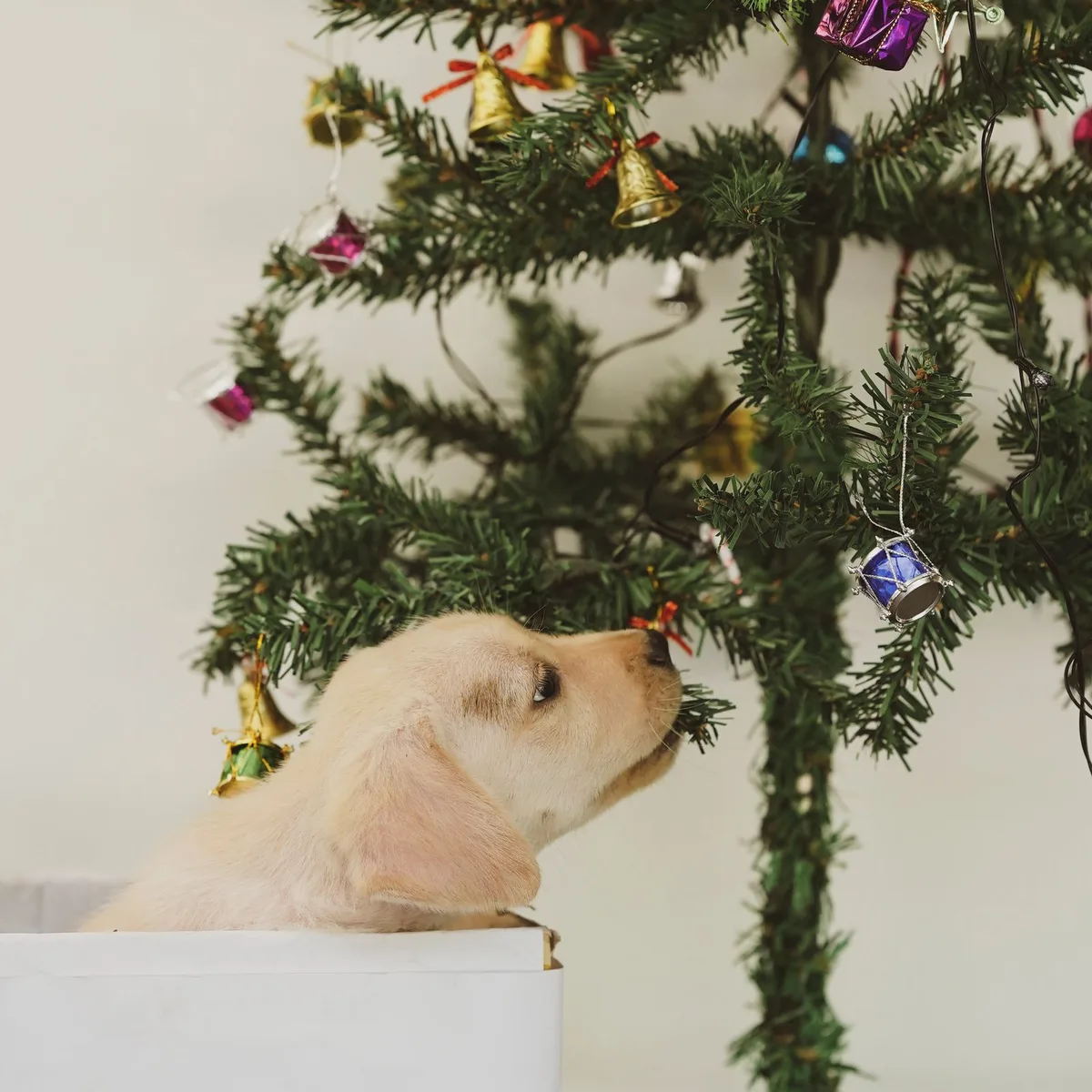
Decorate for the predator, not the photo: the bottom 2 feet of the tree gets nothing breakable, nothing dangly, and nothing with a metal hook — plastics, wood, felt, and unbreakable baubles only — and every fragile ornament moves above the 4-foot line, hung with ribbon or twine loops instead of metal hooks. A cat that bats at a felt star gets a felt star; a cat that bats at glass gets an emergency vet bill and a shredded tree skirt.
Metal hooks are the hidden hazard: they’re swallow-shaped, they fall with every branch brush, and they end up on the floor where vacuum day becomes surgery day. Ribbon loops tied directly to the branch take ten seconds more per ornament and eliminate the class of problem. The high zone keeps the heirlooms; the low zone becomes the pet’s own exhibit — the tree survives, and so does the collection. Our ornament count formula still applies; you’re just sorting the same ornaments by altitude.
| Zone | Height | What hangs there | Fastener |
|---|---|---|---|
| Pet zone | 0–2 ft | Felt, wood, unbreakable plastic only | Ribbon loops |
| Buffer zone | 2–4 ft | Duplicates and plush pieces | Ribbon loops |
| Heirloom zone | Above 4 ft | Glass and keepsakes | Ribbon, never metal hooks |
As an Amazon Associate, we earn from qualifying purchases.

- 30 shatterproof 2.36″ balls in red, green and white — shiny, matte and glitter finishes
- Survives a 6.5-ft drop onto a hard floor, built for kid and pet zones
- Firm caps, fade-resistant color — hang with ribbon loops, no metal hooks
Price and availability shown on Amazon; listing may change.
8. Tree skirt vs box vs barrier at the base
How do I protect the base of the Christmas tree from pets?
The base is where cats sleep, dogs drink, and both dig — so the skirt loses to structure here: a rigid tree collar or a storage box turned upside-down over the stand blocks the water, hides the “cat bed” surface, and survives a pawing far better than any fabric skirt. A fabric skirt on a pet floor is a bed with built-in catnip smell; the moment it’s down, a cat will claim it. The collar’s slippery cone gives paws nothing to knead and turns the water reservoir into a locked room.
If the stand is oversized or the collar budget is spent, the workaround is the storage-bin trick: a lidded plastic bin flipped over the stand, decorated with a ribbon, ugly-side down. It’s the same principle — deny the surface — at a cost of one bin you already own. Whatever covers the stand, keep the cardboard water-guard from idea 5 underneath it; the barrier is for paws, the guard is for the bowl.
9. Deterrents that work (and two to skip)
What smells keep cats away from Christmas trees?
Deterrents are the second line, not the first — they work on the explorer, not the committed climber: citrus peel in the skirt zone and a commercial bitter-apple spray on the lowest branches have real track records, and a motion-activated air canister ends the climbing habit for most cats within a week. The air canister sounds expensive until you price a broken heirloom; it hisses once per approach, the cat learns the tree has a personal weather system, and by day seven the hiss is a rumor nobody tests.
The two to skip: pepper-based sprays (capsaicin in a cat’s eyes is an emergency, not a deterrent) and foil-only strategies (the crinkle stops some cats for two days, then becomes a toy — though a foil collar around the trunk does block one specific route, the kitten’s spiral climb from the stand). Deterrents stack with design: a boring low zone, a blocked water bowl, and a hiss at the tree’s edge make the tree the least interesting object in the room, which is exactly the goal.
| Deterrent | Verdict | Why |
|---|---|---|
| Motion-activated air canister | Works best | One hiss per approach; habit ends within a week |
| Bitter-apple spray on low branches | Works | Bad taste, pet-safe |
| Citrus peel in the skirt zone | Works | Repels the explorer, free |
| Pepper / capsaicin spray | Skip | In a cat’s eyes it’s an emergency, not a deterrent |
| Foil everywhere | Skip | Stops some cats for two days, then becomes a toy |
10. Dog-specific rules: the ground floor matters
How do I dog-proof a Christmas tree?
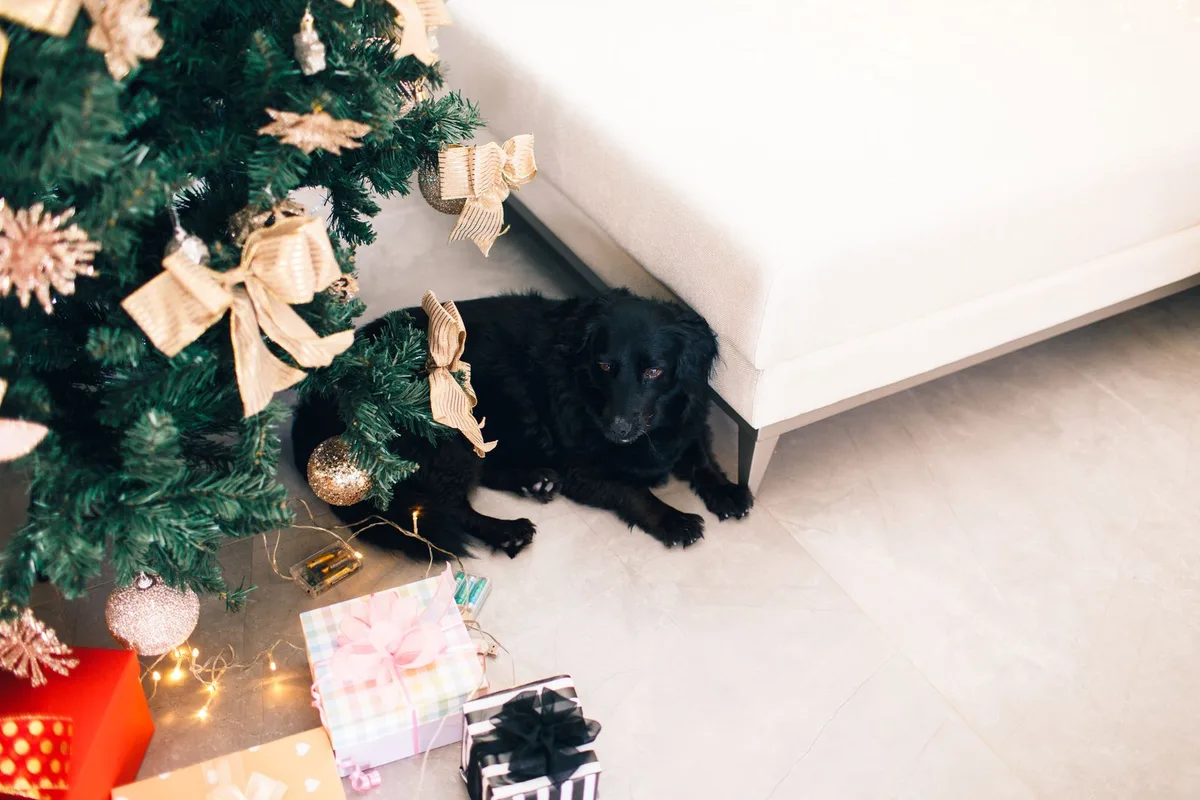
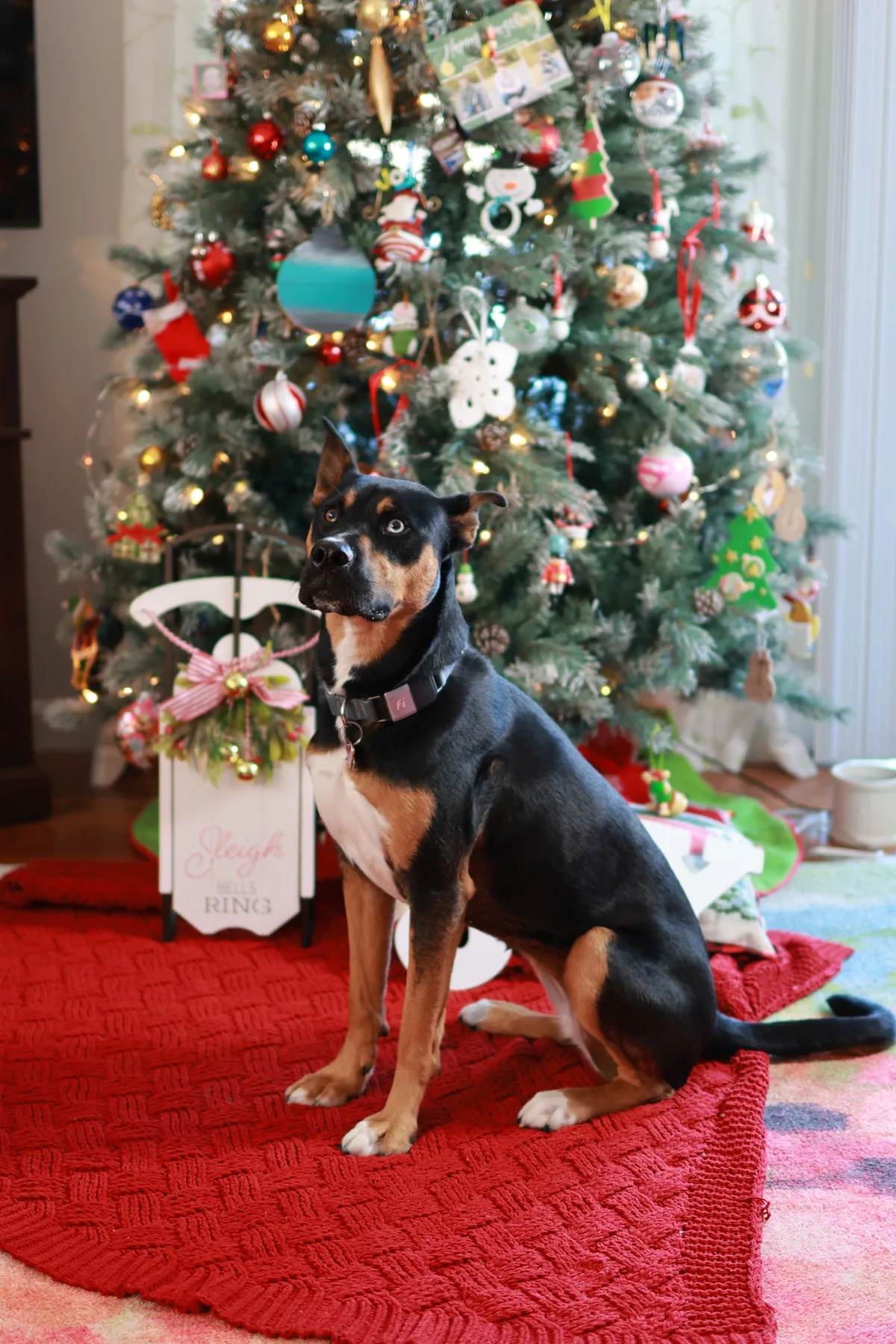
Dogs don’t climb, they collide and chew — so the defense is floor-level: ballast the stand (idea 2’s math), lift a small tree onto a table so the entire tree is above shoulder height, protect the light cords with a bitter-spray-soaked cord cover, and hang nothing edible — popcorn strings, dog-biscuit ornaments and candy canes are chew magnets. A freestanding pet gate in an arc around the tree solves the problem outright for puppies and the chronically wagging; it’s ugly for exactly one December and then it’s tradition.
The tail is the underrated hazard: a happy Lab’s wag at tree height sweeps the bottom 2 feet every pass, and that’s where the ornaments you love used to hang before the two-zone rule. Puppies need the gate plus supervised weeks — a chewed light cord is a burn and electrocution risk, which makes the cord cover the one non-optional item on the dog list. Older dogs mostly need the water bowl blocked and the low zone boring, and they’ll ignore the tree by the second evening.
As an Amazon Associate, we earn from qualifying purchases.

- 23.6″ tall freestanding gate — no mounting, arrives fully assembled
- Adjustable width arcs around the tree or fills a doorway; support feet stop tipping
- Sized for puppies and small dogs — big jumpers need the full anchoring plan
Price and availability shown on Amazon; listing may change.
11. The toxicity quick table: needles, berries, water
Which holiday plants are toxic to cats and dogs?
The tree itself is the least of it — pine, spruce and fir needles are mildly toxic (mouth and stomach irritation) but rarely dangerous: the serious risks are the companions: holly, mistletoe, amaryllis, and lilies, which for cats are genuinely life-threatening even in small amounts. The ASPCA’s toxic and non-toxic plant database is the reference to check before anything with berries enters the house; the table below is the December short version.
| Plant / item | Cats | Dogs | Notes |
|---|---|---|---|
| Fir / spruce needles | Mild | Mild | Mouth + stomach irritation |
| Stand water (plain) | Mild | Mild | Block it anyway (idea 5) |
| Stand water (additives) | Serious | Serious | Preservatives + aspirin |
| Mistletoe berries | Serious | Serious | Heart effects — hang high |
| Holly berries | Moderate | Moderate | Vomiting, lethargy |
| Lilies (any part) | Deadly | Mild | Kidney failure in cats — skip entirely |
| Poinsettia | Mild | Mild | Overrated as a killer, still a stomach ache |
| Metal ornament hooks | Hazard | Hazard | Swallow risk — switch to ribbon |
The one rule to carve in the mantel: no lilies in a cat house, at any price, in any room. Bouquets are the delivery vehicle — a gift bunch with lilies sits on the table for one evening and that’s enough. Everything else in the table is manageable with placement and the two-zone rule.
12. The first-week training protocol
How long until my pet ignores the Christmas tree?
Pets habituate to the tree at different speeds, and the week it takes is mostly scheduling: days 1–2: tree up, undecorated, deterrents armed, supervised evenings; days 3–5: ornaments on in waves (unbreakables first), air canister by the tree, rewarded calm; days 6–7: normal evenings with the deterrent live; most cats stop testing the tree by day 7 to 10, dogs by day 3 to 5. The tree that appears overnight is a novel object; the tree that has been boring for a week is furniture.
The reinforcement math runs both ways: every dramatic chase you stage at the tree is a jackpot, and every calm evening near it earns the good treat. Keep a small jar of treats by the sofa and pay out for lying near (not on) the tree skirt — cats learn fast when the economy is honest. By the second week the deterrent comes down to standby, the gate opens, and the tree stands through January for the same reason the sofa does: it’s where the good things happen, and nothing else.
The Pet-Proof Tree Checklist
Every fix from this page, in the order you’ll need it on setup day:
- ☐ Place the tree 3+ ft from every launch pad (sofa arms, shelves, sills)
- ☐ Rig the 50-lb-test line from the top third to a wall stud or ceiling hook; two points, no bungee
- ☐ Add 25 lb of ballast to the stand (sandbags or plates, zip-tied)
- ☐ Cut the cardboard water-guard; refill with a baster through the slit
- ☐ Sort ornaments into two zones: nothing breakable below 2 ft, no metal hooks anywhere
- ☐ Cover the stand with a collar or flipped bin — no fabric cat beds at the base
- ☐ Bitter spray on low branches and light cords; no pepper sprays, no lilies in the house
- ☐ Run the 7-day protocol: undecorated first, ornaments in waves, reward calm
Frequently Asked Questions
How do I keep my cat out of the Christmas tree?
Combine a top anchor (50-lb-test line to a wall stud or ceiling hook), 25 pounds of stand ballast, a 3-foot gap from launch furniture, and a two-zone decoration rule with nothing breakable below 2 feet. Deterrents — citrus, bitter spray, a motion-activated air canister — handle the rest; most cats stop testing the tree within 7 to 10 days.
Will fishing line really hold a Christmas tree?
Yes — 50-lb-test braided fishing line holds far beyond the roughly 48 ft-lb a 12-pound cat can generate at the top of a 6-foot tree. Tie at the tree’s top third, run to two anchor points in a V to stop rotation, and tension until the tree rocks as one solid unit. Static line only; never bungee, which whips under a final shove.
Is Christmas tree water toxic to pets?
Plain water under a fir or spruce is mildly irritating, but stand additives — preservatives, aspirin, sugar — are genuinely dangerous. Block the reservoir on day one with a cardboard guard slit around the trunk, hide it under the collar, and refill with a turkey baster. The ASPCA recommends preventing access entirely.
Which Christmas decorations are toxic to cats and dogs?
Metal ornament hooks (swallow hazard), edible ornaments, tinsel (intestinal blockage if swallowed), and any plant from the lily family — lilies cause kidney failure in cats even in tiny amounts. Mistletoe and holly berries are the other two to keep out of reach. Fir needles and poinsettia are mild irritants, not emergencies.
How do I dog-proof a Christmas tree?
Ballast the stand against shoulder-checks, lift small trees onto a table so they’re above dog height, protect light cords with bitter-spray-treated covers, hang nothing edible, and gate off the tree for puppies. Dogs habituate in 3 to 5 days — faster than cats — once the low zone is boring and the water is blocked.
Where should you put a Christmas tree with pets?
A corner with two walls, at least 3 feet from any furniture a pet can jump from, away from the room’s running lanes, and out of sightlines to windowsills and shelves. The corner placement also wins on floor-space math — and if the room can’t give 3 feet, the ceiling anchor becomes non-negotiable.
Related Reading
Last updated: November 17, 2026. The ceiling line has held for three Decembers and one very committed tabby.