
Every December I type the same sentence into Google — “how many ornaments for a 6 foot tree” — and every December I get a different answer. Macy’s says 100 to 120. A specialty ornament shop says 60 to 100. A tree brand says 40 to 80. A UK retailer says 100 to 150. A decor blog says 60 to 120. Same tree, five answers, a spread of more than 2×.
That spread isn’t carelessness — it’s four hidden variables nobody states out loud: ornament diameter, tree width, how many sides of the tree you actually see, and whether ribbon and picks get counted. This page names all four, puts the five sources in one table, and derives a single formula you can run for any tree height. Then it does the same for lights, because the “100 bulbs per foot” rule deserves the same treatment.
Table of Contents — 12 Ideas
- Why five sources give five different counts
- The formula: ornaments per vertical foot
- Ornament size: the 60/25/15 mix
- The lights rule: 100 bulbs per foot, honestly adjusted
- The order that makes the count work
- What doesn’t count as an ornament
- Slim, pencil and tabletop trees: the width multiplier
- The corner tree: three sides, not four
- Box math: turning a count into a shopping list
- The 48-plan: distribute in groups, not by mood
- Depth: every third ornament goes deep
- January: store the count, keep the system
1. Why five sources give five different counts
Why five sources give five different counts
Here are the five answers I found, with what each one silently assumes. Read the assumption column and the conflict dissolves — they’re not disagreeing about the tree, they’re disagreeing about the balls.
| Source | 6 ft count | What it assumes |
|---|---|---|
| Macy’s gift guide | 100–120 | Fully loaded display, larger 3–4" ornaments, all 360° visible |
| The Little Ornament Shop | 60–100 | Moderate tree, two looks (light vs full) with a chart per height |
| Silvanest (tree brand) | 40–80 | Three look levels; counts hanging baubles only, front-weighted view |
| Christmas Tree World (UK) | 100–150 | Lush all-round styling; also spec’s 480–600 LEDs for the same tree |
| Home Is Decor | 60–120 | Per-foot rule: 10–15/ft light, 20+/ft full |
The variables, in order of impact: ornament diameter (a 6-inch ball covers four times the area of a 3-inch one), tree width (a pencil tree has roughly 60% of the surface of a full-width tree at the same height), viewing angle (a tree in a corner shows about three-quarters of itself), and what gets counted (ribbon loops and picks fill visual space but aren’t baubles). Once you control for those four, every source’s number lands within about 15% of the same formula — which is the next section.
2. The formula: ornaments per vertical foot
The formula: ornaments per vertical foot
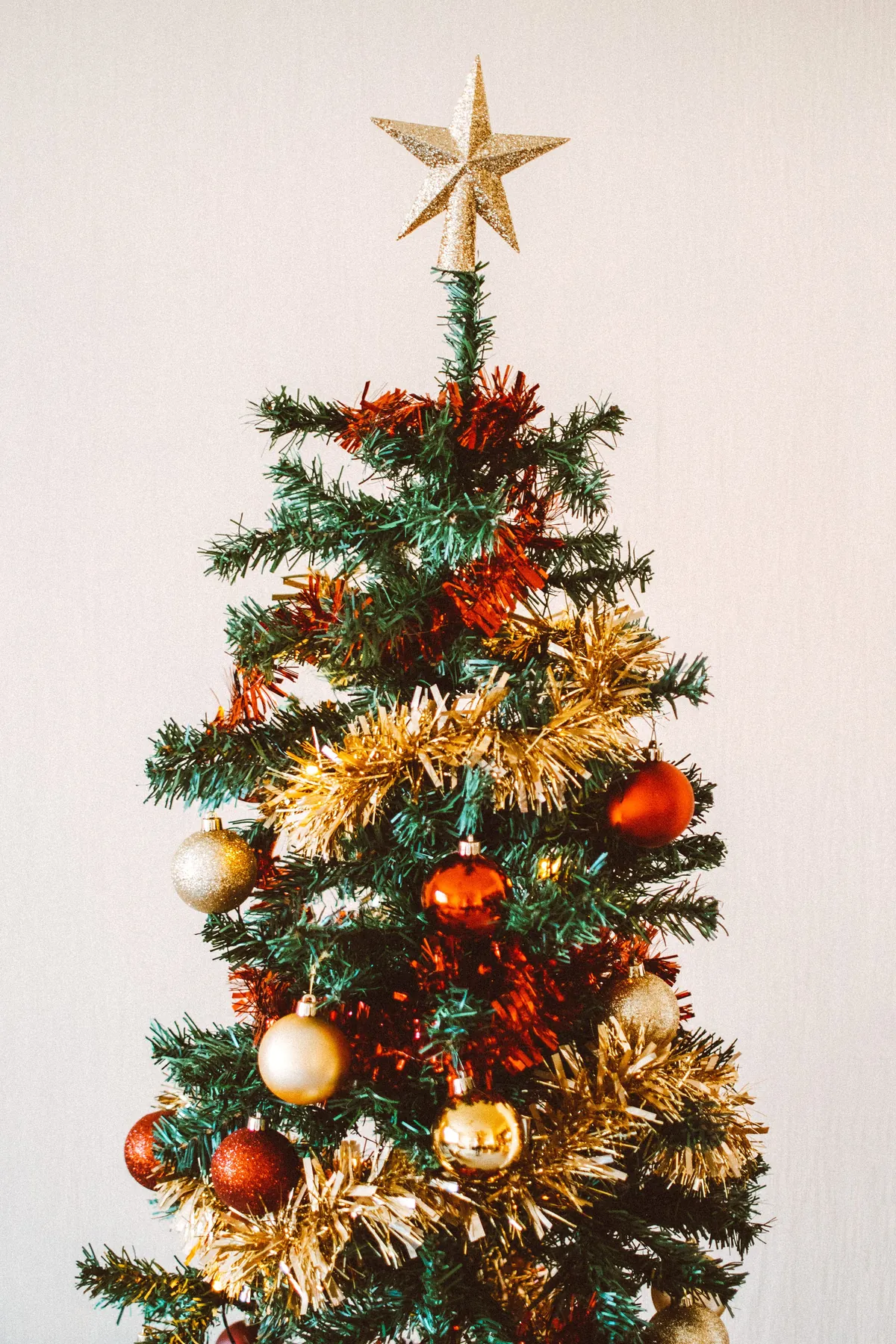
The honest rule of thumb: 10–12 ornaments per vertical foot for a bare, branch-visible look, about 15 per foot for a balanced tree, and 20–25 per foot for a full, ornament-led display. Multiply by your tree’s height in feet, then adjust with two factors: width (slim ×0.7, extra-full ×1.2) and viewing angle (corner placement ×0.75). Everything within ±20% of the result looks deliberate; exactness is false precision.
| Tree height | Light (10–12/ft) | Balanced (15/ft) | Full (20–25/ft) |
|---|---|---|---|
| 4 ft | 40–48 | 60 | 80–100 |
| 5 ft | 50–60 | 75 | 100–125 |
| 6 ft | 60–72 | 90 | 120–150 |
| 7 ft | 70–84 | 105 | 140–175 |
| 7.5 ft | 75–90 | 112 | 150–188 |
| 9 ft | 90–108 | 135 | 180–225 |
Why per-foot works: a tree is roughly a stack of shrinking circles, so surface area scales close to linearly with height for a given profile — which is why the per-foot numbers stay flat from 4 ft to 9 ft while the total climbs. If your tree publishes a tip count (230 tips is slim, 400+ is full), treat tips as a width check: under 250 tips, apply the slim multiplier even if the box says “6 ft”.
3. Ornament size: the 60/25/15 mix
Ornament size: the 60/25/15 mix
A count is only right if the sizes are mixed right. The working ratio: 60% standard balls (2.5–3 inches), 25% large statement pieces (4–6 inches), 15% minis (under 2 inches). The standards do the coverage, the larges anchor the eye and slow it down, the minis fill the gaps the first two leave open. A tree of ninety identical 3-inch balls reads as wallpaper; the same ninety in the 60/25/15 mix reads as designed.
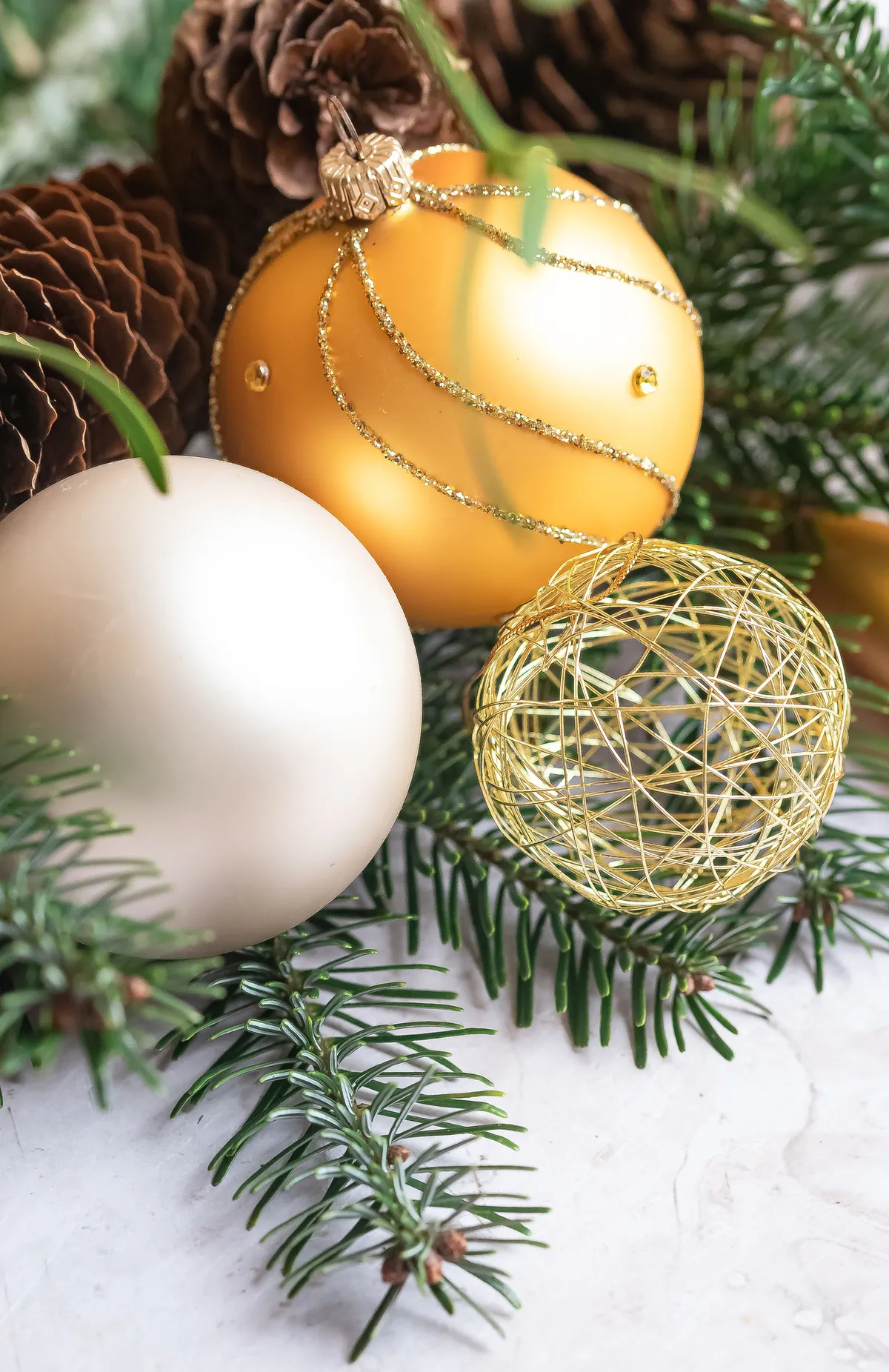
The mix also explains half the disagreement in the table above: sources assuming 4-inch ornaments (Macy’s) need a lower count for the same coverage than sources assuming 2.5-inch ones. If your collection skews small — most budget multi-packs are 2.2–2.7 inches — add 15% to your target count. If you’ve inherited a set of oversized heirloom balls, subtract 20% and spend the savings on minis for the gaps. That math is also the honest way to use a single-size bulk set like the white-and-gold 50-pack below: it supplies the standards, and the larges and minis come from last year’s collection — it’s the finish variety (shiny, matte, glitter) that keeps one box from reading flat.
As an Amazon Associate, we earn from qualifying purchases.

- 50 shatterproof 2.36" balls — hang them as your standards layer, then pull larges and minis from what you already own
- Finish variety in one box: shiny, matte, glitter and textured, so a single white-gold palette doesn’t read flat
- Caps and strings included, safe around kids and pets; 2.36" falls in the 2.2–2.7" range that warrants the +15% count
Price and availability shown on Amazon; listing may change.
4. The lights rule: 100 bulbs per foot, honestly adjusted
The lights rule: 100 bulbs per foot, honestly adjusted
The industry rule is 100 lights per vertical foot for a balanced glow — 600 for a 6-foot tree, which is six standard 100-bulb strands. Mood-light people can drop to 50 per foot (a strand every other foot); showstopper trees run 150 per foot and stop apologizing. Pre-lit tree owners: count the factory bulbs the same way, then add strands only for the specific dark zones you can see from your sofa.
| Tree height | Mood (50/ft) | Balanced (100/ft) | Bright (150/ft) |
|---|---|---|---|
| 4 ft | 200 | 400 | 600 |
| 6 ft | 300 | 600 | 900 |
| 7.5 ft | 375 | 750 | 1,125 |
| 9 ft | 450 | 900 | 1,350 |
Two honest footnotes to the rule. First, bulb spacing matters as much as bulb count: 100 bulbs spread over 33 feet of wire (the budget-strand spec) look sparser than 100 bulbs on 16 feet, so compare wire length, not just the number on the box. Second, the 100-per-foot figure assumes vertical weaving — trunk to tip, in and out — not wrapping around the outside like a maypole. Woven lights make 400 bulbs look like 600; wrapped lights make 600 look like 400. That budget-strand spec isn’t hypothetical, by the way — a clear-wire 100-bulb strand on 33 feet is the standard starter buy. The trade is real but manageable: sparser spacing, near-invisible wire, and six of them woven vertically still deliver the balanced 600-bulb glow on a 6-foot tree.
As an Amazon Associate, we earn from qualifying purchases.

- 100 LEDs on 33 ft of clear wire — exactly the budget-strand spec above; near-invisible wire, so win the spacing back with vertical weaving
- Connectable end to end: six strands hit the balanced 600 for a 6-foot tree without juggling outlets
- 8 modes on a push-button plug, IP44 waterproof, UL588 certified, 10 ft lead wire reaches the socket
Price and availability shown on Amazon; listing may change.
5. The order that makes the count work
| Step | Layer | Key detail |
|---|---|---|
| 1 | Lights | Woven trunk to tip, 100 bulbs per foot |
| 2 | Ribbon | 2-yd wired lengths, tucked on bare branches |
| 3 | Larges (4-6 in) | About 25% of count, placed while fresh |
| 4 | Standards (2.5-3 in) | About 60% of count, main coverage layer |
| 5 | Minis (under 2 in) | About 15% of count, repair local gaps only |
| 6 | Topper | Last; never counted toward the total |
The order that makes the count work
The same 90 ornaments land differently depending on sequence. The professional order: lights first (woven, trunk to tip), then ribbon, then the large statement pieces, then standards, then minis in the gaps, topper last. Ribbon goes on before ornaments because it needs to be tucked and adjusted on bare branches — every ornament hung first has to be hung around the ribbon instead.
The order also protects your count from itself. Ornaments hung first always end up clustered at eye level and on the front face, because that’s where the hand naturally goes — and by ornament 60 you’re improvising. Working in the sequence above, the larges get distributed across the whole tree while you’re still fresh, and the minis do nothing but repair local gaps at the end, which is exactly the job they’re best at.
6. What doesn’t count as an ornament
What doesn’t count as an ornament
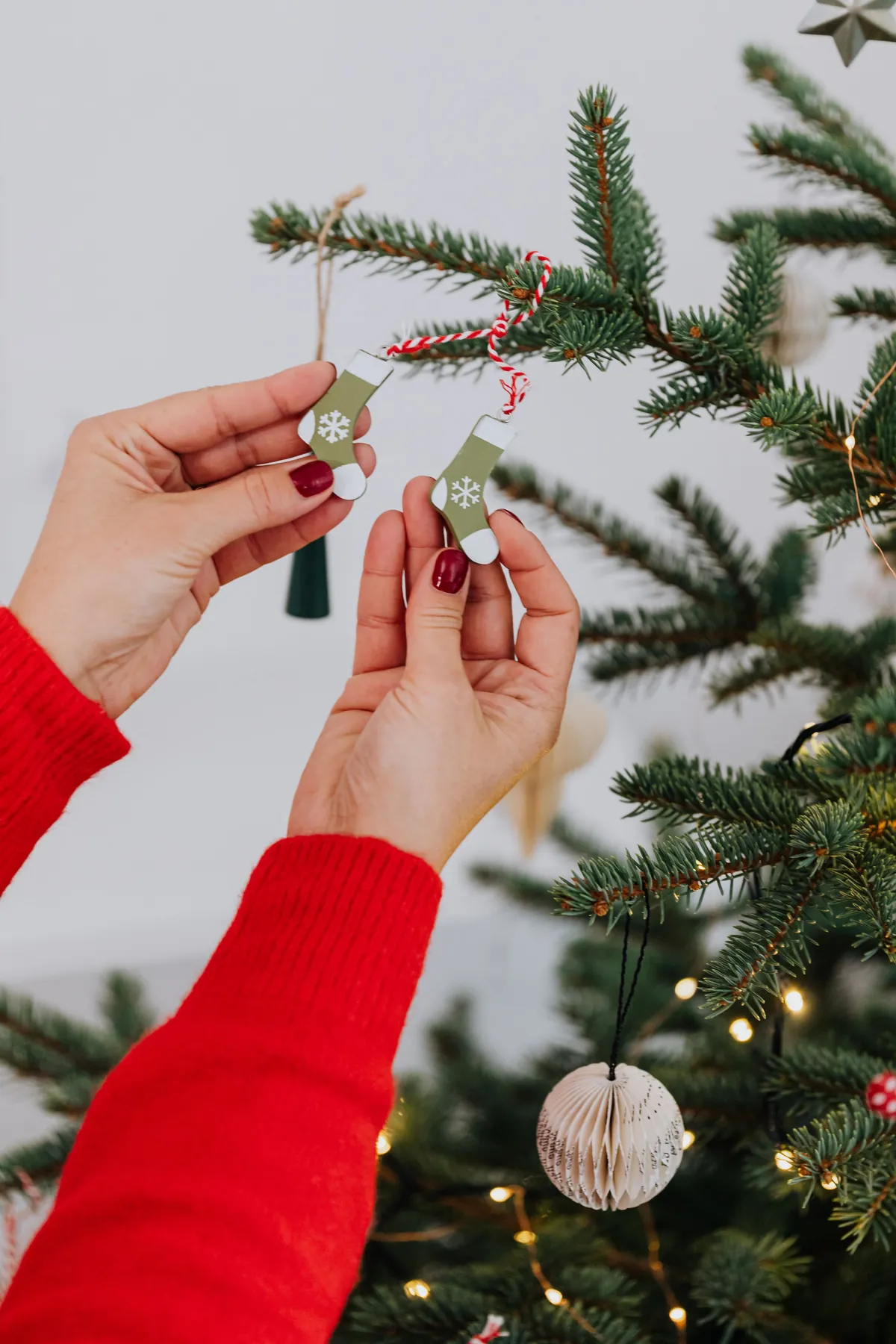
Ribbon, floral picks, garland and the topper fill visual space, which is why several sources’ numbers quietly assume them — and why your tree can look finished at 75 ornaments while the chart says 90. The honest bookkeeping: ribbon and picks subtract from the ornament count, at roughly 5 ornaments per 2-yard ribbon length and 2 per pick. A tree with five ribbon lengths and eight picks is entitled to look full at 15–20 ornaments under the chart number.
The corollary matters for budget year: if last December’s tree felt sparse and you blamed the ornament count, check the ribbon first. Adding three ribbon lengths is the cheapest 15-ornament-equivalent on the market, and wired ribbon holds the S-curve all season where unwired slowly slides into a sad diagonal. Count the fabric, then count the balls.
7. Slim, pencil and tabletop trees: the width multiplier
Slim, pencil and tabletop trees: the width multiplier
Height is only half the spec — the same “6 ft tree” can have a 22-inch footprint (pencil) or a 50-inch one (full), and the surface difference is enormous. Apply the width multiplier to the per-foot count: pencil and slim trees ×0.7, standard ×1.0, extra-full “flocked and fluffy” profiles ×1.2. A 6-foot pencil tree at balanced density therefore wants about 63 ornaments, not 90 — which is why sticking to the generic chart makes pencil trees look overloaded and top-heavy.
Tabletop trees run their own math: 2–3 feet of height at balanced density means 30–45 mini-skewed ornaments, with minis promoted from gap-filler to main event (a 3-inch ball on a 2-foot tree is a statement piece). For the full small-space playbook — where the tree goes when there’s no floor, how to fake height with a wall of lights — see our small Christmas tree ideas for tiny apartments.
8. The corner tree: three sides, not four
The corner tree: three sides, not four
A tree against a wall or in a corner shows about 270° — sometimes 180° — and decorating the invisible back is the most common waste of ornaments in December. Apply the viewing multiplier: floating in a room ×1.0, against a wall ×0.8, tucked in a corner ×0.75. That corner 6-footer drops from 90 balanced ornaments to about 68, and nobody walking into the room can tell which number you used.
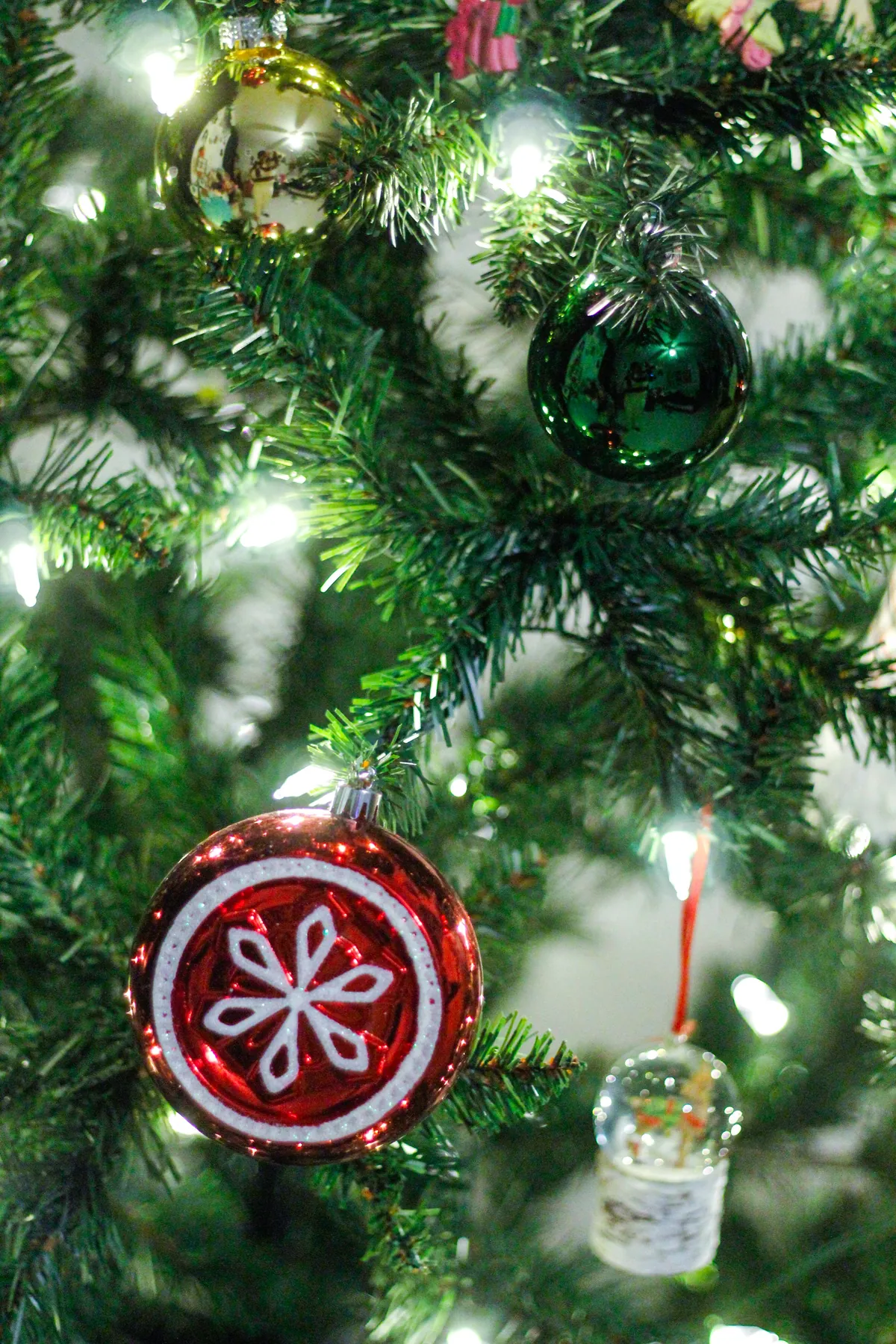
The back rows aren’t ignored entirely — they’re repurposed. The 20% “saved” from the invisible side becomes depth on the visible sides: ornaments pushed deep toward the trunk, peeking between branches instead of sitting on the tips. A tree decorated in three visible layers (tip, middle, deep) photographs twice as rich as one skinned in a single layer across the front, and the deep row is exactly where your mismatched or slightly scuffed baubles go to be useful.
9. Box math: turning a count into a shopping list
| Tree height | Balanced target | Pack list | Purchases |
|---|---|---|---|
| 5 ft | 75 | 4 standard 12-packs, 1 large 9-pack, 1 mini 12-pack | 6 |
| 6 ft | 90 | 6 standard 12-packs, 1 large 9-pack, 1 mini 12-pack | 8 |
| 7.5 ft | 112 | 6 ft list plus 1 standard 12-pack, 1 large pack | 10 |
| 9 ft | 135 | 7 standard 12-packs, 4 large 9-packs, 2 mini 12-packs | 13 |
Box math: turning a count into a shopping list
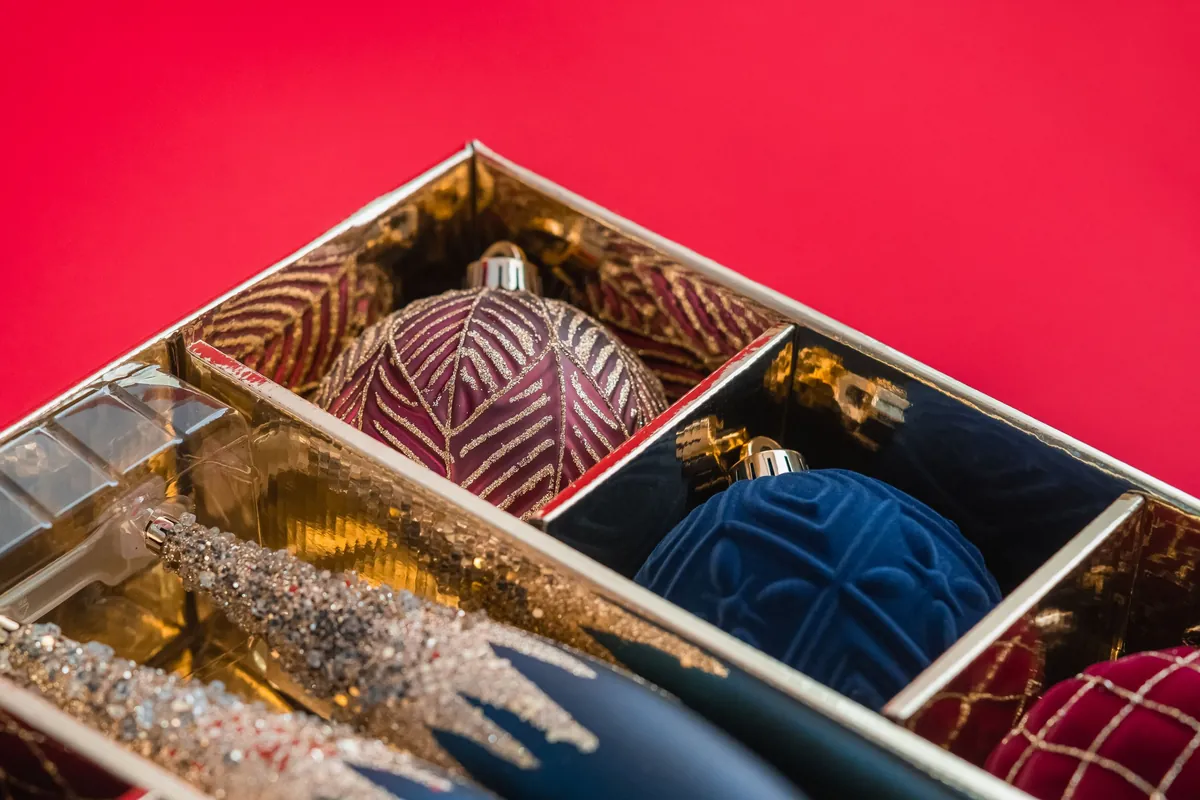
Ornaments are sold in packs of 6, 9, 12, 24 and 50 — and the pack is the real unit of shopping, not the ornament. Converting the balanced 6-foot target of 90 into boxes with the 60/25/15 mix: six 12-packs of standard balls (72), one 9-pack of larges, one 12-pack of minis — eight purchases, a couple of which you may already own. For a 7.5-foot tree at 112, add one standard 12-pack and one large pack.
Two pack-level details worth checking before checkout. Shatterproof plastic (PE or PVC) beats glass for households with pets, kids or carpet, and weighs less on the branch tips; glass earns its keep only where weight is on the lower, stronger branches. And check whether the pack mixes finishes — a box of twelve identical matte balls is less useful than a box mixing matte, gloss and glitter, because finish variety is what keeps a single-color palette from reading flat.
10. The 48-plan: distribute in groups, not by mood
| Zone | Group size (90-tree) | Best size class | Why |
|---|---|---|---|
| Top | 15 | Minis | Thin tips, seen from a distance |
| Upper-middle | 15 | Statement pieces | Seated eye level, where guests look |
| Lower-middle | 15 | Standards | Main coverage zone |
| Bottom | 15 | Larges | Strongest branches, lowest sightlines |
| Each visible side | 15 | Mixed | Forces even coverage before the eye votes |
The 48-plan: distribute in groups, not by mood
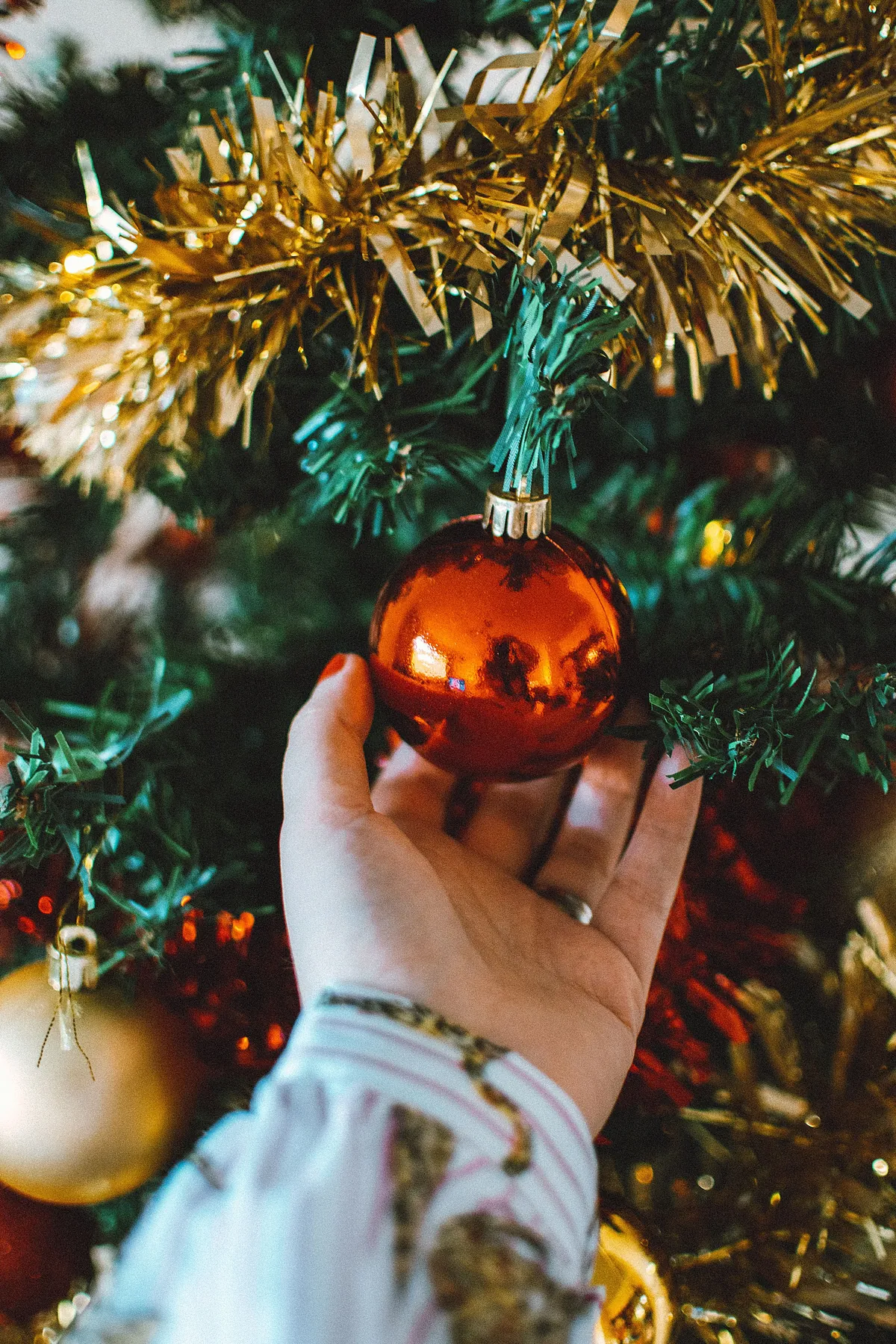
The best distribution trick I’ve adopted — popularized by tree brands and worth borrowing outright — is to split your count into six equal groups and hang one group per zone: top, upper-middle, lower-middle, bottom, and each visible side. For a 90-ornament tree that’s six groups of fifteen; for the classic 48-ornament starter set it’s six groups of eight, which is where the name comes from. The group count forces even coverage before your eye gets a vote, and it converts “is the tree done?” into a countable question.
The zone assignment also encodes the physics: larges go in the bottom two zones where branches are strongest and sightlines are lowest; minis take the top where branch tips are thin and the tree is seen at a distance; statement pieces get the zones at seated eye level, because that’s where guests actually look. One group per zone, larges low, minis high — the tree balances itself.
11. Depth: every third ornament goes deep
Depth: every third ornament goes deep
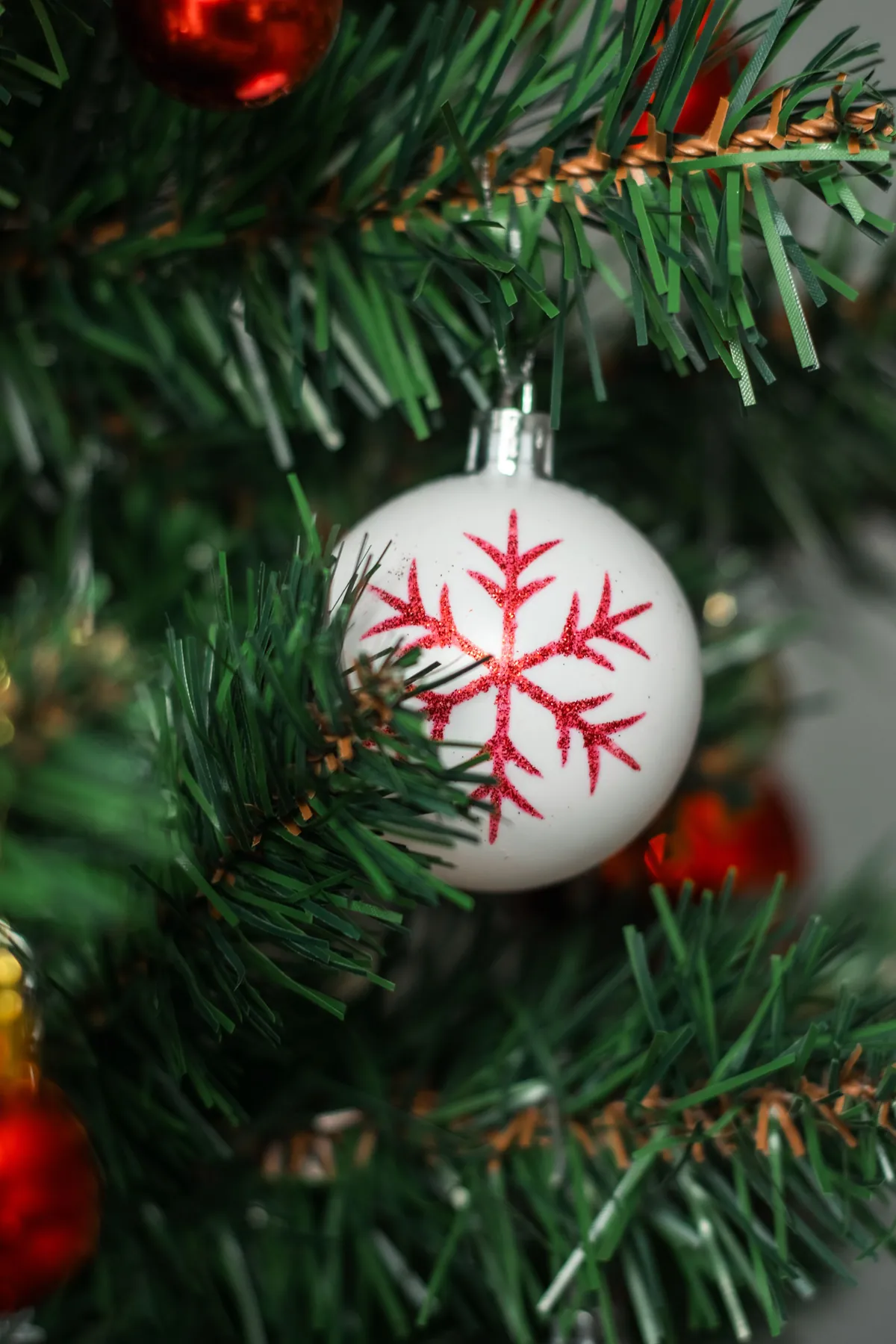
The fastest upgrade to any ornament count costs nothing: hang every third ornament deep, angled toward the trunk, instead of on the outer tips. Deep ornaments catch light from the woven strands inside the tree, which is what makes professionally decorated trees glow from within — the light has baubles to bounce off between the branch layers. A tree with all 90 on the tips looks flat from ten feet away; the same 90 split 60 tips / 30 deep looks twice as dense with zero purchases.
Depth placement has a structural bonus too: deep hooks sit on thicker wood near the trunk, so heavier ornaments belong there anyway. Reserve the tips for minis and shatterproof plastic — the tips are the thinnest wood on the tree and the first thing a cat’s tail or a vacuum cleaner finds. Heavy, heirloom, or glass goes deep; light and expendable goes out.
12. January: store the count, keep the system
January: store the count, keep the system
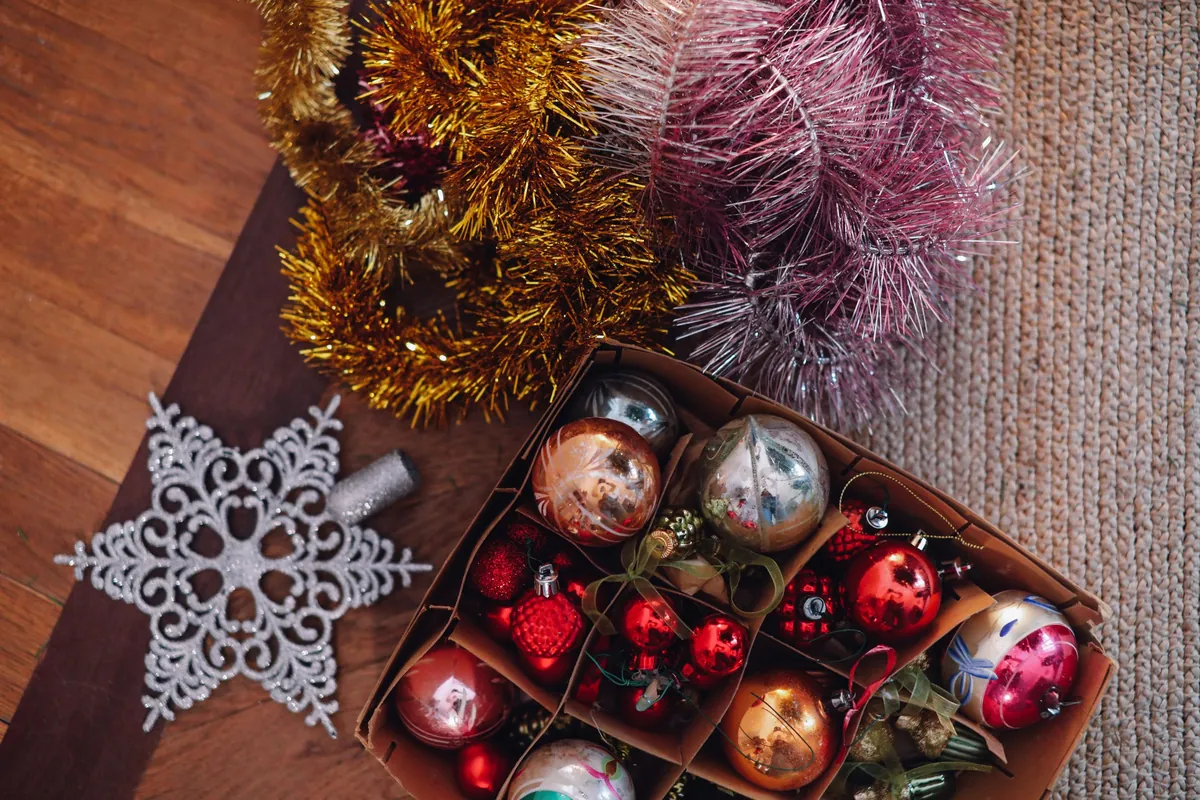
The ornament count is a system, and systems survive on storage. Pack by size class, not by color: standards in one compartment box, larges wrapped individually, minis in a zip bag — next December the 60/25/15 mix reassembles in minutes instead of an excavation. Label the box lid with your tree’s actual count (“6 ft slim, corner, 63 bal, 6 strands”) and next year’s setup starts from data instead of memory. Boxes with a label window on the front — like the pair below — turn that into a one-minute job instead of a stack of identical green lids.
The same count carries over to the rest of the holiday pipeline: the tree’s numbers slot into the same December math as the gift station’s paper-and-ribbon totals — the gift wrapping station supply math is the same discipline applied to boxes instead of branches. Count once, in numbers, and every year after that the only December surprises are the good kind.
As an Amazon Associate, we earn from qualifying purchases.

- Two stackable boxes, 256 total 3" compartments — a 90-ornament system fits with room to grow
- Adjustable dividers take what the grid can’t: oversize larges, bells, light strings
- 600D fabric, dual zippers and a front label window — write "6 ft slim, corner, 63 bal" right on the box
Price and availability shown on Amazon; listing may change.
The Tree Math Tables
Every number from this page, in one place — print it, tape it to the ornament box:
| Number | The rule | 6 ft example |
|---|---|---|
| Ornaments (light) | 10–12 per vertical foot | 60–72 |
| Ornaments (balanced) | 15 per foot | 90 |
| Ornaments (full) | 20–25 per foot | 120–150 |
| Width multiplier | slim ×0.7 / standard ×1.0 / full ×1.2 | slim: 63 |
| Viewing multiplier | wall ×0.8 / corner ×0.75 | corner: 68 |
| Size mix | 60% standard / 25% large / 15% mini | 54 / 22 / 14 |
| Lights (balanced) | 100 bulbs per foot | 600 = 6 strands of 100 |
| Lights (range) | 50/ft mood to 150/ft bright | 300–900 |
| Ribbon credit | each 2-yd length ≈ −5 ornaments | 5 lengths = −25 |
| Depth split | 2/3 on tips, 1/3 hung deep | 60 / 30 |
Budget: three ways to buy the count
| Tier | What you buy | What you get |
|---|---|---|
| Under $40 — the starter | Four 12-packs of 2.7" shatterproof balls, one 100-bulb strand per foot | A 4–5 ft tree at balanced density; mix finishes, skip the larges for year one |
| Under $100 — the balanced | Six 12-packs standard, one 9-pack large, one mini set, six 100-bulb strands | A 6 ft tree at true balanced density with the 60/25/15 mix |
| Under $250 — the showpiece | Everything above at full-density counts, plus wired ribbon and 8–10 picks | A 7.5 ft tree at full density; ribbon and picks carry half the visual load |
The Tree Math Checklist — Save the Numbers
- ☐ Count = height in feet × 10–12 (light) / 15 (balanced) / 20–25 (full)
- ☐ Width multiplier: pencil ×0.7, standard ×1.0, extra-full ×1.2
- ☐ Viewing multiplier: wall ×0.8, corner ×0.75 — never decorate the back
- ☐ Size mix 60/25/15: standard 2.5–3", large 4–6", minis under 2"
- ☐ Ribbon credit: each 2-yd wired length subtracts ~5 from the count
- ☐ Lights: 100 bulbs per foot, woven trunk-to-tip, 50–150/ft range
- ☐ Compare wire length, not just bulb count, between strands
- ☐ Order: lights → ribbon → larges → standards → minis → topper
- ☐ Split into 6 groups, one per zone; larges low, minis high
- ☐ Every third ornament hung deep, angled to the trunk
- ☐ Heavy and glass ornaments deep on thick wood; plastic on tips
- ☐ Box lid labeled with the count — next year starts from data
FAQ: Christmas Tree Count Edition
How many ornaments for a 6 foot Christmas tree?
About 90 for a balanced look (15 per vertical foot), 60–72 for a light branch-visible style, and 120–150 for a fully loaded display. Adjust for width (slim ×0.7) and viewing angle (corner ×0.75), and subtract about 5 ornaments per 2-yard ribbon length. A 90-ornament tree at the 60/25/15 size mix looks deliberate from any angle.
How many lights does a 6 foot tree need?
600 bulbs for a balanced glow — the 100-bulbs-per-foot rule — which is six standard 100-count strands. Moody trees run 300 (50 per foot) and bright showpieces run 900 (150 per foot). Woven trunk-to-tip placement makes the count go further; compare wire length between strands, since 100 bulbs on 16 feet of wire look denser than 100 on 33 feet.
Do ribbon and picks count toward the ornament total?
They cover space but shouldn’t be counted as ornaments — instead, credit them against the total: each 2-yard wired ribbon length substitutes for roughly 5 ornaments and each floral pick for about 2. A tree with five ribbon lengths and eight picks can look finished 25–30 ornaments under the chart number, which is why some sources’ counts seem so much lower than others.
How many ornaments does a slim or pencil tree need?
About 70% of the standard count for the same height — a 6-foot pencil tree takes roughly 63 ornaments at balanced density. Check tip count as the width signal: under about 250 tips, apply the slim multiplier. Tabletop trees (2–3 ft) run 30–45 mini-skewed ornaments, with minis as the main event rather than gap filler.
What size ornaments should I buy?
Aim for the 60/25/15 mix: 60% standard balls (2.5–3 inches) for coverage, 25% large statement pieces (4–6 inches) for anchors, 15% minis (under 2 inches) for gap filling. If your budget packs are all 2.2–2.7 inches, add 15% to the count; one oversized heirloom ball covers the area of four standard ones, so subtract 20% where those dominate.
How do I make a tree look full without buying more ornaments?
Three free moves: hang every third ornament deep toward the trunk so the woven lights have something to bounce off; split the count into six equal groups and place one per zone to force even coverage; and add wired ribbon — each 2-yard length covers what five ornaments would. A corner tree can skip its invisible back entirely and reinvest those ornaments in visible depth.
Last updated: November 14, 2026. We count the ornaments so the tree doesn’t lie to you.

Related Reading
- 15 Small Christmas Tree Ideas for Tiny Apartments
- 15 Christmas Gift Wrapping Station Ideas That Survive 30 Gifts
- 15 Christmas Entryway Ideas That Survive December Traffic
- 15 Christmas Stocking Ideas When You Don’t Have a Fireplace
- 15 Christmas Table Setting Ideas That Look Expensive
- 15 Christmas Porch Decorating Ideas That Survive Rain