
Our first apartment December, I hung the window lights with packing tape. It held beautifully through Christmas, then peeled a stripe of paint off the trim on December 26, and the landlord’s inspection was March 2. I spent February with a paint can and a level, repainting trim I had promised myself I’d never touch. The lights cost $18. The paint, the level and the apology cost the rest of the deposit.
The second December, everything stuck with glass, clips and gravity: suction cups on the panes, adhesive light clips on the painted trim, one steel hook draped over the front door, and not one mark anywhere. This page is the version of that December I wish I’d had — a load table for suction cups, the halving rule for adhesive hooks, the cord-routing answer that keeps window sashes from slicing insulation, and the window outline math so you buy the right footage the first time.
Table of Contents — 12 Ideas
- What can I attach Christmas lights to without nails?
- How much weight does a suction cup hold on glass?
- How many feet of lights does one window need?
- Are window candles tacky or classic?
- Do Command hooks hold Christmas lights on trim?
- How do I hang a wreath without scratching the door?
- Can I run a light cord through a window or door gap?
- What clips work on vinyl siding and window frames?
- What’s the renter-safe decoration list?
- Battery or plug-in for window lights?
- How do I keep glass decorations from falling?
- The 60-second no-nails install check
1. The three-surface rule
What can I attach Christmas lights to without nails?
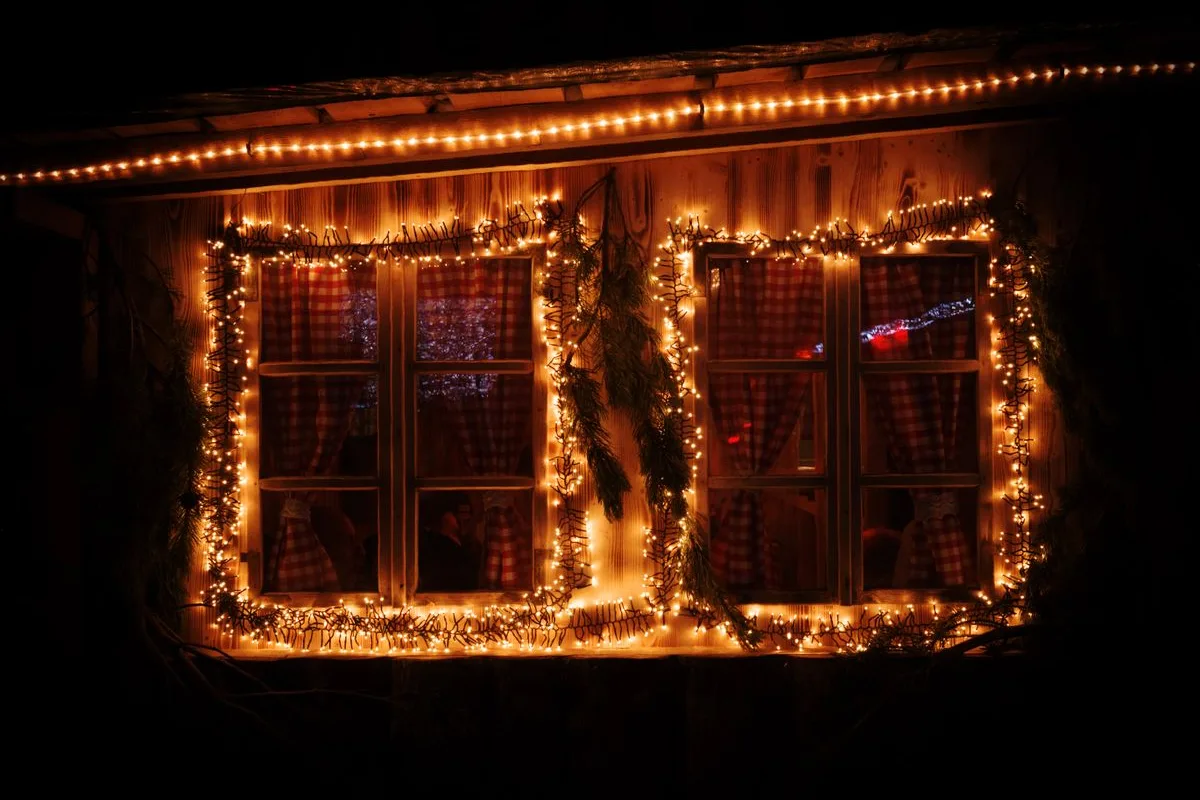
Every no-nails decision starts with the surface, because the surface decides the adhesive. Glass is the easy one: smooth, non-porous, and the only surface where suction cups honestly earn their rating. Painted wood or metal trim takes adhesive hooks and clips, but only if the paint is sound — two-year-old eggshell holds; chalky, flaking or freshly painted (under 30 days) trim lets go and takes the paint with it. UPVC and steel doors take magnets and over-the-door hardware; brick, stucco and rough stone take nothing light-duty, no matter what the package promises.
The matching rule: glass → suction, smooth painted trim → adhesive, steel door → magnet, door → over-the-top hook, everything textured → don’t. Fight the surface you’ve got and you end up repainting trim in February (see above), which is exactly the outcome the table in idea 5 exists to prevent.
2. Suction cups on glass (the honest load table)
How much weight does a suction cup hold on glass?

Suction cups fail for boring physical reasons, so the table below halves every rated number — a cup rated 4 lb gets trusted with 2 lb. Clean the pane with isopropyl alcohol, press the cup from the center outward to push every bit of air out, and mount it warm (a cup that rode in a cold car has shrunk; bring it indoors for an hour). Vacuum slowly bleeds away over weeks, so re-press every cup in January.
| Suction cup diameter | Rated hold on smooth glass | What it safely carries | Survives the season? |
|---|---|---|---|
| 1.2 in (30 mm) | ~1 lb | Light clips, single strand of mini LED (0.2 lb per 33 ft) | Yes, re-press monthly |
| 1.8 in (45 mm) | ~2 lb | Mini light outlines, small ornaments under 1 lb | Yes |
| 2.4 in (60 mm) | ~4 lb | A 3 ft lit wreath (2–3 lb) — trust at 2 lb | Yes, with the halving rule |
| Any cup on textured or coated glass | — | Nothing — low-E coatings and texture break the seal | No |
Two more honesty notes: cold snaps shrink cups overnight (press them again after the first hard freeze), and a cup holding weight at the end of a lever — like a wreath hanging 6 inches below the cup — multiplies the force. Hang wreaths on two cups with a wire between them, not one heroic cup in the middle.
As an Amazon Associate, we earn from qualifying purchases.

- Printed 3 lb hold per 1.75-inch cup on smooth, non-porous glass — idea 2’s halving rule puts the honest working load at 1.5 lb, and a mini-LED outline asks for 0.2 lb
- Clear plastic with metal hooks stays invisible on panes; grips glass, mirrors, tile and metal, and lifts off with an edge flick — fully reusable next December
- Made in USA, 6 to a pack; two cups with wire between them is the wreath rig from idea 2’s lever warning
Price and availability shown on Amazon; listing may change.
3. Window outline math (buy the right footage)
How many feet of lights does one window need?
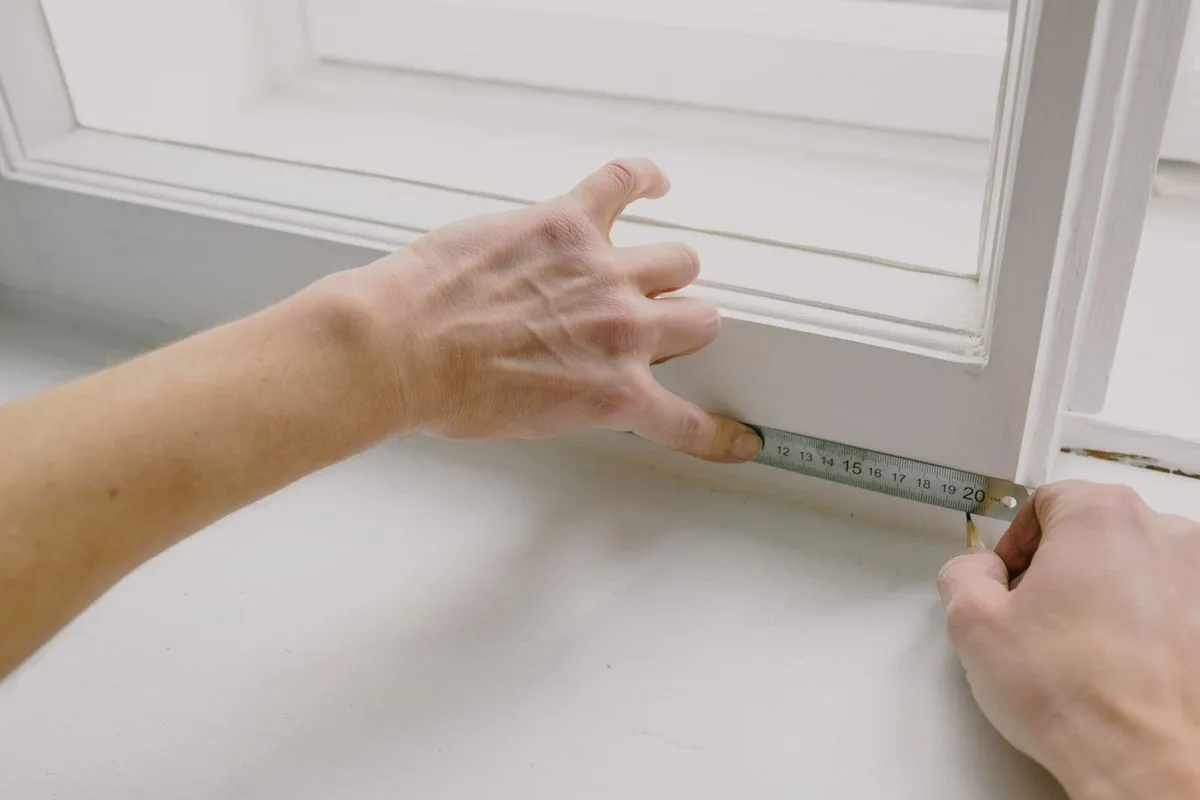
The formula is perimeter plus sag: measure width and height of the window (trim edge to trim edge), add them, double it, then multiply by 1.1 for the gentle dips that make an outline look hung rather than strung. A standard 3 ft × 5 ft double-hung window works out to 2 × (3 + 5) × 1.1 ≈ 17.6 feet — call it 18.
| Window | Perimeter × 1.1 | Lights needed | 33 ft LED strands |
|---|---|---|---|
| Small bath window (2 × 3 ft) | ~11 ft | One 16 ft strand, trimmed layout | 1 |
| Standard bedroom (3 × 5 ft) | ~18 ft | Outline with sag | 1 |
| Living-room picture window (4 × 6 ft) | ~22 ft | Outline plus sill run | 1 |
| Four front windows | ~72 ft | Full street-facing set | 2–3 |
Two to three connectable 33 ft LED strands cover the whole front of a typical house — and at 4 to 5 watts per strand, the electrical side is a rounding error, which the outlet wattage math confirms from the other direction. Buy one extra strand; the strand you return is cheaper than the corner left dark.
4. Window candles (the classic, done right)
Are window candles tacky or classic?
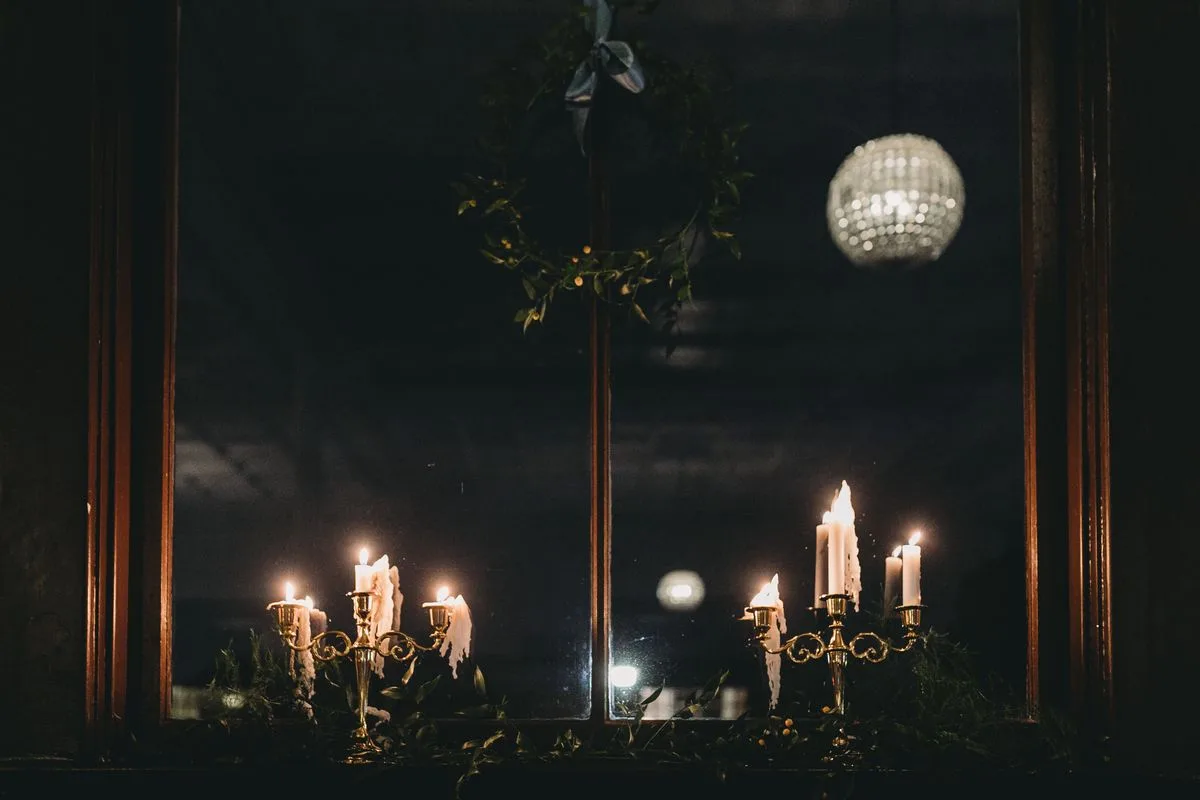
Classic, when the spacing is even. The scheme is one candle per sash, centered, placed two-thirds up the sill so the flame sits at eye level from the street — and every candle shows the same warm tone. The look dies the moment one candle is cool-white and its neighbor is warm, or three candles sit high and one sits low; the pattern is the decoration.
The no-nails part is the best part: window candles just stand on the sill. No adhesive, no cups, nothing. Spend the decision money on automation instead — a dusk-to-dawn sensor or a 6-hour timer (the same on/off rhythm the timer math guide recommends for everything else) means the display runs itself all season, and nobody crawls around at 10 p.m. flipping switches.
The classic window-candle scheme, specified:
| Spec | The classic rule | What breaks the look |
|---|---|---|
| Density | One candle per sash, centered | Random gaps between windows |
| Height on sill | Two-thirds up the sill — flame at street eye level | Three high, one low |
| Color temperature | Every candle the same warm tone | One cool-white neighbor among warms |
| Attachment | Stands on the sill — no adhesive, no cups, no nails | None — this is the zero-risk scheme |
| Automation | Dusk-to-dawn sensor or 6-hour timer | Manual switches flipped at 10 p.m. |
5. Adhesive hooks and clips on trim (the halving rule)
Do Command hooks hold Christmas lights on trim?
Yes — with the halving rule. The rating on the package (a small wire hook holds 2 lb, a medium hook 3 lb, outdoor clips similar) is measured on a smooth, sealed surface at room temperature after the adhesive has cured. Your painted trim in December is none of those things, so: rated 2 lb → trust 1 lb, and on paint older than five years or anything slightly chalky, quarter it. A strand of mini LED weighs about 0.2 lb per 33 feet, so even the halved number carries four strands per hook with room to spare.
The other half of the rule is time and removal: apply above 50°F and wait an hour before loading (24 hours for outdoor or cold installs), and remove by pulling the tab straight down along the surface — stretching it away from the wall at an angle is what takes paint and trim finish with it. Never stick adhesive to wallpaper or to paint applied in the last 30 days; both fail by design, not bad luck.
| Surface | Best attachment | Rated → trusted load | Marks left? |
|---|---|---|---|
| Smooth glass | Suction cup (idea 2) | 2 lb → 1 lb | None |
| Painted wood/MDF trim | Adhesive hook or light clip | 2 lb → 1 lb (halve) | None if pulled correctly |
| Old or chalky paint | Suction on the glass instead | 2 lb → 0.5 lb (quarter) | Paint risk — test a hook for 48 h |
| Steel door / UPVC | Magnetic hook | 3 lb → 1.5 lb | None |
| Brick, stucco, stone | Nothing light-duty | — | Everything sticks badly |
As an Amazon Associate, we earn from qualifying purchases.

- Command’s own spec is one clip per 2 feet of lights; exposed facades get idea 8’s one-per-foot by buying two packs
- Water- and UV-resistant strips rated -20°F to 125°F — the cold-snap survival the idea 5 table asks for
- Bond to doors, flat vinyl, soffits and painted trim; wait 1 hour before loading and remove by pulling the tab straight down, exactly as idea 5 prescribes
Price and availability shown on Amazon; listing may change.
6. The front door (gravity does the work)
How do I hang a wreath without scratching the door?
| Wreath | Hanger type | Rated hold | Typical cost (USD) |
|---|---|---|---|
| 12 in, unlit (about 2 lb) | Flat steel over-door hook | 5–10 lb | $5–10 |
| 18 in, lit (3–4 lb) | Adjustable-length over-door hook | 10–15 lb | $10–20 |
| 24 in, lit (4–5 lb) | Heavy-gauge over-door hook | Up to 15 lb | $15–25 |
| Double doors, two wreaths | One hook per panel | 5–15 lb each | $12–30 |
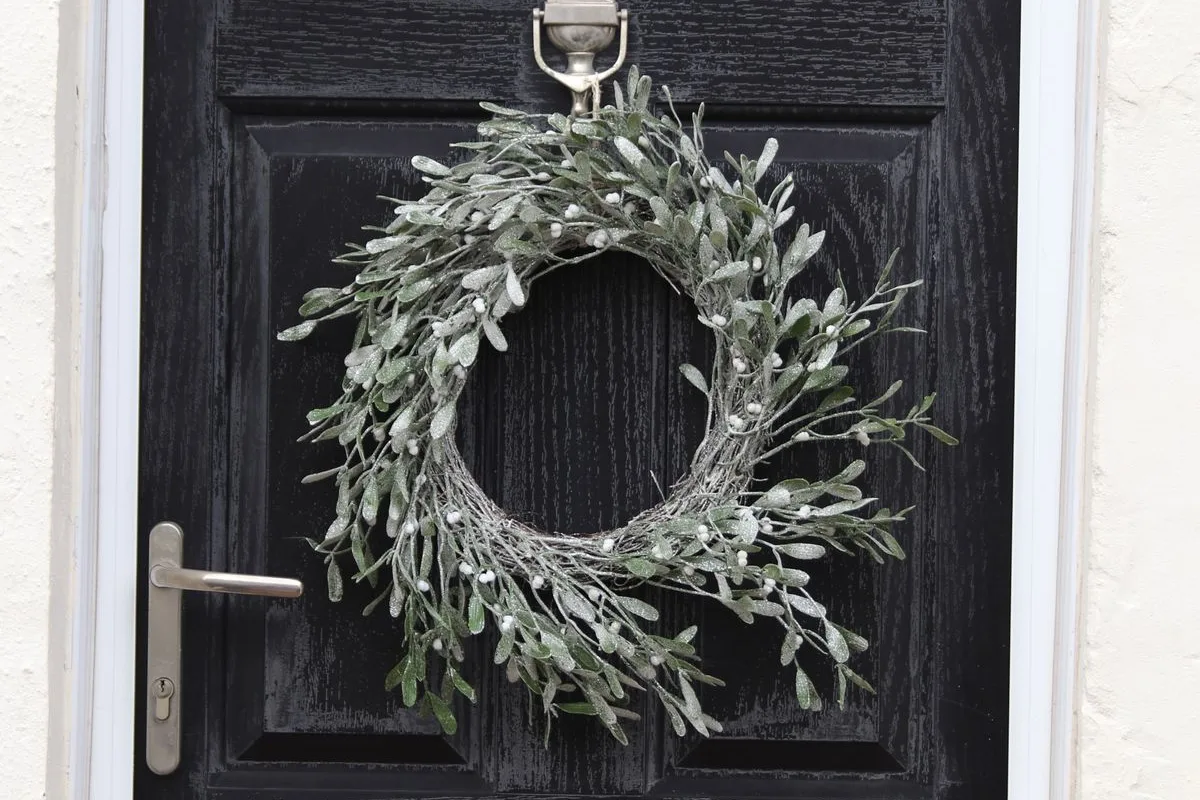
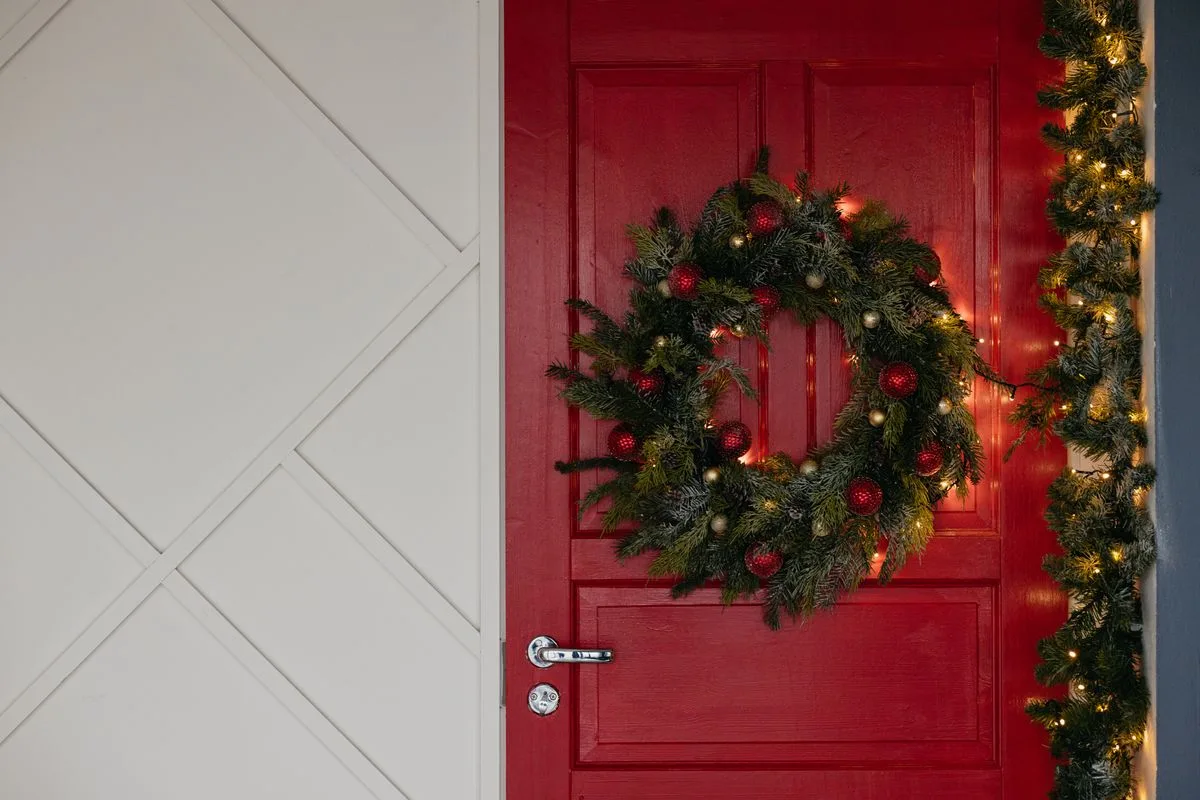
An over-the-door wreath hanger is the entire answer: a flat steel hook that drapes over the top edge, holds 5 to 15 lb depending on gauge, and touches the door only at the top — no adhesive, no suction, no holes. Choose an adjustable-length model so the hook hangs the wreath at eye level rather than at doorknob height, and add a felt or rubber pad where the metal meets the paint if your door is finished in anything softer than factory paint.
Lights around the doorframe reuse the trim rules from idea 5 — adhesive clips on painted trim, magnets if the frame is steel — and the garland question is the same math as the stair banister guide: measure, multiply by 1.5 for the wrap, and stop trying to stretch one strand. The entryway decor plan handles what goes beside the door; this page just promises none of it leaves a mark.
7. Cord routing (the question everyone gets wrong)
Can I run a light cord through a window or door gap?
| Method | Setup | Risk | Typical cost (USD) |
|---|---|---|---|
| Battery strand on the sill | None — no cord at all | None | $10–25 per strand |
| Purpose-made flat cord under a door | Lay flat, door closes normally | Minimal if seal stays intact | $8–15 |
| Window fixed open 0.5 in | Cord rests in the channel | Only if opened mid-season | $0 |
| Cord through a closing sash | — | Shock and fire hazard | Never |
Never through a closing window sash. A double-hung window pinches the cord between two sash channels designed to seal tight, which cuts insulation invisibly and hands you a shock and fire risk for the rest of the season — the one mistake on this page that isn’t cosmetic. A door gap is the same story with worse odds: the weatherstripping exists to compress, and a round cord in it destroys the seal you heat with.
The honest options, in order of preference: battery lights with the box on the sill (idea 10), which delete the cord entirely; a purpose-made flat cord designed to pass under a door without stopping it from closing; or routing through a window that stays open a fixed half-inch with the cord resting in the channel — only if that window is never opened all season and the cord isn’t pinched anywhere. What you don’t do is pinch, staple or squeeze any cord anywhere.
8. Clips for siding, gutters and window frames
What clips work on vinyl siding and window frames?
| Run | Clip type | Clips needed | Install temp |
|---|---|---|---|
| 20 ft gutter run | All-plastic gutter clips | 20 (one per foot) | Any temperature |
| 40 ft vinyl siding run | S-shaped panel-edge clips | About 40 | Any temperature |
| One window frame outline | Spring or adhesive-backed clips | 4–6 per frame | Above 40°F if adhesive |
| Exposed wind-blown facade | Wrap-style clips that hold the strand | 1 per foot | Above 40°F if adhesive |
Vinyl siding takes S-shaped clips that hook the panel edge — the clip grips the siding’s return lip and the strand clips into it, no adhesive on the vinyl itself (adhesive on vinyl siding fails in the first freeze and can pull the finish). Gutters and shingles take all-plastic gutter clips that pinch on, one per foot along the run. Window frames — the aluminum or vinyl kind — take small spring clips that wedge into the channel or adhesive-backed clips rated for outdoor temperatures.
The unifying rule across all of them: plastic clips only, one per foot, installed above 40°F if they’re adhesive-backed. Family Handyman’s outdoor light hanging guide walks the same clip-per-foot logic for gutters and rooflines if your display grows past the windows. Metal clips in cold, wet Decembers rust, stain trim, and conduct nothing you want conducted. If the clip needs to survive wind, aim for the clip that wraps the strand rather than pinches it — pinch points are where insulation fails by February.
9. The renter-safe list
What’s the renter-safe decoration list?

The fully reversible list: window candles standing on sills (idea 4), suction cups on glass, adhesive hooks on trim — applied and removed correctly — over-the-door hangers, battery lights, window decals and gel clings, and a projection light that needs nothing but an outlet and a dark wall. Everything on that list comes down in March with the paint intact, which is the whole test.
The near-list needs a conversation before it needs an install: adhesive on aged paint (idea 5’s test-a-hook-for-48-hours move), anything on textured glass, and exterior mounts on rented facades. The never-list needs no conversation: nails, screws, staples, duct tape, packing tape (RIP our deposit), and hot glue on any painted or UPVC surface. If the removal method involves a scraper, it isn’t a no-nails method.
10. Battery or plug-in for windows?
Battery or plug-in for window lights?
| Setup | Power draw | Runtime | Typical cost (USD) |
|---|---|---|---|
| One 50-bulb LED window outline, plug-in | 4–5 watts | Unlimited while plugged in | $10–20 per strand |
| Same outline, battery | Milliwatts; about 3 D cells | 6 h nightly, most of the season | $15–30 per strand |
| 66 ft, 200 LED battery strand | 4 AA batteries | 6-on/18-off timer cycle | $20–35 |
| Whole-facade outline, plug-in | Add 4–5 watts per strand | Unlimited | $30–60 for 2–3 strands |
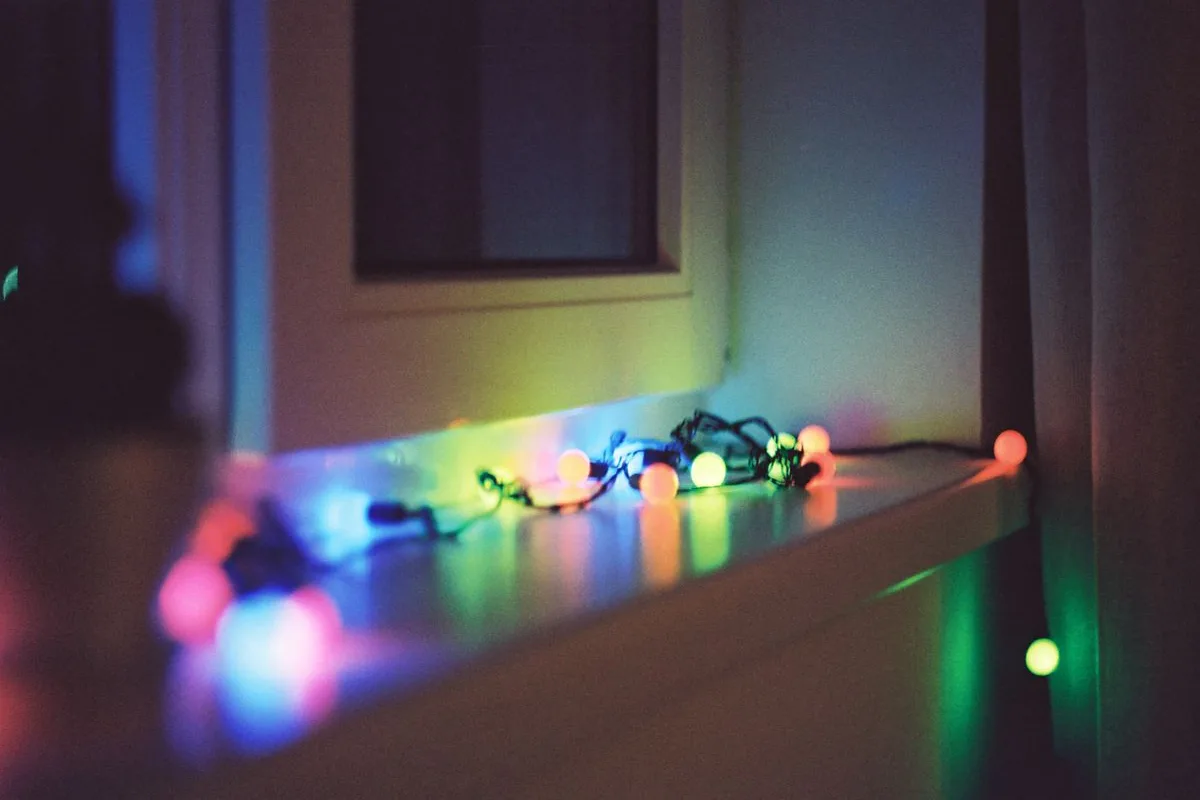
Battery wins for anything the cord question touches — upstairs windows, front doors far from an outlet, any window you’d have to route a cord through (idea 7). The math: an LED strand of 50 bulbs draws 4 to 5 watts, and battery versions sip milliwatts, so three D batteries run a 6-hour nightly schedule for most of the season. The non-negotiable feature is the timer: 6 hours on, 18 off, restarting automatically — without it, battery boxes get switched off by hand exactly once and stay off.
Plug-in wins where an outlet is already inside the window and the run is long or bright — picture windows, whole-facade outlines, anything pairing with the circuit math at scale. The practical split most houses land on: plug-in downstairs where outlets live, battery upstairs where cords would have to do something stupid.
As an Amazon Associate, we earn from qualifying purchases.

- 66 feet and 200 warm-white LEDs on green wire — a whole window display from one battery box on the sill, no cord through any sash
- Built-in 6-on/18-off timer with a memory chip; idea 10’s must-have feature, press once in November
- Runs on 4 AA batteries (swappable sooner than idea 10’s D-cell example) with 8 modes and weather-resistant wire
Price and availability shown on Amazon; listing may change.
11. Keeping glass decorations up (and safe when they don’t)
How do I keep glass decorations from falling?
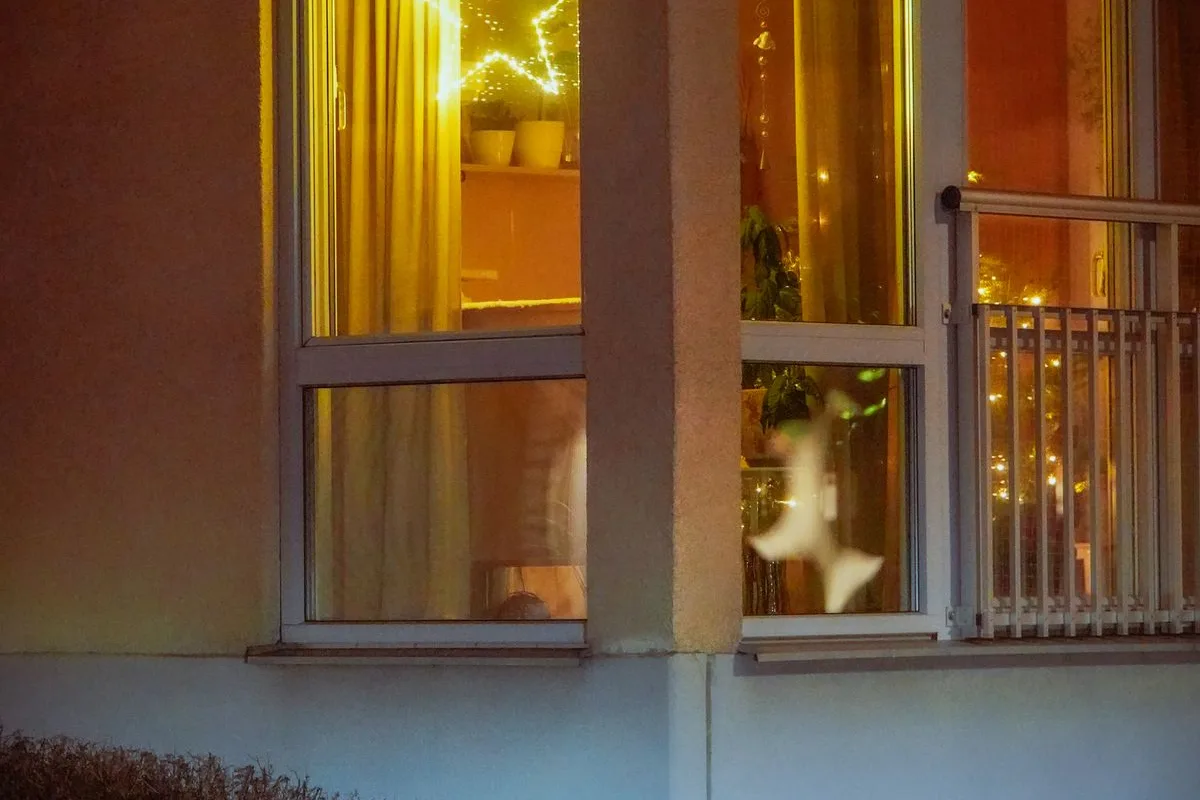
Redundancy and landing zones. Anything glass or fragile gets two attachments — two suction cups, or a cup plus a bead of removable poster putty as a second line — so one failing seal is an inconvenience, not a floor cleanup. Anything hanging over a walkway, a cat’s territory (the cat-proofing rules apply to window shelves too) or a baby’s reach gets the soft-landing treatment: nothing heavy below chest height, nothing fragile above a tile floor without a second anchor.
Weight discipline comes from the tables, not vibes: a lit wreath is 2 to 3 lb, a strand of mini LED is 0.2 lb per 33 feet, a glass ornament is half a pound. Sum what each cup or hook actually carries, halve the rating, and you have margin for the January cold snap that shrinks every adhesive on the street at once.
12. The 60-second check before anything sticks
The 60-second no-nails install check

Run it before the first cup presses: match every attachment to its surface from the idea 5 table, total the weight each hook or cup carries and halve the rated number, confirm no cord crosses a closing sash or door edge anywhere, warm the cups and adhesive indoors and wait the hour before loading, and put the whole display on timers so it runs without you. Sixty seconds here is the difference between this page and a February with a paint can — the tape-and-scapel revival tour is one winter you only get to do once.
No-Nails Install: The 6-Point Checklist
- ☐ Every attachment matched to surface: suction on glass, adhesive on sound trim, magnet on steel, over-door hook on the door
- ☐ Loads halved (or quartered on old paint) against the table; nothing over a walkway without redundancy
- ☐ Zero cords through closing sashes or door edges; battery or flat cord where routing was the plan
- ☐ Cups cleaned with alcohol, pressed warm, re-press scheduled after the first hard freeze
- ☐ Adhesive applied above 50°F, loaded after 1 hour (24 h outdoor), removal tab located
- ☐ Timers set 6-on/18-off; outline footage bought at perimeter × 1.1 with one spare strand
Related Reading
- Christmas Tree Lights Calculator: how many strands by tree height
- How Many Light Strings on One Outlet? The Wattage Math
- Light Timer Schedules: The 6-Hour Math
- Stair Garland Math: How Much Garland for a Banister
- Christmas Entryway Decor Ideas
- How Many Ornaments and Lights Does a Christmas Tree Need?
- Christmas Tree Footprint Math: Floor Space, Skirt Size and the Gifts Underneath
Last updated: November 23, 2026. The security deposit came back in full, and it keeps them.
[…] 18, repeats — with a memory chip that keeps your mode through the off-cycle. This is why the window lighting guide leans battery: upstairs windows and far doors get the same disciplined schedule as the plugged-in […]