
The short version
50 ornaments fit one 32-quart bin with an egg-crate divider, 25 feet of garland fills another, and a 7.5-foot tree needs a 52-inch storage bag. An attic of holiday decor for a normal family lands at 4-6 bins plus the tree bag. Enter your ornament count below and the calculator sizes the bins, the shelf frontage, and the label list — with different advice for attic, basement, or closet storage.
What’s in this guide
- 1. How many storage bins do holiday decorations actually need?
- 2. The tree question: storage bag or disassembled bins?
- 3. Attic vs basement vs closet: the location changes the bin
- 4. Weight limits and stacking: why bins fail in January
- 5. The three-line label that finds anything next December
- 6. The January pack-down order that saves next year’s setup
1. How many storage bins do holiday decorations actually need?
The working number is 50 ornaments per 32-quart bin — that is what an egg-crate divider tray actually holds without crushing, and it keeps the lid closing flat instead of ballooning. Garland packs one bin per 25 feet, lights want their own bin at roughly one per ten strands, and every bin you stack costs about 16 inches of shelf frontage. A family with a 7.5-foot tree, 100-150 ornaments, and two garlands lands at 4-6 bins plus a tree bag, which fits a single attic shelf or half a basement rack.
| Ornaments | 32-qt bins | Shelf frontage | Typical household |
|---|---|---|---|
| 50 | 1 | 16 in | apartment tree, first Christmas set |
| 100 | 2 | 32 in | one-tree family, 5-6 years of collecting |
| 150 | 3 | 48 in | two-tree or heirloom-heavy family |
| 200 | 4 | 64 in | collector or inherited collections |
Count ornaments before you buy bins, not after — the boxes tell you. Shatterproof ornaments ship in cartons of 12 or 24, so a closet with six cartons is 72-144 ornaments, which is two to three bins. Sorting by color or by family-of-origin (the ornaments the kids made versus the ones inherited) splits cleanly across the egg-crate divider and saves the arguments next year; if the count is still a guess, the ornament count calculator and the how-many-ornaments guide settle it before you shop for bins.

As an Amazon Associate, Herpickery earns from qualifying purchases.
2. The tree question: storage bag or disassembled bins?
Tree storage has two honest options and one bad one. The good options: a dedicated tree storage bag sized to the tree, or disassembly into bins for artificial trees that split cleanly into thirds. The bad one is the original box — crushing branches into cardboard costs an hour of branch-fluffing every December and cracks the light wiring within three seasons.
| Tree height | Storage bag | Bins (disassembled) | Bag weight when full |
|---|---|---|---|
| 6 ft | 45-inch bag | 2 bins | 15-20 lb |
| 7.5 ft | 52-inch bag | 3 bins | 20-25 lb |
| 9 ft | 63-inch bag | 3 bins + tops bin | 28-35 lb |
The bag wins for most families because it keeps the tree assembled: branches stay shaped, lights can stay attached if you use the wrap-around style, and next year’s setup drops from an afternoon to twenty minutes. The bin route wins in basements and closets where a 5-foot duffel-shaped bag has nowhere to stand. Weight is the tiebreaker for attics — a full 9-foot tree bag pushes 35 pounds, which is above the safe one-hand ladder carry, so second-floor attic owners should split even bagged trees across two bags.
Real-tree families skip all of this and store only the stand and the ornaments — the bin math above still applies, and the vacuum bags in section 3 handle the tree skirt and the stockings in a fraction of the shelf space.
3. Attic vs basement vs closet: the location changes the bin
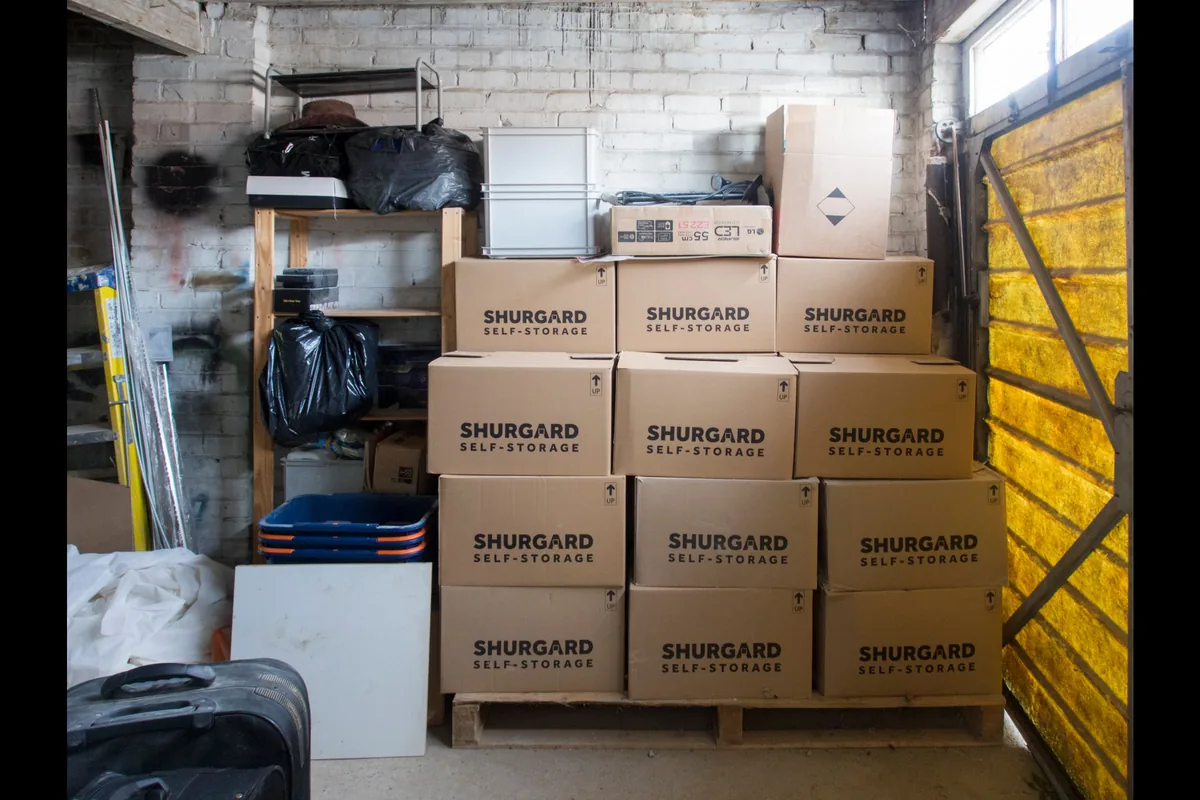
The same collection wants different containers depending on where it sleeps. Attics punish cardboard — heat cycles plus the pests that follow the smell of pine and flour mean plastic with positive latches, or nothing at all. Basements punish cardboard differently: concrete wicks moisture upward through any bin sitting directly on the floor, and one humid August turns a season of ornaments fuzzy. Closets punish volume, not material — the constraint is the 13-inch clearance under a bed and the 6-inch gap beside hanging clothes.
| Location | Container rule | The failure mode it prevents |
|---|---|---|
| Attic | plastic bins, latched lids, under 30 lb each | pests, heat-warped cardboard, dropped-bin shatter on ladder trips |
| Basement | gasket-sealed bins raised 2 in on racks | concrete wicking, August humidity, fuzzy heirloom ornaments |
| Closet / under-bed | low-profile 12-qt bins and zip bags | the 13-inch under-bed clearance problem |
Soft goods convert to vacuum space everywhere, but the savings matter most in basements and closets where shelf inches are scarce. Tree skirts, stockings, table linens, and spare throws compress to a quarter of their volume in the 12 jumbo vacuum bags that hold roughly one closet’s worth of textiles — and textiles are exactly what vacuum bags are safe for, unlike ornaments, which should never share a bag with a pump.

As an Amazon Associate, Herpickery earns from qualifying purchases.
4. Weight limits and stacking: why bins fail in January
Bins fail from the bottom up, and always in January when you are rushing. A 32-quart bin handles about 40-50 pounds of load, but the practical ceiling is 30 pounds of contents — above that, the lid bows, the latches creep, and the bin below the stack starts praying. Glass ornaments are the usual culprit: 50 glass balls weigh nearly twice their shatterproof equivalents, and a “glass ornaments” label on a bin you are about to lift over your head is information you want before the lift.
| Bin contents (32 qt) | Realistic weight | Attic-safe? |
|---|---|---|
| 50 shatterproof ornaments | 12-18 lb | yes, one-hand carry |
| 50 glass ornaments | 22-30 lb | borderline — split into two bins |
| 10 light strands | 15-20 lb | yes |
| 50 ft garland + wreaths | 10-15 lb | yes |
| tree stand + skirt + tree bag | 35-45 lb | carry separately, never stack it |
Stacking follows one rule: three bins high, heaviest at the bottom, never the tree bag on top of anything. Above three bins the top one needs a step stool to reach, which is how the December-just-grab-one trip becomes the everything-crashes trip. Wire shelving changes the math — plastic bins bow between wire spans under 30 pounds, so put a sheet of 1/4-inch plywood across the shelf first, or buy bins with flat rigid lids and rest every bin on its own lid, not on the one below.
5. The three-line label that finds anything next December
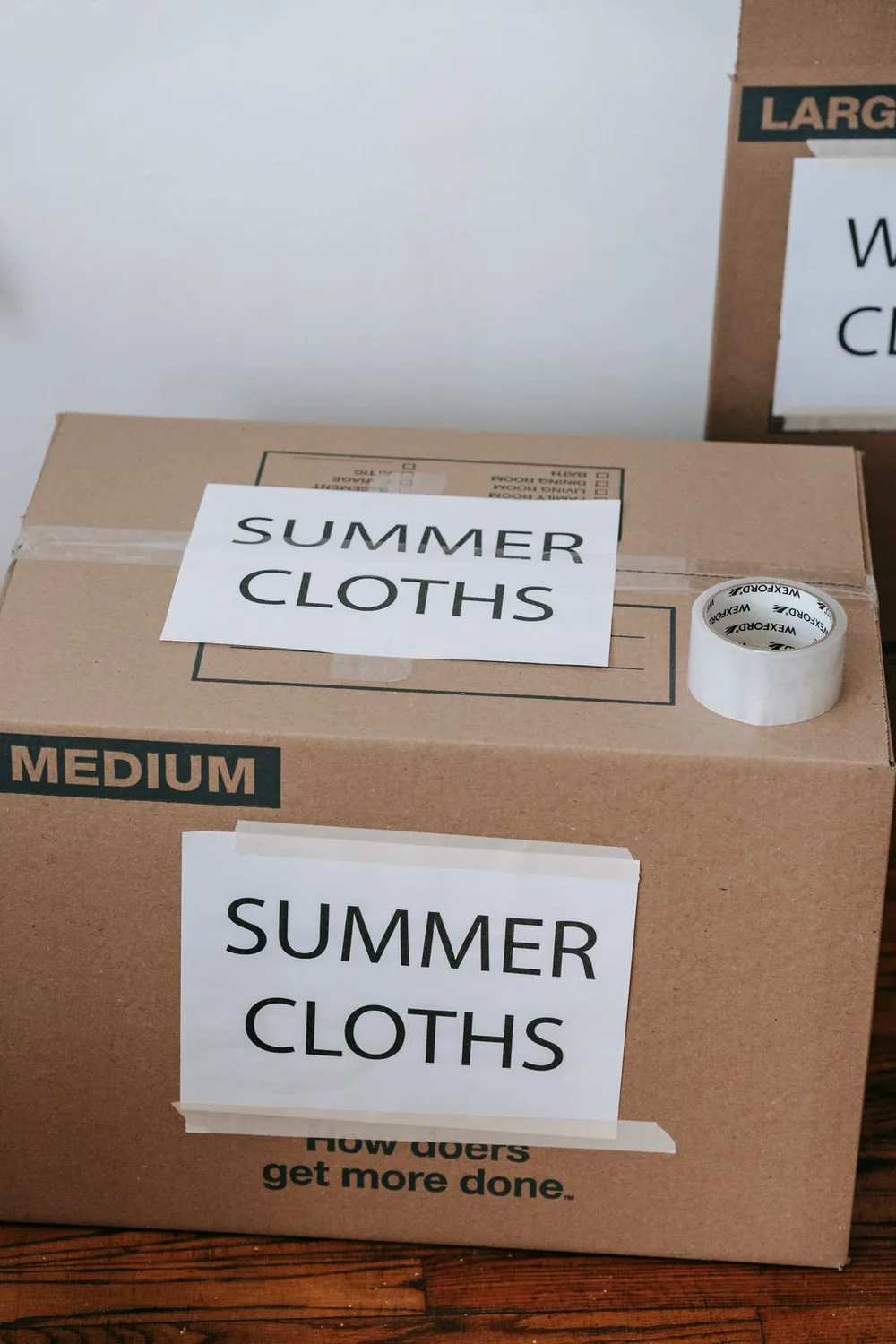
Unlabeled bins are a tax you pay every December, and the rate is roughly an hour per year per unlabeled shelf. The fix is a three-line label, printed or written identically on every bin: line one is the room (living room, kitchen, entry), line two is the contents (ornaments — glass, lights — icicle, stockings), and line three is the placement rule (mantel, tree, banister). A bin labeled “Christmas stuff” answers nothing next year; a bin labeled “living room / icicle lights / mantel” means the mantel gets done first because you can find it without opening anything.

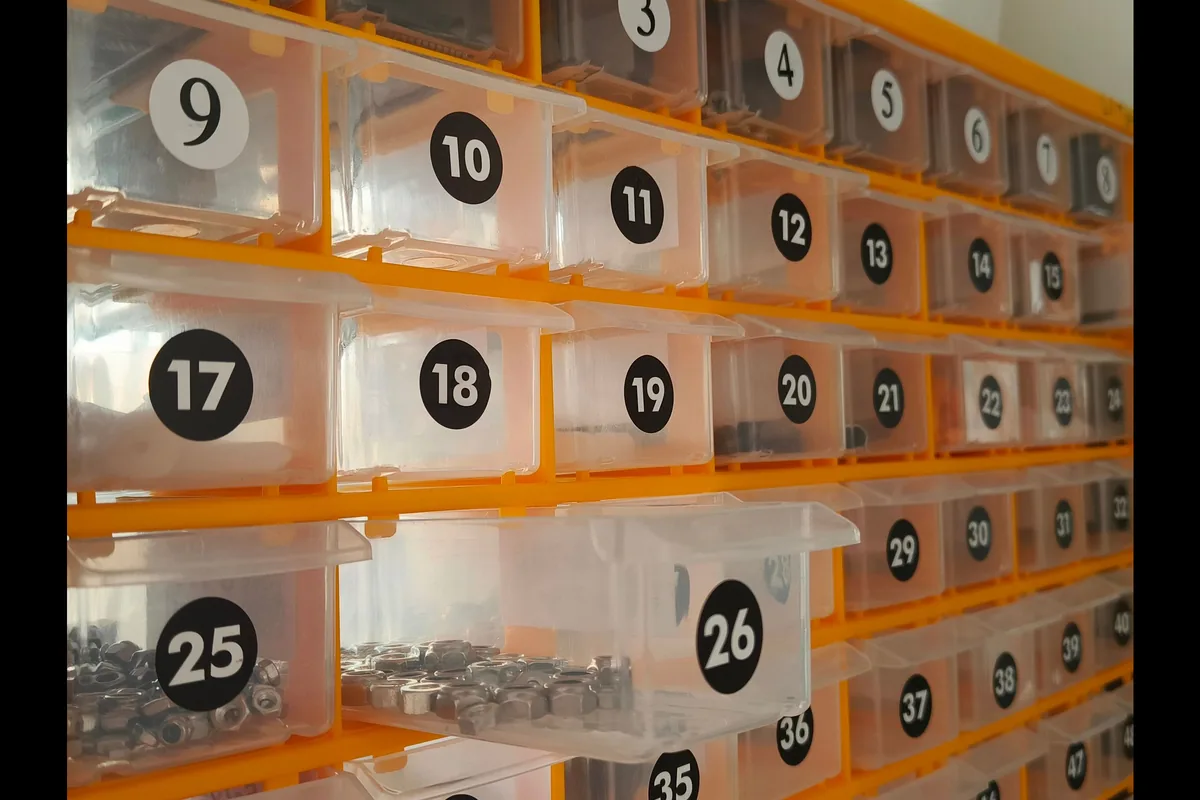
Print labels rather than handwriting them — the thermal-label and tape-printer route survives attic heat and basement damp that fade marker within two seasons. A label maker pays for itself the first January, and the small one below lives in the same bin as the tape. Number the bins too (BIN 01 of 07, written on the lid edge and on a phone note that lists every number): the phone note becomes the inventory, and next year’s “where are the icicle lights” question is a search, not an excavation.

As an Amazon Associate, Herpickery earns from qualifying purchases.
6. The January pack-down order that saves next year’s setup
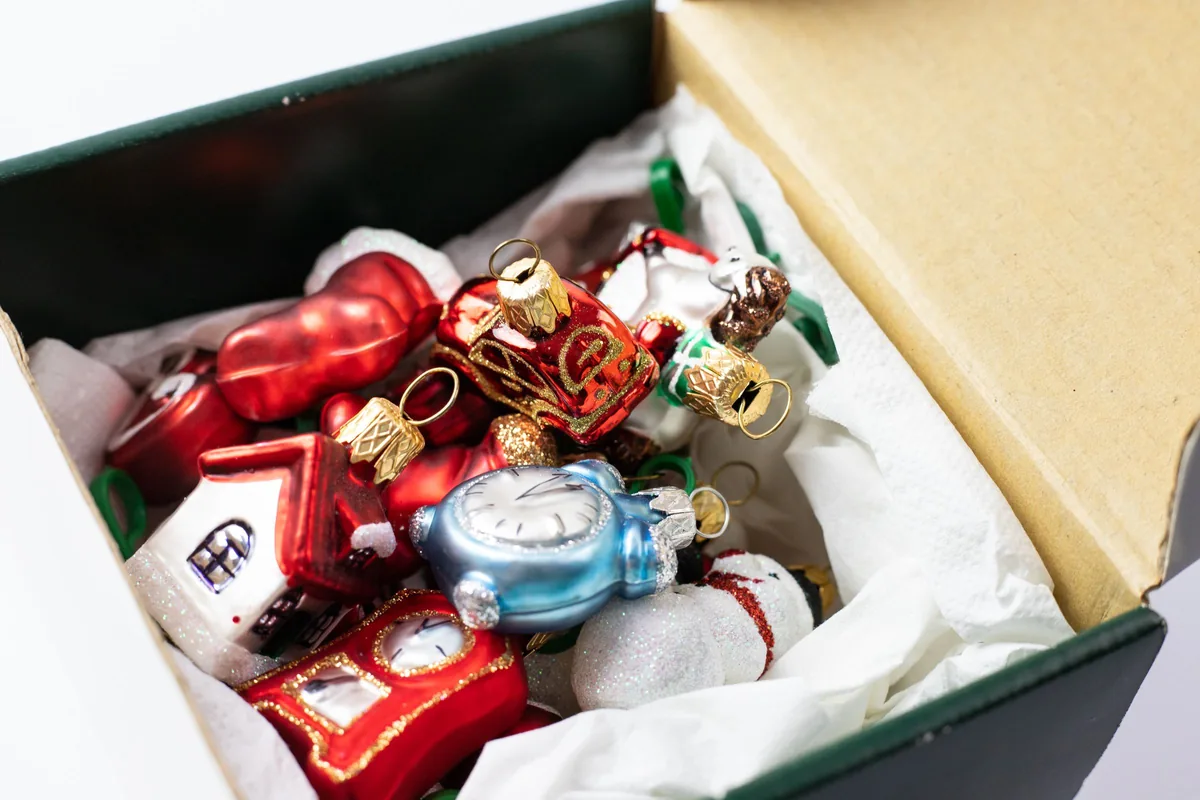
Pack-down order determines setup speed, and the rule is pack in reverse: whatever comes off last goes in first. Ornaments come off the tree last but box first — while you still have the egg-crate dividers out — and the tree itself goes into its bag on day two, after the needles-or-dust have settled. Lights are the exception: they should be wrapped the day the tree comes down, because lights stuffed loose in January cost their knots and a strand-testing hour in December.
Three habits finish the job in one afternoon. First, the next-year note: one index card in BIN 01 listing what ran out this year — two strands of lights died, the ribbon is gone, the tree skirt needs replacing — so the December unboxing starts with a shopping list you wrote while the information was fresh. Second, photograph every filled bin before the lid closes; the photos live in the same phone album and answer “which bin has the mantel garland” from the hardware store aisle. Third, leave the first bin (BIN 01) as the “open first next year” bin: tree stand hardware, the mantel hooks, and the index card, so next December’s setup begins with the bin that unlocks every other bin — and the stair garland math guide sizes the garland you just packed so next year’s order is right. For the December side of the cycle, the gift wrapping station guide keeps the paper shelf sane during the season, and the Christmas morning brunch plan marks the transition week when decor comes down.
FAQs
How many storage bins do I need for Christmas decorations?
Count 50 ornaments per 32-quart bin and 25 feet of garland per bin, then add a tree storage bag. A typical one-tree family lands at 4-6 bins plus the bag — about 5 feet of shelf frontage total.
What size storage bag do I need for a 7.5-foot tree?
A 52-inch tree storage bag fits a 7.5-foot tree with branches intact. Six-foot trees take a 45-inch bag and 9-foot trees need a 63-inch bag; a full 7.5-foot bag weighs 20-25 pounds.
Can I store Christmas decorations in cardboard boxes?
Not in attics or basements. Attic heat warps cardboard and the pine-and-flour smell draws pests; basement concrete wicks moisture into anything touching the floor. Plastic bins with latching lids are the only safe choice for either space.
How heavy can a storage bin be for the attic?
Keep every attic bin under 30 pounds of contents — lid bows above that weight, latches creep, and a 35-pound bin is a two-hand hazard on a ladder. Glass ornaments are the usual overload; split them across two bins.
What should I label storage bins with?
A three-line label: room, contents, placement. “Living room / icicle lights / mantel” finds anything next December; “Christmas stuff” finds nothing. Print labels on a label maker rather than marker, which fades in attic heat within two seasons.
Related guides
[…] the wrapping station away too? The new Storage Bin Calculator sizes the bins, shelf frontage, and labels for everything you just took down — ornaments, […]