
Last February I stood in my own bathroom holding a level and a hair dryer, trying to figure out why I looked like I had aged a decade overnight. I had just hung a beautiful new vanity bar — at exactly the height the old fixture had occupied, because why waste a junction box — and the result was that every morning my mirror handed me a gray jawline, a shadow mustache, and the general energy of a Victorian ghost. The fixture was fine. The bulb count was fine. The height was fine, by landlord standards. What was not fine was that I had mounted a light meant to shine down at my face from a position where its own reflection glared back at me, and neither my forehead nor my foundation recovered for weeks. The fix was a tape measure, two drywall anchors, and about forty minutes. This calculator is that forty minutes, compressed.
—
—
—
—
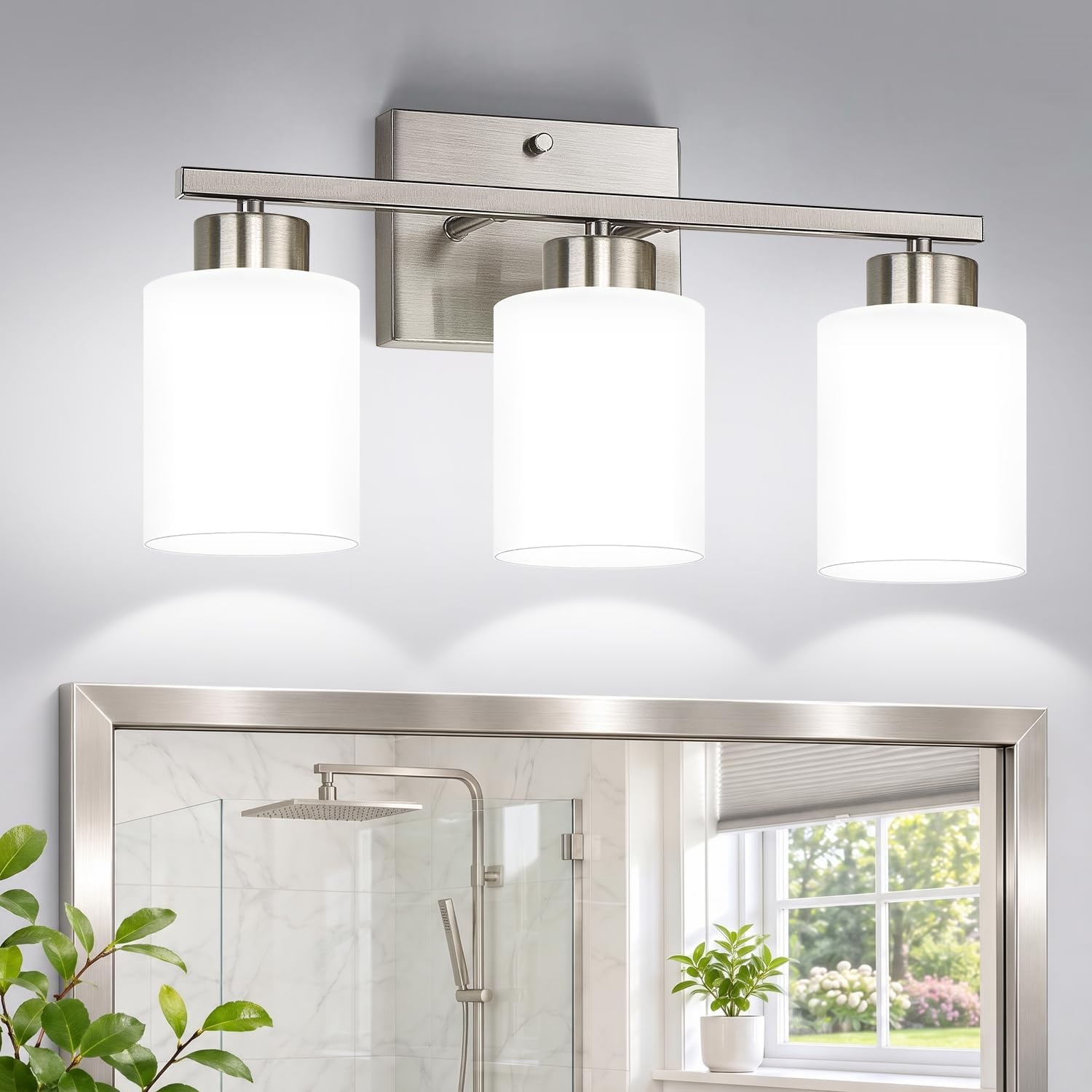
Brushed Nickel 3-Light Vanity Fixture with Milk Glass Shades
The milk glass shades are the frosted-diffusion this page keeps recommending, in a fixture sized to the 75% rule for a 30-inch mirror. E26 sockets take any 2700K CRI-90 bulb you spec in the calculator.
Why overhead light betrays your face
A single source directly above the mirror casts shadows downward: under the brow, under the nose, under the chin. Makeup artists and hotel designers call the fix cross-lighting — two sources flanking the face at eye level, each filling in the shadow the other would create. That is why side sconces are the gold standard and why a bar above the mirror, however handsome, always leaves a little under-chin shadow it cannot erase. The height rules below exist to get each kind of source into the position where it does its one job. Vanity fixtures light the face; ceiling fixtures light the room; a shower light lights the wet zone. Asking one fixture to do all three jobs is how bathrooms end up both dim and glaring at the same time. And because a vanity bar hangs over the same sightline math as kitchen fixtures, the ceiling-height version of this question lives in the pendant light height calculator — same rule, different room.
How high should a vanity light be above the mirror?
Mount the bar so its center sits 75 to 80 inches above the finished floor, which for a standard 36-inch-tall mirror hung at eye height lands the fixture 3 to 6 inches above the mirror top. The floor measurement is the one to trust: on a tall mirror the “3 inches above the glass” version can drop the bulbs into reflection range. Below 75 inches to center, the bare bulbs sit inside the mirror’s sightline and glare into your eyes every time you step up to the sink. Above 80, the light starts projecting so steeply downward that it re-creates the very shadows you mounted it to avoid. Width follows the 75 percent rule: a 30-inch mirror takes a 22 to 24 inch fixture, sized to the glass and never past its edges. If the fixture is significantly narrower, the mirror’s outer corners go underlit; if it is wider, the hardware starts competing with the glass it is supposed to serve. Lighting retailer Foundry Lighting’s bathroom vanity sizing guide reaches the same 75-to-80-inch and 75-percent numbers from the fixture side of the counter.
Sconce height and spacing beside the mirror
Mount each sconce so its center sits 60 to 66 inches off the floor for standing adults — the American Lighting Association splits the difference at 65 to 70 — and space them 28 to 36 inches apart, center to center. The exact height should put the light source at or just below eye level, with shade bottoms around 60 to 68 inches so you never stare straight into a bulb. On a narrow wall, 28 to 30 inches is the floor: below that the two sconces start reading as one source and the bilateral benefit fades. On a wide wall, 36 to 40 inches gives each side of the face its own dedicated fill. Leave 2 to 6 inches of wall between the sconce plate and the mirror edge — closer than 2 and the fixtures read as mounted on the glass, farther than 6 and the light stops reaching the center of your face. Each sconce should stand about 25 to 30 percent of the mirror’s height, so a 36-inch mirror gets 9 to 11 inch fixtures. Over a seated vanity, the whole assembly drops to 52 to 66 inches.
Lumens, Kelvin, and CRI at the mirror
The American Lighting Association specs about 1,600 lumens per sink for task lighting at the vanity, doubled for a double vanity. Color temperature should sit at 2700K to 3000K — the same Kelvin as every other bulb in the room, because mixed temperatures make the mirror and the ceiling light fight each other. If makeup happens daily, lean to 3000K for slightly crisper detail without going clinical. Color rendering matters even more than temperature at a mirror: CRI 90 or higher so skin tones and foundation shades look the way they will outdoors. A bar fights a steeper angle than side sconces, so it compensates with output — if your mornings involve precise eyeliner work and your only option is a bar, point the shades down, diffuse them through frosted or opal glass, and put the fixture on a dimmer so full task brightness is one slide away but not the only setting.
Bathroom ratings, GFCI, and the NEC tub rule
Vanity fixtures live in steam, so every standard bathroom fixture should be damp-location rated; anything inside or directly over a tub or shower needs a wet rating. The NEC draws a hard line in 410.10(D): no corded or pendant fixture within 3 feet horizontally and 8 feet vertically of the bathtub rim — that is what keeps a swinging pendant out of reach of a soaking bather. Bathroom circuits require GFCI protection, and any fixture swap is a breaker-off, voltage-tester-confirmed job. Wiring a new junction box or moving an existing one is electrician territory, not Saturday-afternoon territory. When the box position is fixed and the wall around it is getting fresh paint anyway, the paint coverage calculator sizes that patch job, and the towel hardware next to the vanity hangs by its own rules in the towel bar height calculator.
| Piece | Height | Note |
|---|---|---|
| Piece | Height to center | Why |
| Over-mirror bar | 75–80 in. | 3–6 in. above mirror top; below 75 the bulbs glare into the glass |
| Side sconces (standing) | 60–66 in. | Eye level; shade bottoms below eye line |
| Side sconces (ALA center) | 65–70 in. | Association midpoint for average adults |
| Sconces over seated vanity | 52–66 in. | Seated eye line at a makeup desk |
| Bar over double vanity | One per sink | One continuous bar under-lights the outer faces |
Five vanity light mistakes that need re-wiring
| Mistake | Cost | Fix |
|---|---|---|
| Mistake | What it looks like | The fix |
| Single ceiling can over the sink | Shadow mustache, gray jawline every morning | Cross-light the face: sconces or bar at the mirror |
| Bar mounted at 70 in. | Bulb reflections floating in the mirror all day | Hold 75 in. minimum to center |
| Clear glass, bare bulbs | Glare doubled by the mirror | Frosted or opal shades, always |
| Fixture wider than the mirror | The “glowing hat” look | 75% rule; never past the glass edges |
| Mixed Kelvins in one room | Vanity fights the ceiling light | One Kelvin everywhere; 3000K if makeup is daily |
Sizing both setups takes two numbers off the wall — mirror top height and mirror width — and one decision about who stands in front of it. Spacing each sconce from the glass is the same finger-clearance logic that sets shelf gaps in the shelf spacing calculator, and keeping the light source out of a reflective surface’s sightline is the same rule that decides TV mount height in the TV wall mount height calculator. Same wall physics, different room.
Height specs at a glance
| Mirror | Bar | Sconces | Each sconce |
|---|---|---|---|
| Mirror width | Bar width (75%) | Sconce spacing (c-to-c) | Each sconce height (25–30%) |
| 24 in. | 18 in. | 28–34 in. | 7–8 in. |
| 30 in. | 22–24 in. | 34–36 in. | 8–9 in. |
| 36 in. | 26–28 in. | 36 in. (wall permitting) | 9–11 in. |
| 42 in. | 31–32 in. | Pair + third light | 11–13 in. |
| 48+ in. | 36+ in. or split | Sconces fail — go bar | 13–15 in. |
Fixture specs that matter more than height
| Spec | Target | Why |
|---|---|---|
| Spec | Target | Notes |
| Output | ~1,600 lm per sink | Two sinks double it; dimmer lets you split task vs. night use |
| Color temp | 2700–3000K | Same Kelvin as every other bulb in the room |
| CRI | 90+ | Below 90, foundation shades lie to you |
| Rating | Damp-location | Wet rating only inside the tub/shower zone |
| NEC 410.10(D) | 3 ft / 8 ft | No corded or pendant fixture within 3 ft horizontal, 8 ft vertical of the tub rim |
Frequently asked questions
How high should a vanity light be above the mirror?
Mount an over-mirror vanity bar so its center sits 75 to 80 inches off the finished floor, which lands it 3 to 6 inches above a standard 36-inch mirror top. The floor rule matters more than the mirror rule: below 75 inches, the bulbs sit in the mirror’s own reflection and glare into your eyes.
What height should bathroom sconces be beside the mirror?
Mount each sconce so its center sits 60 to 66 inches off the floor for standing adults, about 28 to 36 inches apart center to center. The light source should sit at or just below eye level so it fills in shadows rather than shining straight into your eyes. Over a seated vanity, drop the range to 52 to 66 inches.
How wide should a vanity light be compared to the mirror?
An over-mirror bar should be about 75 percent of the mirror’s width and never wider than the glass. A 30-inch mirror takes a 22 to 24 inch fixture. Each side sconce should be about 25 to 30 percent of the mirror’s height so the mirror stays the anchor on the wall.
Do bathroom vanity lights need to be damp rated?
Yes. Standard vanity fixtures should be rated for damp locations because steam and humidity corrode unprotected sockets. Fixtures inside or directly over a tub or shower need a wet rating, and the NEC prohibits corded or pendant fixtures within 3 feet horizontally and 8 feet vertically of the bathtub rim.
What color temperature is best for bathroom vanity lighting?
Use 2700K to 3000K with a CRI of 90 or higher. Warmer light flatters skin at night, 3000K gives slightly crisper detail for daily makeup, and anything below CRI 90 makes foundation shades look different indoors than out. Keep every bulb in the bathroom at the same Kelvin.
Last updated: November 27, 2026